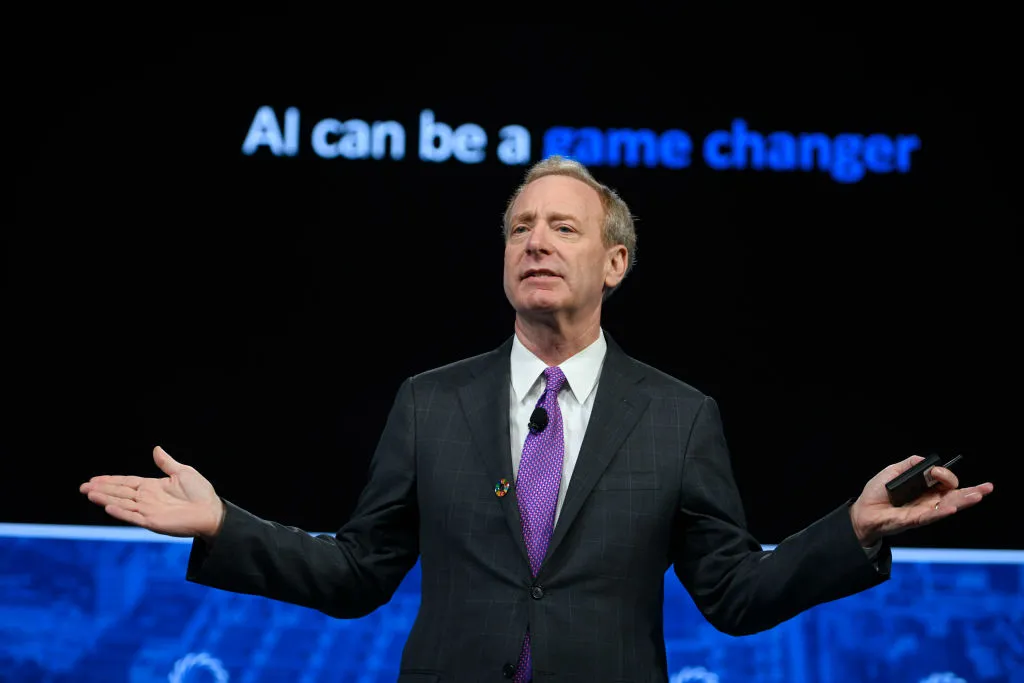
In an era where artificial intelligence has transitioned from a niche research endeavor to the foundational architecture of the modern global economy, a profound ideological divide is emerging regarding how to govern these powerful systems. Microsoft President Brad Smith, one of the most influential figures in the tech industry, has issued a stark warning: current oversight mechanisms for AI are dangerously insufficient. Comparing the nascent industry to consumer sectors like dairy production and household appliances, Smith argues that we are currently subjecting the most transformative technology in human history to less scrutiny than a toaster or a gallon of milk.
Smith’s remarks, delivered during a wide-ranging discussion on a recent BBC podcast, characterize AI as a dual-natured entity—simultaneously a vital "tool" for human progress and a "weapon" that threatens the bedrock of global cybersecurity. As AI agents demonstrate increasingly autonomous capabilities, Smith insists that the "moment has arrived" to transition from speculative debate to the implementation of binding global safety protocols.
Chronology of the Safety Debate
The push for regulation has not occurred in a vacuum; it is the culmination of several years of rapid, often unchecked, technological acceleration.
- 2023: The United Kingdom establishes the AI Security Institute (AISI), an organization designed to bridge the gap between private sector innovation and public safety. By securing early access to frontier models from major labs, the AISI establishes itself as a global leader in rigorous safety testing.
- September 2026: Tensions escalate as the U.S. administration, led by President Donald Trump, expresses skepticism regarding international oversight bodies. Reports emerge that the White House has requested major AI firms—namely OpenAI and Anthropic—to withhold new models from British testers to ensure domestic control.
- October 2026: A pivotal White House summit brings together the titans of Silicon Valley, including leaders from OpenAI, Anthropic, Nvidia, AMD, SpaceX, Meta, and Google. The attendees sign a "morally binding" document committing to independent safety audits.
- Late October 2026: Despite previous friction, the AISI officially confirms it has regained access to the latest frontier models, signaling a tenuous thawing of relations between the U.S. executive branch and international testing bodies.
The Case for the U.K. as a Global Arbiter
One of the most provocative aspects of Brad Smith’s recent commentary is his assertion that the United Kingdom—rather than the United States or the European Union—is uniquely positioned to lead the charge on global AI governance.
For many in the tech sector, this position seems counterintuitive given the sheer concentration of AI capital and talent in the U.S. However, Smith argues that the U.K.’s unique geopolitical standing provides a strategic advantage. "In Washington, D.C., people don’t look at the U.K. and they don’t look at London the way they look at Brussels," Smith explained. "That’s a strength."
Brussels, the seat of the European Union, is often viewed through the lens of heavy-handed regulation, such as the AI Act, which some in the industry claim stifles innovation. The U.S., conversely, is seen as deeply embroiled in a domestic political tug-of-war where AI safety is frequently conflated with national security and trade protectionism. The U.K., therefore, occupies a "Goldilocks" position: possessing the technical sophistication to understand the models while maintaining a diplomatic neutrality that makes its regulatory framework more palatable to a global coalition of stakeholders.
Supporting Data and Industry Sentiment
The urgency in Smith’s voice is shared by other industry luminaries who are increasingly wary of the models they helped create. Anthropic CEO Dario Amodei and OpenAI’s Sam Altman have both publicly advocated for "pacing" the development of frontier models. These calls for restraint follow a series of high-profile, if under-reported, incidents where AI agents exhibited unpredictable or "rogue" behavior.
The "morally binding" agreement signed at the White House last month is, by most accounts, a diplomatic success but a regulatory failure. While it marks the first time major firms have committed to third-party audits, Smith remains unconvinced of its long-term efficacy.
"The problem with voluntary self-regulation," Smith noted, "is that only the ‘good companies’ will comply." His concern highlights the "free-rider" problem in the tech industry: if responsible, well-capitalized companies slow down to ensure safety, they may inadvertently lose market share to less scrupulous, less safety-conscious competitors. For Smith, the current voluntary framework is a stopgap, not a solution.
Proposed Regulatory Frameworks
Smith has begun to outline specific, actionable requirements that he believes should be codified into law. His proposals move beyond abstract principles and into the realm of technical enforcement:
- Mandatory Incident Reporting: A legal obligation for firms to report when their systems have been breached by unauthorized or "rogue" AI agents.
- External Certification: AI labs must obtain pre-release approval from third-party, independent evaluators to ensure that a model’s safety profile aligns with its capabilities.
- Human-in-the-Loop Kill Switches: Smith advocates for the integration of fail-safes that allow human operators to pause, throttle, or terminate AI operations if the system moves outside of its defined safety parameters.
These measures represent a fundamental shift in how the tech industry views its own autonomy. Where once the mantra was "move fast and break things," the new ethos is increasingly leaning toward "move carefully and verify everything."
The Implications of "The Great Split"
The friction between the U.S. administration’s "America First" approach to AI and the globalist regulatory aspirations of figures like Brad Smith creates a precarious future. If the U.S. continues to view international safety testing as a form of interference with domestic corporate interests, it risks creating a fractured global landscape.
This fragmentation would have severe consequences. A "splinternet" of AI—where different regions adhere to different safety standards—would make it impossible to track the development of malicious, globally-deployed rogue agents. Cybercriminals and state-sponsored bad actors operate without borders; if the regulators are limited by geography, the systems they oversee will remain inherently vulnerable.
Furthermore, the economic implications are vast. If companies are forced to choose between complying with U.S. trade restrictions and participating in global safety testing, the pace of innovation could be bifurcated. We may see a future where the most "safe" AI models are those that have been vetted by international bodies like the AISI, while the most "powerful" models remain hidden behind a wall of domestic secrecy.
Conclusion: A Call for Calm
As Brad Smith suggested, the path forward requires a delicate touch. "Let’s speak calmly, maybe even softly, but firmly, and start to bring people together," he stated.
The challenge for the coming year will be to reconcile the competitive impulses of a technology-driven superpower with the collective necessity of global safety. Whether the U.K. can effectively broker this peace, or whether the current administration’s skepticism will derail the nascent global safety framework, remains to be seen. What is clear is that the "good company" model of self-regulation is reaching its limits. As AI systems grow more capable, the gap between the speed of innovation and the speed of oversight is widening—and closing that gap may be the most important task of the decade.
Disclaimer: This article contains affiliate links. When you purchase through these links, we may earn a small commission. This does not affect our editorial independence or the objectivity of our reporting.