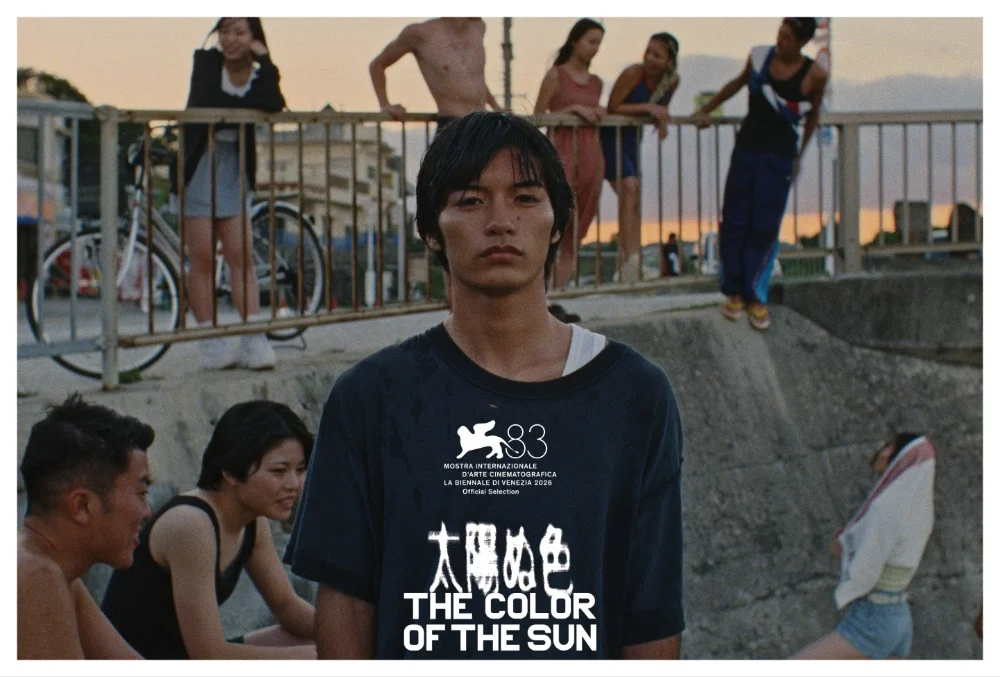
In the humid, sun-drenched landscapes of Okinawa, where the tranquility of the Pacific meets the constant, mechanical drone of U.S. military helicopters, a new cinematic voice has emerged. Paris-based sales powerhouse The Pool Films has officially acquired the world rights to The Color of the Sun, the highly anticipated feature directorial debut of acclaimed Tokyo-based photographer and commercial director Xavier Tera.
Set to hold its world premiere in the prestigious Horizons section of the 81st Venice Film Festival, the film arrives with significant industry buzz. It represents not only a bold pivot for Tera—who has previously crafted iconic visuals for global music heavyweights like Harry Styles, Kaytranada, and Rosalía—but also a sophisticated exploration of cultural identity, post-colonial tension, and the universal fragility of adolescence.
A Convergence of Artistic Visionaries
At its core, The Color of the Sun is a collaborative triumph. Shot entirely on 35mm film, the production boasts the visual mastery of cinematographer Sayombhu Mukdeeprom. Mukdeeprom, a name synonymous with the most evocative imagery in modern cinema, brings his signature texture and light-sensitivity to the project, having previously defined the aesthetic palettes of Luca Guadagnino’s Call Me by Your Name and Challengers, as well as the ethereal, Palme d’Or-winning Uncle Boonmee Who Can Recall His Past Lives by Apichatpong Weerasethakul.
The film is a complex international co-production spanning Italy, Canada, and Japan. The production team is a formidable assembly of industry talent, featuring producers Janie Chartier (Twin Brains), Stella Rossa Savino (MIA Film), Antonio Miyakawa (Wise Pictures), and notable figures Jeremy O. Harris and Shogen. Further cementing the film’s pedigree is the involvement of executive producer John Lesher, the Oscar-winning force behind Birdman.
Plot Dynamics: The Anatomy of a Summer
The narrative follows Kamei, a Japanese teenager navigating his final summer before the looming threshold of high school graduation. Alongside his core group of friends, Kamei occupies the liminal space between childhood and the uncertain demands of adulthood. This rhythm of life is fundamentally fractured by the arrival of Colin, a teenager raised within the walls of one of the 30-plus U.S. military bases that dot the Okinawan landscape.
The official synopsis promises a raw, uncompromising look at this collision of worlds: “First sexual awakenings, blurred loyalties, and betrayal unfold beneath the drone of helicopters.” The film’s emotional center lies in the uncanny, mirror-like resemblance between Kamei and Colin—a visual and metaphorical motif that forces the protagonist to confront deep-seated insecurities. It is a story that moves beyond the typical tropes of youth cinema, positioning itself as a poignant meditation on what it truly means to "belong" in a world that is constantly shifting underfoot.
A Personal and Cultural Chronology
For Xavier Tera, the journey to The Color of the Sun was a process of discovery born from the isolation of the global pandemic. Born in Montreal and raised across the cultural intersections of the U.K., Canada, and Japan, Tera’s background has always been defined by mobility and observation.
“Amid the initial waves of the Covid pandemic, I left Tokyo for Okinawa,” Tera explained in his director’s statement. “While I had a cursory understanding of Okinawa’s recent history, the depth of its cultural richness and historical independence really hit me.”
Tera’s background as a fashion photographer—working with global titans like Nike, Adidas, Burberry, and Moncler—is evident in the way he frames the human form against the stark, political backdrop of his setting. He noted that his time in Okinawa triggered memories of his own upbringing in Canada, a nation equally defined by the complexities of French and British colonial history.
“I became increasingly aware of the parallels between Okinawa’s history and that of Indigenous communities around the world,” Tera noted. “Rather than making a film about geopolitics, I wanted to explore these ideas through something deeply intimate: the relationship between two teenagers from the same place, but not from the same background.”
The Cast: Capturing Authenticity
To bring this intimate story to life, the production turned to a cast that prioritizes authenticity over Hollywood gloss. The ensemble is anchored by a group of first-time actors—Naoto Shimajiri, Daido, Ichiro Andre Castro, and Yuma Taira—who provide the raw, unfiltered energy required to ground the film’s coming-of-age arc. They are joined by the more seasoned West Mulholland, known for his work in Presence and Animal Kingdom, providing a bridge between the local Okinawan experience and the outsider’s perspective represented by the base culture.
Industry Implications and Future Outlook
The acquisition by The Pool Films signals strong confidence in the project’s commercial and critical potential. Gilles Sousa, co-founder of The Pool Films, was effusive in his praise, describing the project as a "visually captivating and emotionally resonant debut." He highlighted the synergy between Tera’s narrative perspective and Mukdeeprom’s cinematography, suggesting that the film is poised to become a staple of the international festival circuit.
Following its world premiere at the Venice Film Festival, which runs from September 2 to 12, the film is scheduled to be introduced to international buyers. The industry is watching closely; in an era where global cinema is increasingly looking to localized stories to address broader, transnational themes, The Color of the Sun appears to be the perfect candidate for crossover success.
Thematic Resonance: Beyond the Geopolitical
While the film is set against the highly politicized geography of Okinawa, Tera has been careful to emphasize that his primary interest lies in the human element. The film avoids being a didactic lecture on military presence, opting instead for a character study that asks difficult questions about tradition, change, and the hybridity of culture.
“The clash and the uncanny resemblance between Kamei and Colin becomes the story’s beating heart,” the synopsis notes. This "clash" is not merely between two individuals, but between two ways of existing in the world. As the characters navigate their first sexual awakenings, the backdrop of the U.S. military base acts as a constant, low-frequency reminder of the outside world’s intrusion into their personal development.
Tera’s transition from high-end commercial work to feature filmmaking is a significant move. His ability to distill complex, abstract concepts into a single, striking frame—a skill honed through his photography—appears to be the foundation upon which The Color of the Sun is built. By focusing on the "unexpected beauty that can emerge when cultures collide," Tera offers a perspective that is both timely and timeless.
Conclusion
As the film prepares to make its debut in Venice, the narrative surrounding The Color of the Sun is one of artistic maturation and bold risk-taking. By blending the sensibilities of a world-class cinematographer with the unique, multicultural perspective of an emerging director, the production has created a work that feels distinctively Okinawan while speaking a universal language of youth and displacement.
Whether it is through the lens of its 35mm film stock, which captures the unique, saturated light of the Okinawan summer, or the delicate performances of its young cast, The Color of the Sun is set to be one of the most discussed debuts of the year. For Xavier Tera, this is not just a film—it is a meditation on the echoes of history and the relentless, often painful process of finding one’s place in the sun. As the international market awaits its premiere, the anticipation suggests that this "visually captivating" debut will leave a lasting mark on the landscape of contemporary independent cinema.