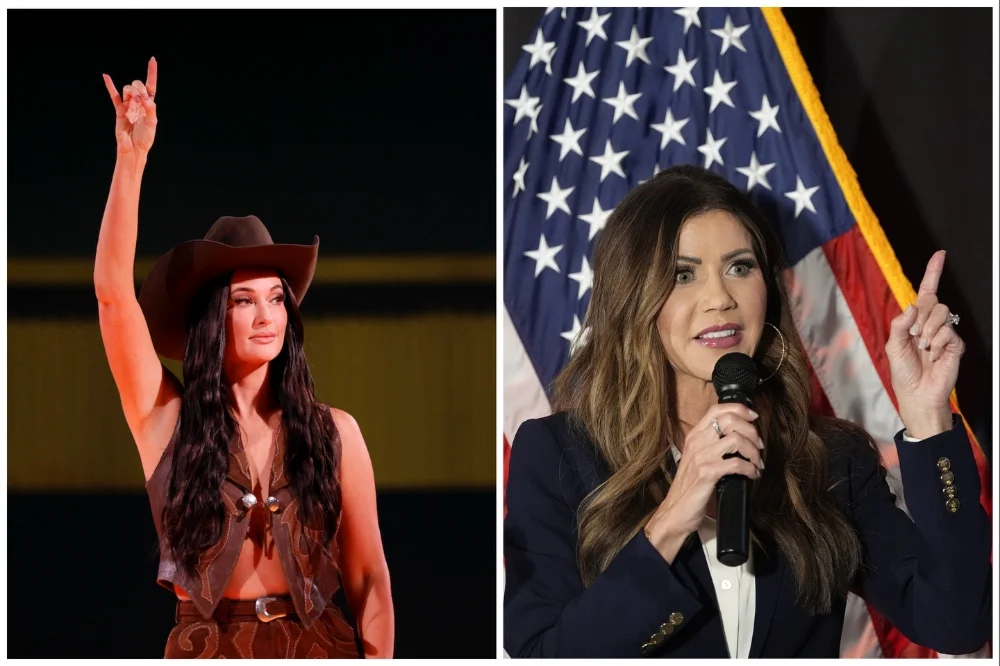
In an era where the lines between political discourse and celebrity culture are increasingly blurred, few exchanges have captured the public imagination quite like the recent clash between country music star Kacey Musgraves and former Homeland Security Secretary Kristi Noem. What began as a partisan jab on the social media platform X (formerly Twitter) quickly devolved into a viral moment that left the former governor retreating from the spotlight, serving as a stark reminder of the lingering shadows cast by political controversies.
The Catalyst: A Texas Concert and a Campaign Trail Intersection
The incident originated over the weekend at a Kacey Musgraves concert, where Texas state representative and current U.S. Senate candidate James Talarico was in attendance. Talarico, a Democrat who has been making significant waves in the polls within the traditionally deep-red state of Texas, shared a photo of himself with the "Deeper Well" singer on social media.
“Thank you for having me last night, Kacey Musgraves!” Talarico captioned the post, which featured the singer captured in the act of photographing the candidate. The image, seemingly innocuous, served as a lightning rod for political friction.
For Kristi Noem, the former South Dakota governor and short-lived Secretary of Homeland Security, the association was unacceptable. Noem, who has remained a vocal figure in conservative circles despite her turbulent tenure in the Trump administration, took to X to voice her disapproval, not only of Talarico’s presence at the concert but of the cultural alignment between the country-pop icon and the Democratic challenger.

A Failed Attempt at Polarization
In an attempt to weaponize the cultural cachet of country music, Noem sought to pit Musgraves against fellow country artist Ella Langley. “I’ll take Ella Langley over Kacey Musgraves any day,” Noem tweeted, injecting a note of partisan gatekeeping. “And if I’m choosin’ Texas, I’ll take Ken Paxton over James Talarico.”
The maneuver was intended to create a classic "us vs. them" narrative, a staple of modern political campaigning. However, the attempt to drag Langley into the fray backfired almost immediately. Sources close to the Alabama-born singer indicated that the unsolicited endorsement and the attempt to weaponize her image against a peer were unwelcome. Shortly after the tweet went live, observers noted that Langley’s digital team moved to distance her from the discourse, untagging her handle from the post to avoid being caught in the political crossfire.
The "Mic-Drop" Moment
If Noem expected a conventional back-and-forth, she severely underestimated the speed and wit of her opponent. Musgraves, known for her sharp lyrical sensibilities and refusal to adhere to the "shut up and sing" mandate often imposed on country artists, delivered a rebuttal that effectively ended the conversation.
Quote-tweeting Noem, Musgraves wrote: “I don’t think you have a dog in this fight but if you did you would have shot it.”

The retort was a devastating reference to a deeply unpopular anecdote from Noem’s 2024 memoir, No Going Back. In the book, Noem described the killing of her 14-month-old wirehaired pointer, Cricket, in a gravel pit, citing the dog’s behavior as "untrainable." The anecdote, intended to showcase the former governor’s capacity for "tough decisions," instead became a national PR disaster, widely credited with effectively ending her prospects as a potential vice presidential candidate during the 2024 campaign.
The visceral nature of the insult sent ripples through the platform, with the post garnering millions of impressions within hours. Following the reply, Noem—a frequent poster on the platform—went entirely silent, opting not to engage further with the singer.
Contextualizing the Controversy: A Pattern of Political Friction
This interaction did not occur in a vacuum. Kacey Musgraves has spent the better part of a decade carving out a space as an artist who bridges the gap between traditional country roots and progressive social values.
Earlier this year, the artist faced similar conservative backlash after urging her concert audiences to donate to the Young Center for Immigrant Children’s Rights. During the performance, Musgraves framed the request as her "birthday wish," stating: “It’s a wonderful organization, and they help give aid—legal aid—and money to children whose parents have been deported unfairly. It’s not a political thing. It’s just, these kids need help.”

The statement prompted a swift rebuke from conservative commentators, including Fox News’ Tomi Lahren, who publicly questioned the singer’s definition of "unfair deportation." Despite such pressures, Musgraves has maintained a consistent stance on issues ranging from LGBTQ+ rights to humanitarian concerns, signaling a shift in the Nashville establishment where artists are increasingly willing to challenge the traditional political expectations of their core demographic.
The State of the Race: Talarico vs. Paxton
The underlying tension of the feud rests on the surprising competitiveness of the Texas Senate race. James Talarico, whose campaign has been buoyed by high-profile endorsements—including a recent video endorsement from country music legend Willie Nelson—is currently polling within striking distance of Republican candidate Ken Paxton.
According to the latest Trafalgar Group poll, Talarico holds 47.1% of the prospective vote, while Paxton, who has faced a myriad of legal and ethical scandals throughout his tenure, holds 43.6%. While Texas has not elected a Democratic senator since 1993, the narrowing margin has created a state of high anxiety among Republican strategists. Noem’s desire to disparage Talarico and align herself with the incumbent reflects the high stakes of the upcoming election cycle.
Implications for Political Communication
The Musgraves-Noem exchange provides a case study in the risks of performative political social media usage. For a politician, "picking a fight" with a beloved pop-culture figure can be a high-reward strategy if the public rallies to the cause. However, as evidenced here, it can also lead to a humiliating public defeat if the celebrity is equipped with a resonant cultural touchstone—in this case, the "Cricket" incident—that bypasses policy debates and targets the opponent’s personal reputation.

Furthermore, the incident highlights the ongoing shift in the country music industry. Historically, country artists were expected to maintain a neutral or conservative political persona. Today, artists like Musgraves and Nelson are proving that an artist can maintain, and even grow, their audience while taking explicit political stances. This, in turn, makes these artists formidable opponents for politicians who try to use them as props in cultural warfare.
The Decline of the "Noem Brand"
Kristi Noem’s trajectory over the past year has been one of consistent professional attrition. Once considered a rising star within the Republican party and a top-tier contender for the vice presidency, her influence has waned significantly following her appointment as Secretary of Homeland Security. Her subsequent firing from that position in March of this year, following a series of administrative and public-facing controversies, forced her into a diminished role as the U.S. special envoy to the Shield of the Americas.
The fact that her most prominent engagement in the current news cycle resulted in a viral, mocking dismissal by a singer suggests that her brand of "hard-line" rhetoric is struggling to find traction outside of her immediate base. The public’s collective memory of her memoir’s most grisly chapter remains a "glass ceiling" of sorts, limiting her ability to engage in common political disputes without being reminded of the animal welfare controversy that stained her national profile.
Conclusion: The New Frontier of Celebrity Politics
As the 2026 midterm cycle approaches, the collision between the entertainment industry and the political arena is likely to intensify. The Musgraves-Noem feud serves as a harbinger for a political landscape where celebrity influence is not just an accessory to a campaign, but a decisive weapon.

For now, the score stands clearly in favor of the artist. By staying on message and utilizing humor to deflect a pointed political attack, Kacey Musgraves managed to reinforce her own brand while highlighting the perceived vulnerabilities of her detractor. Kristi Noem, by contrast, has been forced into a retreat, illustrating that in the digital age, a well-timed, sharp-witted response can do more to shape public perception than any traditional press release or political ad campaign.
As both figures move forward—Musgraves on her tour and Noem in her diplomatic role—the event will likely be remembered as one of the more bizarre, yet telling, moments of the current political cycle, proving once again that in the world of social media, the loudest voice is not always the most effective.