By Investigative Staff
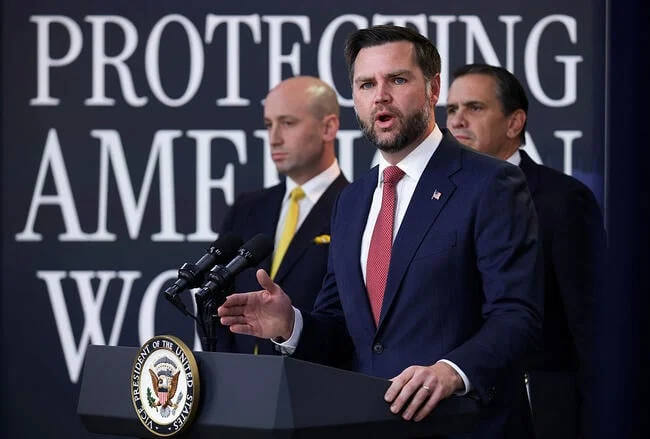
In a significant escalation of the federal government’s oversight of higher education, the Department of Labor has launched a sweeping investigation into nine of the nation’s most prominent research institutions. Vice President JD Vance, acting in his capacity as chair of the administration’s Fraud Task Force, announced on Thursday that the probe focuses on the alleged misuse of the J-1 visa program—a cornerstone of academic international exchange—to systematically undercut the wages of American researchers and graduate students.
The investigation, which has already resulted in the issuance of federal subpoenas, marks a confrontational new chapter in the relationship between the federal government and elite academia. As the Labor Department’s Inspector General, Anthony D’Esposito, vows to “follow the money,” the targeted institutions find themselves under immense pressure to defend their labor practices, their reliance on international talent, and their adherence to federal immigration law.
The Scope of the Investigation: A Multi-Front Challenge
The investigation targets a prestigious list of universities, including Arizona State University, Brown University, Harvard University, Yale University, Stanford University, the California Institute of Technology (Caltech), the Massachusetts Institute of Technology (MIT), the University of California, Davis, and the University of Pittsburgh.
At the heart of the government’s argument is a statistical discrepancy that Vice President Vance described as “something weird.” According to federal data cited by the administration, these nine institutions utilize J-1 visa holders for federally funded research grants at a rate of approximately 61 percent. This figure stands in stark contrast to the national average of 38 percent.
"They’re using these visas way too much," Vance stated during a Thursday press conference. "They’re using them to undercut the wages of American grad students and American researchers." The administration asserts that American counterparts in these research positions earn, on average, $20,000 more annually than those on J-1 visas, suggesting that universities are opting for international labor not necessarily out of a lack of domestic talent, but as a cost-saving measure that disadvantages U.S. citizens.
Chronology of the Escalation
The current probe is the culmination of months of behind-the-scenes data collection by the Labor Department and the Fraud Task Force.
- March 2026: The administration officially establishes the Task Force to Eliminate Fraud, with Vice President Vance appointed to lead the initiative. The mandate of the task force is to identify systemic inefficiencies and illegal activities involving federal funding and immigration programs.
- Spring/Summer 2026: The Department of Labor begins auditing visa usage data across top-tier research universities, identifying the 61 percent utilization rate among the nine institutions now under scrutiny.
- Early October 2026: Federal investigators finalize the scope of the inquiry, determining that the use of J-1 visas—which are intended for cultural exchange, teaching, and research—may have been repurposed to bypass domestic labor market protections.
- Thursday, October 2026: The Labor Department formally announces the investigation. During a press conference, it is confirmed that subpoenas have been served to the leadership and legal departments of the nine identified universities.
Inspector General’s Stance: A Law Enforcement Approach
Inspector General Anthony D’Esposito, a former New York Police Department detective, has set a pugnacious tone for the investigation. His rhetoric indicates that the Department of Labor is treating this not merely as a regulatory compliance check, but as a potential criminal inquiry.
"I don’t care how prestigious a university thinks it is," D’Esposito said during the announcement. "Break the law and screw the American people, and I will personally cuff you in the university square. I don’t care how large your endowment is, how powerful your alumni are or how many politicians you have on speed dial."
D’Esposito’s team is specifically tasked with investigating whether foreign influence, improper financial relationships, or outright visa fraud are compromising research funded by U.S. taxpayers. The mention of “foreign influence” hints at long-standing concerns within the administration regarding the security of proprietary research and the potential for intellectual property theft, specifically in relation to academic partnerships with China.

Institutional Responses: Compliance and Defense
The targeted universities have reacted with a mixture of cooperative legal posturing and a vigorous defense of the role of international scholars in American innovation.
Defending the Mission
Several institutions emphasized that their use of international talent is a vital component of their global competitiveness. A spokesperson for MIT noted that the university is currently reviewing the “very broad” subpoena but stressed that the government itself vets each individual J-1 visa holder. "America’s ability to attract top talent from around the world while protecting U.S. economic and security interests is a national strength, and that competitive advantage should be supported," the spokesperson added.
Arguments for Economic Vitality
Arizona State University, which produces a high volume of STEM graduates, framed its hiring practices as a necessity of the modern economy. "This benefits both the Arizona and the United States economies," an ASU spokesperson said. "ASU has hired the talent needed to perform these functions and done so in complete compliance with existing United States policy and law."
Procedural Cooperation
Other institutions, such as Brown and Stanford, have publicly committed to complying with the subpoenas. Brown University explicitly stated that it would "respond promptly and directly to the government," while maintaining that its international scholars make "essential contributions" to research that advances American innovation.
Implications for Higher Education and Labor Policy
The investigation could have profound consequences for the American academic landscape. Should the Department of Labor find evidence of systemic wage suppression or visa fraud, the implications could extend far beyond the nine universities currently under the microscope.
1. Potential for Policy Overhaul
The investigation may serve as the catalyst for a total reevaluation of the J-1 visa program. If the administration determines that the program is being exploited, it could introduce stricter caps, higher salary floors for international researchers, or more rigorous reporting requirements for universities.
2. The “Brain Drain” vs. “Protectionism” Debate
The case pits two competing visions of American interests against each other. On one side, the administration argues that "protecting American workers" is paramount and that institutions of higher learning have prioritized cheaper, foreign labor over domestic graduates. On the other side, academic leaders argue that the American research ecosystem is fundamentally dependent on an open-door policy for the world’s brightest minds, and that restricting this flow will only serve to cede scientific leadership to other nations.
3. Financial and Reputational Risk
For the universities involved, the risks are significant. Beyond the potential for fines or legal sanctions, there is the threat of restricted access to future federal research grants. Given that these institutions rely on billions of dollars in federal funding annually, any finding of "improper financial relationships" or "visa abuse" could jeopardize their core operational budgets.
4. Legal Precedent
The aggressive language used by Inspector General D’Esposito suggests that this is a test case for how far federal authorities can go in policing the internal operations of private and public universities. If the government succeeds in proving that universities used federal grant money to bypass domestic labor laws, it could set a precedent for increased federal oversight of university hiring practices for decades to come.
As the documents requested by the subpoenas begin to flow into the Department of Labor, the academic community waits to see if this is a temporary political firestorm or the beginning of a structural shift in how America’s elite institutions manage their international labor force. For now, the message from the administration is clear: the era of unchecked reliance on international visa programs for subsidized research may be coming to an abrupt end.