ALEXANDRIA, VA — In what is being described as one of the most brazen internal thefts in the history of the American intelligence community, David J. Rush, a former senior federal executive with high-level security clearances, pleaded guilty on Tuesday to a massive wire fraud scheme. Over the course of less than a year, Rush systematically siphoned approximately $194 million from the federal government, using the money to amass a private fortune of gold bars, luxury South Florida real estate, and high-end vehicles.
The case has sent shockwaves through Washington, D.C., raising urgent questions about the oversight of "black budget" programs and the vetting processes for those entrusted with the nation’s most sensitive secrets. Rush, 51, of Ashburn, Virginia, entered his plea in federal court in Alexandria, following a tentative agreement reached in September. The final plea deal mandates that Rush pay at least $195.4 million in restitution, covering the direct losses from his fraud and nearly $2 million in unauthorized private charter flights billed to the taxpayer.
Main Facts: A Fortune Built on Fiction
The scale of David Rush’s deception is staggering, not only for the dollar amount but for the audacity of the methods used. Holding a Top Secret/Sensitive Compartmented Information (TS/SCI) clearance, Rush occupied a senior executive post at a clandestine department identified in court filings only as "Government Agency 1." Though the filings use a pseudonym, statements from high-ranking officials, including CIA Director John Ratcliffe, have linked the case directly to the Central Intelligence Agency.
According to the Department of Justice, Rush’s scheme rested on the creation of entirely fictitious "Special Access Programs" (SAPs). These programs, which in reality exist to protect the military’s most sensitive technological and intelligence secrets, were used by Rush as a "black box" to bypass traditional financial audits.
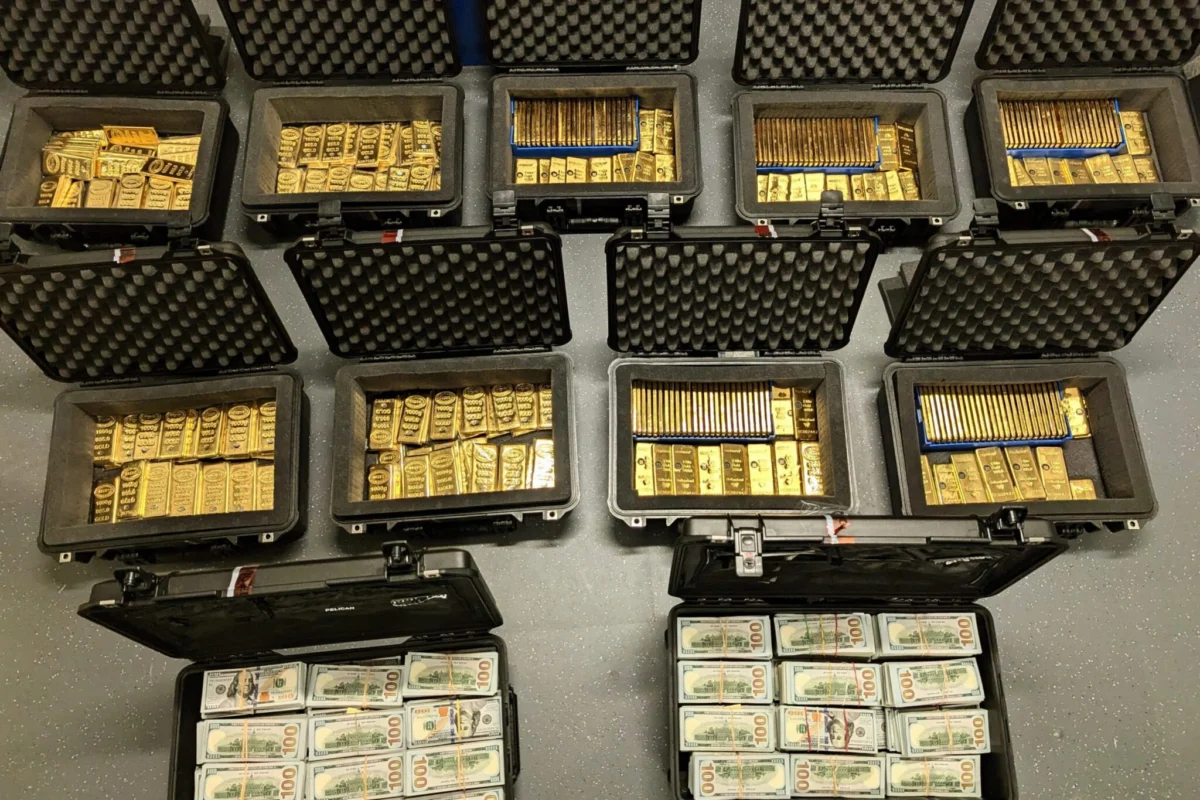
By the time the FBI raided his Virginia home in May 2026, Rush had converted nearly $200 million in stolen funds into a portfolio of tangible assets that read like a list from a high-stakes heist film:
- 298 Gold Bars: Valued at over $46 million, stored in Pelican cases.
- Luxury Real Estate: Four prime properties in South Florida, including mansions in Palm Beach and Hobe Sound.
- High-End Vehicles: Two 2026 BMW Alpina XB7s.
- Luxury Goods: Over 30 luxury watches, including several Rolexes, and more than $2 million in cash and Euros.
Chronology: The Rapid Rise and Fall of a Rogue Official
The timeline of Rush’s fraud reveals a frantic period of accumulation that began in late 2025 and accelerated with startling speed until his arrest.
October 2025: The Architecture of Deceit
Rush began his campaign by inventing two distinct, fake classified programs. Leveraging his authority to identify "mission requirements" and approve the necessary resources, Rush effectively became his own approving official. He conducted "read-ins"—highly formal security briefings—for private contractors, forcing them to sign non-disclosure agreements (NDAs) for programs that did not exist. When legitimate contracting officials raised questions about the massive outflows of cash, Rush invoked his security clearance, telling them they lacked the "need to know" to see the details of the spending.
November 2025 – March 2026: The Real Estate Spree
Under the guise of a Special Access Program that supposedly required "operational covers" in South Florida, Rush directed a government contractor to funnel approximately $145 million to a shell company he controlled: 0701 Holdings LLC. The invoices were billed as "consulting fees."
During this five-month window, Rush went on a buying binge:
- November 2025: Purchase of a $21.9 million home in Palm Beach.
- January 2026: Acquisition of a $27 million Palm Beach estate.
- February 2026: Purchase of a $13.65 million parcel in Palm Beach and a $40 million parcel in Hobe Sound.
Court documents reveal that Rush viewed these not as government assets, but as personal investments. In intercepted communications, he fretted over whether certain architectural features of the guesthouses would "hamstring" him when he eventually decided to resell the properties for a personal profit.
Spring 2026: The "Gold Standard" Assignment
In early 2026, Rush launched his second "program." He informed a subcontractor executive that a highly sensitive, six-person assignment required the use of untraceable assets, such as gold, diamonds, or cryptocurrency. At Rush’s direction, the subcontractor purchased 298 gold bars at a total cost to the government of $46.3 million. The bars were delivered in heavy-duty Pelican cases directly to a safe in Rush’s office in Loudoun County.
May 2026: The FBI Intervention
The scheme began to unravel after an internal investigation at the CIA identified "potential crimes" and referred the matter to the FBI. On May 19, 2026, federal agents executed a search warrant at Rush’s Ashburn residence. They discovered all 298 gold bars, their serial numbers matching the records of the subcontractor. Alongside the bullion, agents found $2.1 million in cash, over 100,000 Euros, and a collection of 35 luxury watches.
Supporting Data: A Career Built on Fabricated Credentials
Perhaps the most troubling aspect of the David Rush case is how he attained the seniority required to commit such a fraud. Investigation into his background revealed that Rush’s entire professional persona was a fabrication.
While applying for his high-level posts, Rush claimed to be a combat veteran and a decorated military pilot. He presented records indicating he held a bachelor’s degree from a university in South Carolina and a doctorate from a prestigious institution in New York. The Department of Justice confirmed that Rush never graduated from either school and never flew for the military. While he had served in the Navy reserves, he left in 2015; however, starting in 2021, he claimed 392 hours of military leave from his civilian job—essentially getting paid by the government for "service" he was not performing.
Furthermore, the investigation uncovered a severe breach of national security unrelated to the financial theft. In late 2025, while the fraud was at its peak, Rush admitted to providing sensitive information about a U.S. clandestine human source to a foreign government official. This admission has escalated the case from a matter of simple embezzlement to a significant counterintelligence failure.
Official Responses: Betrayal of Public Trust
The reaction from the highest levels of the U.S. government has been one of condemnation and a promise of systemic reform.
CIA Director John Ratcliffe issued a stern statement following the plea: "David Rush abused his position and betrayed the public trust and should be held fully accountable for his actions. The CIA has zero tolerance for those who exploit the secrecy of our mission for personal gain."
Attorney General Todd Blanche emphasized the administration’s commitment to oversight. "Federal employees are entrusted with serving the American people, not themselves," Blanche said. "The Trump Administration is committed to rooting out waste, fraud, and abuse in the federal government, including by prosecuting those who foolishly defraud American taxpayers. This case serves as a warning: no matter how high your clearance or how secret your work, you are not above the law."
The Director of National Intelligence (DNI) has also requested that the Inspector General for the Intelligence Community conduct a "top-to-bottom" review of how Rush was able to bypass internal controls for so long.
Implications: Secrecy as a Shield for Corruption
The David Rush case highlights a systemic vulnerability within the U.S. intelligence infrastructure: the "Need to Know" loophole. By operating within the world of Special Access Programs, Rush was able to use the very classification system designed to protect the country as a shield for his criminal activity.
The Failure of Vetting
The fact that a man with entirely fabricated academic and military credentials was able to obtain a TS/SCI clearance and a senior executive role suggests a catastrophic failure in the background investigation process. If the "Gold Standard" of vetting—the polygraph and the Single Scope Background Investigation (SSBI)—failed to catch a fake PhD and a fake pilot, the intelligence community may need to overhaul its entire personnel security protocols.
The Autonomy of Senior Officials
Rush’s ability to act as his own "approving official" points to a lack of "two-man rule" oversight in financial disbursements for classified programs. In the private sector, a $145 million transfer would require multiple levels of corporate approval; in the world of "Government Agency 1," Rush’s word—and his clearance—were seemingly enough to move mountains of cash.
The National Security Cost
Beyond the $194 million loss to the treasury, the compromise of a clandestine human source is an irreparable blow. Such breaches put lives at risk and damage the credibility of U.S. intelligence with foreign partners. While the gold and the mansions can be recovered, the trust lost within the agency and the damage to human intelligence networks may take years to mend.
David Rush now awaits his fate. As part of his plea agreement, he has forfeited all seized assets, including the gold, the properties on Jupiter Island and Palm Beach, the BMWs, and the remaining $38.65 million in the 0701 Holdings LLC account. He faces a maximum of 20 years in federal prison when he is sentenced on January 28, 2027. The Justice Department has indicated that its investigation into potential co-conspirators and the full extent of the security breaches remains ongoing.