In the modern landscape of British social commentary, poking fun at the aristocracy has long been a national pastime. Yet, amidst the widening chasm of social inequality in the United Kingdom, the extreme wealth and utter societal remove of the upper classes have begun to look less like a quaint historical remnant and more like a performative absurdity. Enter Lady, the recklessly freeform and wildly enjoyable debut feature from writer-director Samuel Abrahams. It is a film that breathes fresh, if somewhat delirious, life into the mockumentary genre, offering a biting portrait of a woman fading into obsolescence with a glass of gin in one hand and a delusion of grandeur in the other.
The Premise: A Portrait of Delusion
At its core, Lady is a high-wire act of character study. The narrative follows Lady Isabella Ravenhyde, an obscenely wealthy, chronically bored narcissist who is desperately clinging to the fraying edges of her relevance. Convinced that her life is worthy of a major streaming platform’s attention, she commissions Sam (Laurie Kynaston), a young, soft-spoken, and slightly downtrodden filmmaker, to document her daily existence.
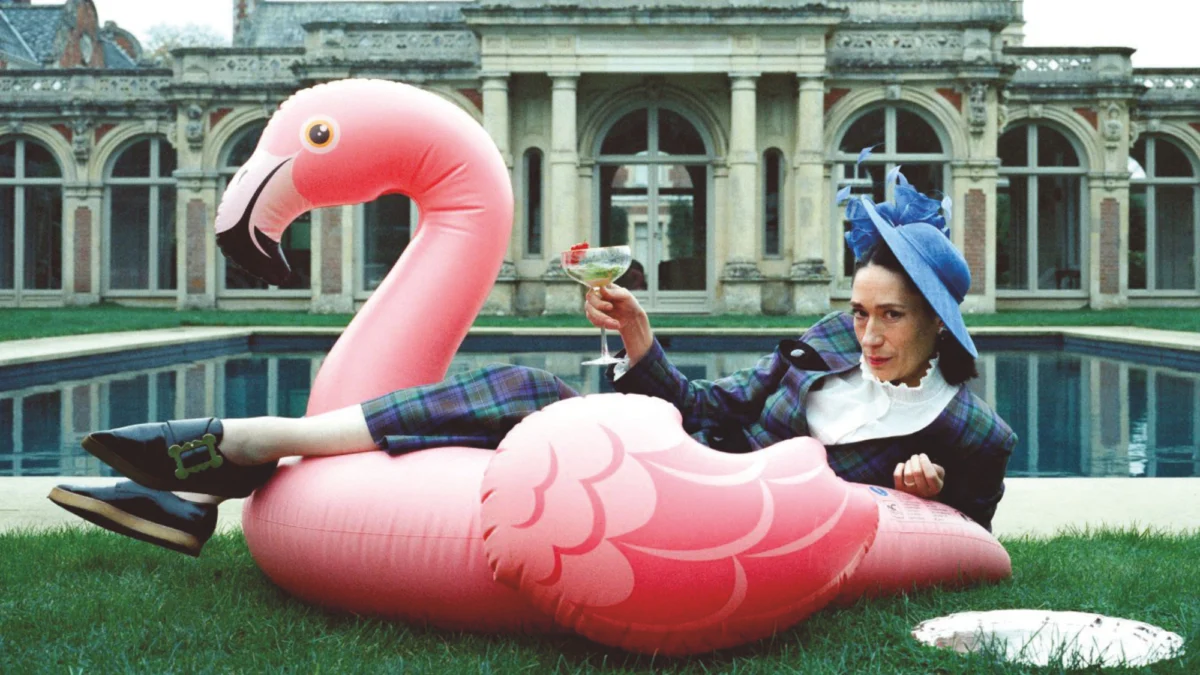
Sam, who boasts a BAFTA nomination for a short film—a credential he clings to as fiercely as Lady Isabella clings to her titles—is struggling to find a story in the vacuum of her life. The film masterfully explores the friction between the two: the desperate, aging aristocrat who believes she is the “answer to the Kardashians,” and the aspiring auteur looking for a breakthrough that clearly isn’t coming. As Lady Isabella swans about her crumbling country manor, engaging in copious day-drinking and showcasing a wardrobe that can only be described as “aggressively garish,” the film highlights the bizarre, transactional relationship between the subject and the lens.
A Masterclass in Transformation: The Rise of Sian Clifford
The film is, without reservation, a vehicle for Sian Clifford. Having spent years as a reliable “team player”—most notably as the uptight, endlessly put-upon sister Claire in Phoebe Waller-Bridge’s Fleabag—Clifford has finally been handed the keys to the kingdom. While her previous work established her as a master of the “gifted wallflower” archetype, Lady shatters that perception entirely.
Clifford’s performance as Lady Isabella is a whirlwind of fevered physical comedy, acerbic line readings, and moments of startling, raw vulnerability. She throws herself into the role with an untethered, vanity-free commitment that suggests she knows this is a once-in-a-career opportunity. Whether she is barking obtuse, soul-crushing demands at her long-suffering maid, Becky (played with impeccable exhaustion by Juliet Cowan), or attempting to seduce a deeply uncomfortable Sam, Clifford commands every frame.
Critics have already drawn inevitable comparisons to Lisa Kudrow’s television masterpiece The Comeback. Much like Valerie Cherish, Lady Isabella is a woman whose hunger to be seen outweighs her grasp on reality. While the two inhabit different strata of social privilege, they share a common language: the desperate, human need to remain relevant in a world that is moving on without them.
Chronology of a Comedy: From Script to Screen
The development of Lady reflects a lean, agile approach to filmmaking. Writer-director Samuel Abrahams, collaborating with co-writer Miranda Campbell Bowling, opted for a narrative structure that is deliberately slender. The script is a collection of pithy quips and throwaway gags that serve as a frame for the real attraction: Clifford’s performance.
The production timeline saw a rapid move from concept to screen, favoring a documentary-style aesthetic that relies on Josh Mallalieu’s jagged, agitated editing to maintain the illusion of a film-within-a-film. The production design, particularly the costume work by Terri Higgins, is integral to the storytelling. The garish, high-fashion pieces act as armor for Lady Isabella, signaling her obsession with status even as the fabric of her life begins to unravel.
The film’s climax—which, in the interest of spoilers, remains best experienced firsthand—takes a turn that validates Lady Isabella’s initial premise in the most unexpected way. It is a stroke of narrative genius that elevates the film from a simple character study into a meta-commentary on the nature of modern fame.
Supporting Data and Production Context
The film’s success relies heavily on its ensemble and technical team:
- Direction & Writing: Samuel Abrahams (Director/Writer) and Miranda Campbell Bowling (Writer).
- Leading Performance: Sian Clifford as Lady Isabella Ravenhyde.
- Supporting Cast: Laurie Kynaston as Sam, the filmmaker; Juliet Cowan as Becky, the maid.
- Cinematography/Editing: Josh Mallalieu, whose editing style is critical in keeping the mockumentary conceit afloat.
- Costume Design: Terri Higgins, whose work serves as a primary visual shorthand for the character’s madness and wealth.
The film’s budget and scope are purposefully modest, proving that the most effective satire often requires little more than a strong concept and a singular, powerhouse performance. By keeping the narrative “quick and nimble,” Abrahams allows the humor to breathe without the baggage of heavy exposition.
The Industry Perspective: Does It Hold Up?
While some might argue that Lady is a “one-joke enterprise”—the joke being the juxtaposition of aristocratic entitlement and modern social media vanity—the quality of the execution renders the critique moot. The joke is not only funny enough to carry the film, but it also serves as a sharp lens through which to view our current media landscape.
The industry response has been largely centered on the emergence of Clifford as a leading lady. After years of playing supporting roles in projects like The Ballad of Wallis Island and Mother Mary, Clifford has proved she can hold the center of a project with an intensity that is both exhausting and exhilarating. The film is a testament to the idea that a truly great performer can elevate even the thinnest premise into a compelling work of art.
Societal Implications: The Death of the Aristocracy
Beyond the laughs, Lady poses a deeper, more unsettling question: What happens to the elite when their status is no longer self-sustaining? Lady Isabella is a woman who firmly believes in her own importance by birthright. When the reality of her irrelevance crashes into her vanity, the result is a tragicomedy of the highest order.
The film skewers not just the aristocracy, but the media ecosystem that has taught elites like Lady Isabella that they are "stars" simply because they exist. By framing the documentary around her, the film forces the audience to confront their own consumption of such figures. Are we watching Lady Isabella because she is interesting, or because we enjoy watching the collapse of a relic?
As Lady Isabella desperately chases a low-rent regional talent contest—culminating in a scene where she performs modern dance in an oversized crow costume—the viewer is left with a complex emotional cocktail: pity, hilarity, and a begrudging respect for her commitment to the bit.
Conclusion
Lady is a triumph of character-driven comedy. It is a film that understands the absurdity of its subject and leans into it with both style and substance. By placing Sian Clifford at the center of a crumbling manor, Samuel Abrahams has crafted a biting, stylish, and ultimately human look at the intersection of old money and new media. It is a must-watch for anyone interested in the evolving landscape of British satire and a definitive showcase for an actor who, finally, has been given the spotlight she so richly deserves.