By [Your Name/Journalistic Staff]
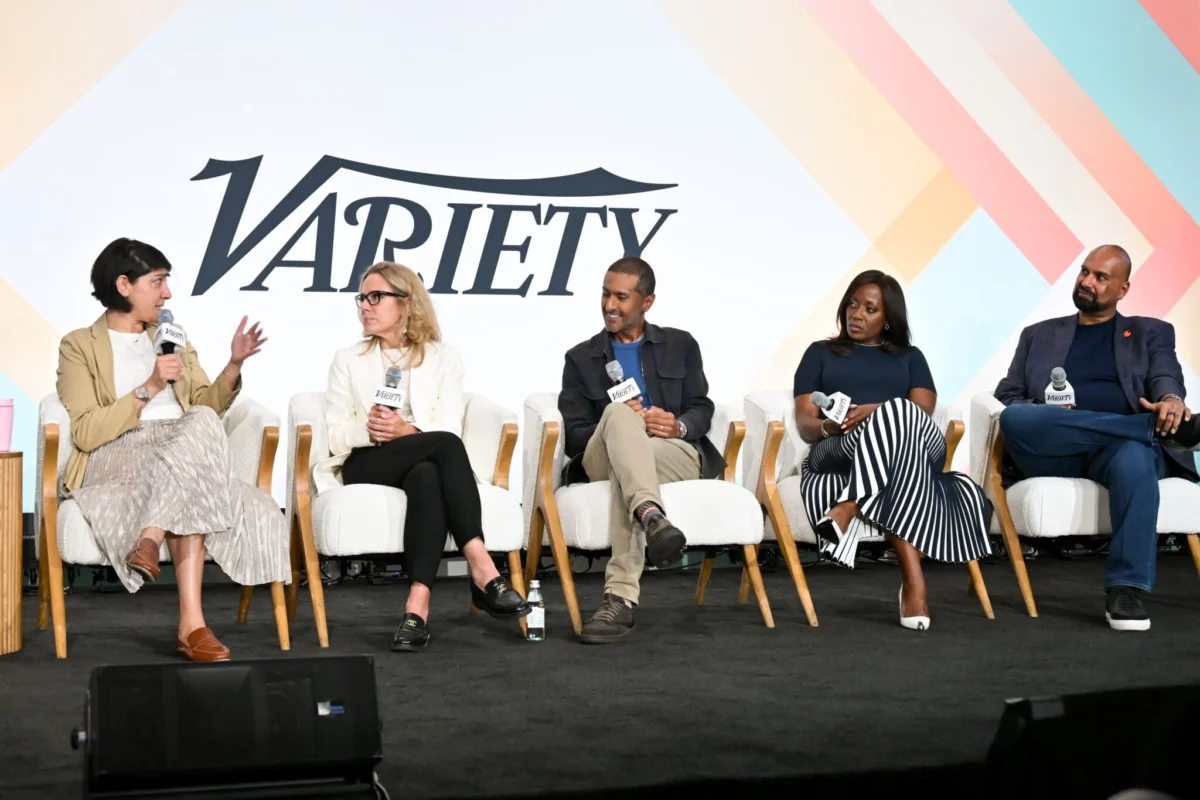
As the global media landscape undergoes a seismic transformation, Hollywood’s most influential architects are recalibrating their strategies. In a high-stakes environment defined by the rapid maturation of Artificial Intelligence and the sobering aftermath of the "Peak TV" era, the industry is searching for a new equilibrium. This pivot point was the central focus of the Variety Entertainment & Technology Summit, presented by EY in Los Angeles, where a panel of senior executives gathered to map out the future of storytelling.
The discussion, moderated by Variety executive editor for TV, Michael Schneider, featured a powerhouse roster of industry leaders: Clancy Collins White (President of Creative Affairs, Warner Bros. Television), Simran Sethi (President of Scripted Programming, Hulu Originals and ABC Entertainment), Liz Jenkins (Chief Business Officer, NBCUniversal Entertainment), Abhijay Prakash (President, Blumhouse Atomic Monster), and Rahul Purini (President, Sony’s Crunchyroll).
The Economics of Sustainability: Moving Past "Peak TV"
For years, the industry was intoxicated by the "Peak TV" phenomenon—a period characterized by an aggressive, often reckless, expansion of content volume. Liz Jenkins of NBCUniversal provided a sobering assessment of that era, suggesting that the industry’s previous model was fundamentally unsustainable.
"We were in a place for a while where, frankly, the economics were a bit unsustainable," Jenkins remarked. "Supply likely exceeded demand."
The current strategy for major conglomerates like NBCU, which manages a diverse portfolio including Peacock, Bravo, and the NBC broadcast network, has shifted toward a more surgical approach. Rather than casting the widest possible net in hopes of capturing a monolithic audience, companies are now laser-focused on identifying priority demographics. The goal, Jenkins explained, is to "super-serve" these core segments first, allowing for organic growth rather than forced expansion.
This sentiment of strategic restraint is echoed across the industry, marking a departure from the "tonnage-first" mentality that defined the last decade.
The Strategic Shift: Linear vs. Streaming
A persistent question in the modern media era is whether streaming services cannibalize the traditional linear broadcast model. Disney’s Simran Sethi challenged the notion that these mediums are in a zero-sum game. According to Sethi, Disney’s data indicates that the audiences for Hulu/Disney+ and linear television are distinct.
"They don’t cannibalize each other. They’re distinct audiences," Sethi noted. "People who have a habit of watching live on television are not necessarily the ones streaming online. It really did make the pie bigger."
By viewing these platforms as complementary rather than competitive, studios are finding ways to use streaming as a "catch-up" mechanism, bolstering linear viewership rather than diminishing it. This realization has empowered studios to maintain a multi-platform presence, ensuring their intellectual property (IP) remains accessible to diverse viewer habits.
The Return of "Watercooler" TV
Perhaps the most significant trend identified by the panel is the industry-wide retreat from the "binge-drop" model popularized by Netflix. Executives argued that the weekly release cadence is not merely a distribution choice, but a deliberate effort to foster cultural relevance and shared community experiences.
Sethi emphasized that for younger generations, the concept of "watercooler television"—where a massive audience watches a show at the same time and discusses it—is a revitalizing force. "The idea that you can have this shared experience watching something weekly is an important return to what society feels like it’s gravitating towards: being together, talking, and connecting."
This strategy has yielded tangible success for Warner Bros. Television. Clancy Collins White pointed to the runaway success of The Pitt, which recently swept seven 2026 Emmy Awards, including Best Drama Series. "At a time when so much emphasis is being placed on IP, it’s an incredibly compelling original idea," Collins White said. "Audiences are really enjoying the weekly drop as opposed to the binge model."
Jenkins added that for certain programs, particularly reality hits like Peacock’s Love Island USA, a weekly rollout provides the necessary "runway" to build buzz. Citing the success of Season 6, which saw a surge in engagement following the addition of reality star Ariana Madix, Jenkins noted that shows often require time to reach a "tipping point" in the cultural consciousness.
The AI Frontier: "Slop" vs. Storytelling
No conversation about the future of media is complete without addressing Artificial Intelligence. While the technology has sparked existential anxiety, the panel’s perspective was one of nuanced pragmatism.
Abhijay Prakash of Blumhouse Atomic Monster offered a distinct take on the disruption. He categorized the current wave of AI-generated content—often derisively labeled "AI slop"—as a threat primarily to low-production-value, short-form creator content. However, he was quick to distinguish this from professional, high-concept storytelling.
"Those are not the kinds of things that could be spat out of algorithms and large language models," Prakash said, referencing the recent success of his studio’s films Obsession and Backrooms. He argued that true theatrical horror, or any high-quality cinematic event, requires a human touch that AI cannot replicate.
Prakash also challenged Hollywood to change its relationship with platforms like YouTube. Rather than using the site solely for promotional trailers, he believes studios must treat YouTube as a destination where they can "natively" reach a younger, massive audience. "We have to figure out how to be present in front of them… actually have an offering for the consumer on the platform that is increasingly dominant."
Anime: The Global Found-Family Phenomenon
Sony’s Crunchyroll has become a case study in specialized, global audience engagement. Rahul Purini noted that the anime market is currently thriving, with an estimated 650 million regular viewers outside of China and Japan.
According to Purini, the secret to anime’s global expansion is its thematic universality. "It’s grief, it is fame, it is found family," Purini explained. "Our fans are telling us there are stories that are relatable, but the stories feel real and are very different from other stories they get in their entertainment mix."
By prioritizing the "themes and stories" over mere visual aesthetics, Crunchyroll has successfully fostered a loyal, growing community that values the emotional depth of the medium—a strategy that aligns with the broader industry goal of connecting with audiences on a human level.
Conclusion: The Path Forward
As the summit concluded, the consensus among the panelists was clear: the industry is entering an era of "capital C content"—a return to quality, emotional resonance, and strategic distribution.
Liz Jenkins summarized the philosophy that will likely guide the next decade of media: "It’s not just about tonnage. At the end of the day, it starts and begins with great stories and great storytellers. And what works are things that audiences emotionally connect to."
Clancy Collins White reinforced the importance of independence and flexibility. By maintaining a footprint across multiple platforms, studios are ensuring they remain agile enough to survive the shifting winds of technology and consumer behavior.
In an industry defined by its ability to reinvent itself, Hollywood appears to be shedding the excesses of the past. The focus has shifted from the volume of the product to the value of the experience. Whether through the communal ritual of weekly episode drops, the strategic use of global streaming platforms, or the refusal to compromise on human-centric storytelling in the face of AI, the message from the Variety Entertainment & Technology Summit was one of cautious, calculated optimism. The future of entertainment is not just about what is being made, but how it is being made—and more importantly, why it matters to the people watching.