In the high-stakes world of American political satire, few institutions hold as much cultural weight as Saturday Night Live (SNL). The show’s October 3 cold open served as a masterclass in political caricature, offering a scathing, surreal, and deeply comedic look at the current state of the Republican Party. Through a series of rapid-fire vignettes, the cast took aim at the party’s ongoing identity crisis, the eccentricities of its most prominent figures, and the absurdity of modern political discourse.
The Strategy Room: Setting the Stage
The sketch begins in the cramped, high-pressure confines of a GOP campaign office. Andrew Dismukes and Ashley Padilla take on the roles of beleaguered Republican strategists. Their task is Herculean: attempting to build genuine buzz and coherent messaging for a party that seems increasingly fractured.
The framing of the sketch establishes a tone of desperation. Dismukes and Padilla navigate a chaotic parade of high-profile political figures, each representing a different facet of the current conservative dilemma. This structural choice allowed the writers to showcase the show’s ensemble talent while providing a clear narrative thread: the struggle to present a unified front in an era defined by unconventional, often chaotic, political theater.
A Parade of Caricatures: The Chronology of the Sketch
The cold open functioned as a "who’s who" of the modern Republican establishment, with each impression serving to highlight a specific grievance or quirk currently circulating in the news cycle.
Marco Rubio and the Language of Discontent
Marcello Hernández led the parade as Senator Marco Rubio. His segment focused on the shifting rhetoric within the party. Speaking in Spanish—a recurring feature of the real Rubio’s outreach efforts—the character admitted that Donald Trump had not lived up to the lofty expectations set by his base. Hernández’s performance captured the nuance of a politician caught between loyalism and the reality of failing policy, specifically targeting the dissatisfaction regarding ongoing military interventions, which the sketch framed as failing to improve the nation’s standing.
The Frozen Figure of Mitch McConnell
Perhaps the most visually striking moment occurred when Mikey Day appeared as a frozen, wheelchair-bound Mitch McConnell. Day’s physical comedy was precise, as the character could only communicate through a shaky, persistent peace sign. The segment provided a meta-textual layer of humor when Day’s character nearly derailed the "fourth wall" of the sketch by attempting to deliver the iconic "Live from New York" line prematurely. The moment served as a hilarious nod to the fragility of the live television format and the unpredictability of the aging political guard.
The Charisma Void: JD Vance
Jeremy Culhane’s portrayal of Vice President JD Vance focused heavily on the criticism of Vance’s perceived lack of charisma. In a biting scene involving a camera test, Culhane’s Vance stammers through a robotic introduction—"Hi, I’m JD Vance"—before being unceremoniously dismissed by the strategists. It was a sharp critique of the difficulty the party has faced in projecting authenticity and relatability in its current messaging.
Pete Hegseth and the ‘State of the Force’
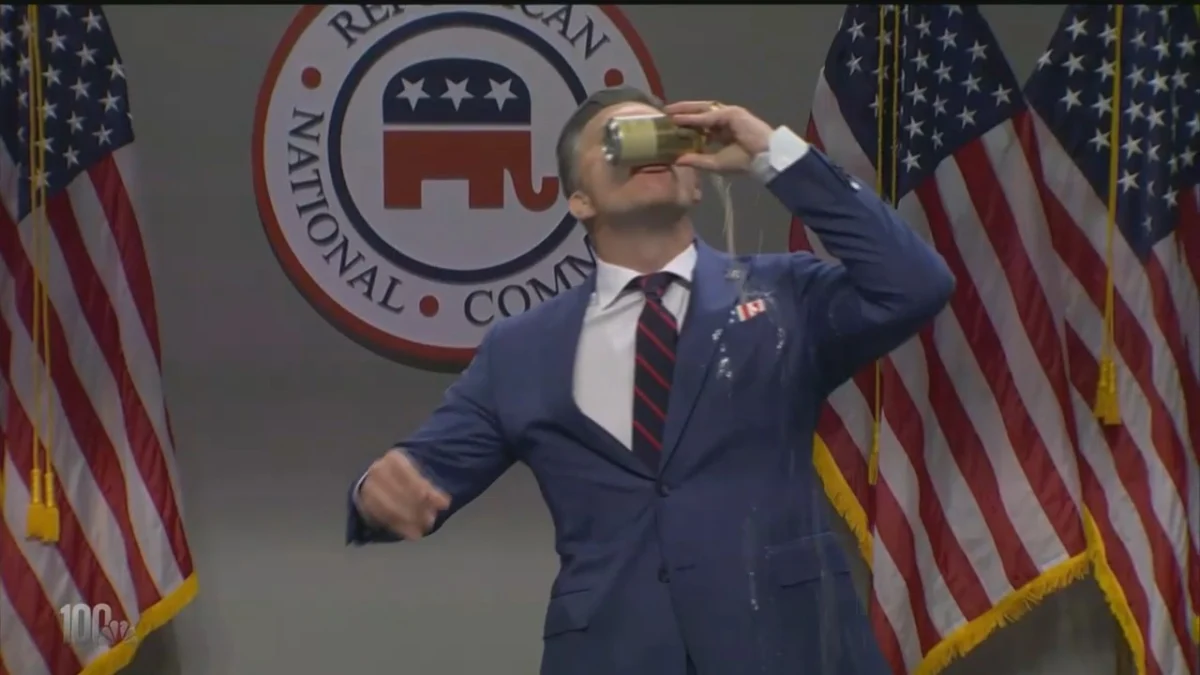
The emotional and comedic peak of the sketch arrived with the return of Colin Jost as Pete Hegseth. Jost’s performance centered on a parody of Hegseth’s recent, highly publicized "State of the Force" address. Jost’s Hegseth arrived on set chugging a Bero beer, mocking Tom Holland’s non-alcoholic brand by labeling it "Spider-Man’s new non-alcoholic bitch beer."
The segment took a turn for the absurd as Jost’s Hegseth urged the audience to perform a "shocking" patriotic duty: "I need all you patriots at home to do the gayest thing ever and vote." He further leaned into the culture wars by claiming, "I’m putting God back in war and it’s working. Our soldiers are praying a lot more than they used to." The biting satire here was clear: the show was highlighting the increasingly performative and theological nature of modern conservative military rhetoric.
The Trumpian Finale
The segment concluded with James Austin Johnson’s definitive portrayal of Donald Trump. Entering with the simple, dismissive directive, "Let me cook," Johnson’s Trump pivoted immediately to a parody of his recent midterms strategy. Trump mocked the concept of offering financial incentives to voters, stating, "If the Republicans win, I’ll give everyone $5,000 and that is not a bribe because I have no intention of following through on that promise." This line cut to the heart of the critique regarding the honesty and viability of the promises made by the GOP leadership.
Supporting Data: The Reality Behind the Parody
While SNL is a comedy program, the effectiveness of its satire relies on a foundation of observable reality. The sketch touched upon several major political themes that have dominated recent news cycles:
- The Hegseth Controversy: The parody of Pete Hegseth’s "State of the Force" reflects genuine concern and criticism regarding the politicization of the military and the proposed restructuring of the Pentagon. The "State of the Force" address was widely criticized for its unorthodox tone and its focus on cultural issues rather than strategic military operations.
- Financial Incentives as Policy: Trump’s claim about paying voters references actual, albeit hyperbolic, discussions regarding midterm strategy. By framing it as a "non-bribe," SNL highlights the legal and ethical gray areas that often characterize Trump’s populist rhetoric.
- The "Frozen" Leadership: The depiction of Mitch McConnell as physically frail speaks to a broader national conversation regarding the age of American political leaders and the transition of power within the GOP.
Official Responses and Public Reaction
The reaction to the episode, which was hosted by Dakota Johnson with musical guest Turnstile, has been largely positive among critics who view the cold open as a return to form for the show’s political commentary. Social media engagement spiked following the broadcast, with clips of Jost’s "Hegseth" monologue and Johnson’s "Trump" dialogue circulating widely.
Political analysts have noted that by focusing on the absurdity of the GOP’s internal messaging, SNL has effectively tapped into a vein of viewer exhaustion. While the Republican National Committee and the representatives of the figures parodied rarely respond to SNL sketches directly, the cultural impact is undeniable. The sketch serves as a mirror, reflecting how these politicians are perceived by a significant portion of the electorate: disconnected, performative, and increasingly desperate.
Implications: The Role of Satire in Election Cycles
The implications of such a sketch are significant. In an election cycle characterized by high polarization, Saturday Night Live functions as a release valve. By stripping away the veneer of political gravitas and replacing it with pure, unfiltered caricature, the show allows viewers to process the complexities of current events through a lens of humor.
Furthermore, the sketch highlights the challenge for the GOP in crafting a narrative that appeals to both its base and the broader, more moderate electorate. The "strategists" depicted in the opening scene are struggling with a real-world problem: how to reconcile the conflicting, often extreme, demands of the current conservative movement.
As the political landscape continues to evolve, the ability of SNL to capture the zeitgeist remains a critical part of the American media ecosystem. By skewering both the policy failures and the personal eccentricities of those in power, the show maintains its position as the preeminent voice of televised political satire. Whether through the "frozen" silence of a party leader or the bombastic promises of a former president, the October 3 cold open successfully underscored the surreal nature of the modern political stage, reminding audiences that in the world of American politics, truth is often stranger—and funnier—than fiction.