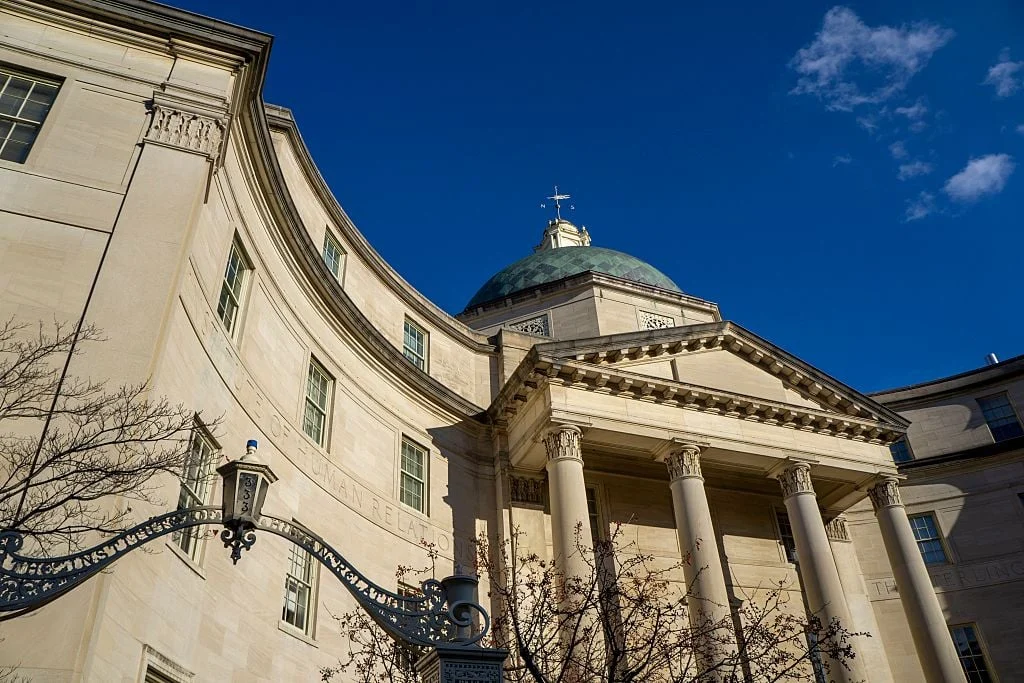
NEW HAVEN, Conn. — Yale University is currently embroiled in high-stakes negotiations with the United States Department of Justice (DOJ) regarding allegations of discriminatory admissions practices. The discussions, which center on the university’s compliance with federal mandates prohibiting the use of race in student selection, mark a critical inflection point for one of the world’s most prestigious academic institutions.
President Maurie McInnis, in a formal address to the Yale community on Monday, confirmed that the university is in the midst of a "voluntary resolution" process. The move comes as federal authorities intensify their scrutiny of higher education institutions, aiming to enforce the Supreme Court’s landmark ruling that effectively struck down affirmative action in college admissions.
The Genesis of the Investigation
The current friction between Yale and the federal government traces back to May 2026, when the Department of Justice released findings alleging that the Yale School of Medicine had circumvented the Supreme Court’s race-based admissions ban. According to the DOJ’s investigation, the medical school allegedly utilized “racial proxies”—data points or evaluative criteria that indirectly serve to identify an applicant’s race—to influence the composition of its incoming classes.
While the immediate focus of the DOJ’s findings was the School of Medicine, the scope of the federal inquiry has since expanded. The DOJ is concurrently investigating admissions policies within Yale College and the Yale Law School. The federal government’s position is that any institutional mechanism—be it legacy preferences, specific geographic weighting, or subjective qualitative assessments—that functions as a backdoor for racial balancing is a violation of federal law.
A Chronology of Escalation
The legal tension between Yale and the federal government did not emerge in a vacuum. To understand the current impasse, one must look at the broader timeline of institutional oversight:
- June 2023: The U.S. Supreme Court issues its ruling in Students for Fair Admissions v. Harvard/UNC, fundamentally altering the legal landscape for higher education admissions in the United States.
- Late 2024–Early 2025: The Department of Justice, under the current administration, initiates a wave of compliance audits targeting Ivy League and other elite research universities to ensure adherence to the new legal standard.
- May 2026: The DOJ publicly releases its findings against the Yale School of Medicine, alleging the use of illicit proxies.
- June–July 2026: Intense speculation regarding a potential settlement between Yale and the federal government permeates academic circles, leading to significant outcry from faculty and student advocacy groups.
- July 13, 2026: President Maurie McInnis breaks the administration’s silence, confirming that voluntary resolution talks are underway.
The Pushback: Faculty and Student Concerns
The prospect of a settlement has been met with fierce resistance from within the university’s walls. In recent weeks, faculty members and student organizations have organized protests and issued open letters demanding that the university administration refuse to “cave” to federal pressure.
Critics of a potential settlement argue that any agreement with the DOJ could set a dangerous precedent, granting the government unprecedented leverage to dictate university policy. For many faculty members, the fear is that a settlement would necessitate the dismantling of diversity, equity, and inclusion (DEI) initiatives that have been central to Yale’s pedagogical mission for decades.
In her Monday address, President McInnis attempted to quell these anxieties. She framed the negotiations as a “standard and important practice” for legal teams. "It is a required and reasonable step," McInnis stated, emphasizing that the dialogue is designed to allow the government and the university to exchange information and determine if the matter can be resolved without resorting to the protracted uncertainty of a full-scale federal lawsuit.
Defending Academic Freedom
A central pillar of McInnis’s response has been the defense of institutional autonomy. She explicitly stated that Yale remains “committed to safeguarding academic freedom” and that the university “must maintain the right to decide who we admit and hire in accordance with the law.”

This rhetoric is carefully calibrated. By invoking “academic freedom,” the university is signaling that while it intends to comply with the letter of the law, it will fight to maintain control over its holistic review processes. The challenge for Yale—and for other universities in similar positions—is defining the fine line between “holistic review” (which is permissible) and “proxy-based discrimination” (which the DOJ alleges is illegal).
Implications of a Voluntary Resolution
Should Yale reach a voluntary resolution with the Department of Justice, it would be joining an growing list of institutions that have opted for settlement over litigation. Over the past 18 months, several major universities have struck deals with the federal government to resolve allegations of regulatory non-compliance.
These settlements are rarely uniform, but they often include a package of concessions that fundamentally alter campus life. Typical components of such agreements include:
- Structural Admissions Overhauls: Implementing rigorous, audited systems to ensure that no demographic data is accessible to admissions officers during the evaluation process.
- Disciplinary and Hiring Changes: Altering faculty hiring guidelines to align with federal interpretations of meritocracy.
- Campus Governance Restrictions: In some instances, universities have agreed to limits on campus protest activity or changes to administrative structures that govern student conduct.
- Financial Penalties: Multimillion-dollar fines have become a hallmark of these resolutions, serving both as a punitive measure and a deterrent to future non-compliance.
The Broader Context: A Changing Legal Landscape
Yale’s situation is emblematic of a broader ideological battle over the role of elite institutions in American society. The Trump administration’s approach to higher education has been marked by a concerted effort to dismantle race-conscious policies and, in many cases, to challenge the perceived “ideological capture” of universities.
For Yale, the stakes could not be higher. If the university fails to negotiate a settlement, it faces the prospect of a high-profile court battle that could result in a court-ordered restructuring of its admissions office, massive financial damages, and a permanent shift in how the university defines its community.
Conversely, by settling, Yale risks alienating its base of faculty, donors, and students who view any cooperation with the DOJ as a betrayal of the university’s core values. This internal friction highlights the impossible position in which many university presidents find themselves: trying to balance the requirement to uphold federal law with the mission to preserve the autonomy of the academy.
Conclusion: The Path Forward
As of this week, Yale has confirmed that it has already implemented changes to its admissions processes, though it has not formally conceded to the specific findings issued by the DOJ in May. This suggests a strategy of “quiet compliance”—making enough adjustments to satisfy federal regulators while avoiding an admission of guilt that could open the university up to secondary lawsuits from private plaintiffs.
The coming months will likely see further developments as the negotiation window narrows. For the academic community at large, the Yale case serves as a bellwether. As the legal definition of “equal protection” in admissions continues to be contested in the courts, institutions like Yale remain the primary testing grounds for the future of higher education in the United States. Whether the university can navigate this process while maintaining its integrity and independence remains the central question for the current academic year.