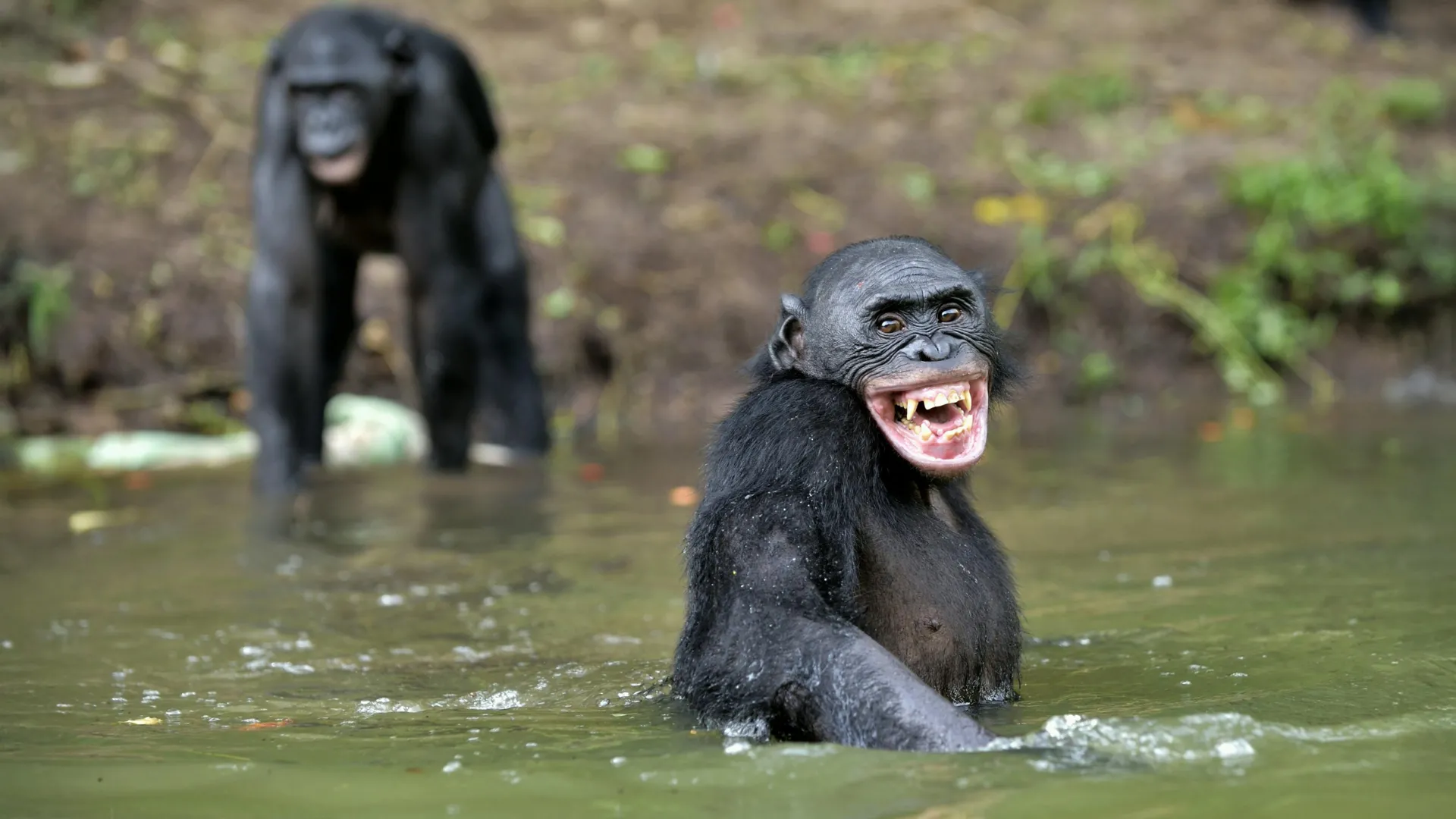
In the silent corridors of evolutionary history, language has long been considered the "Holy Grail" of anthropology. Because spoken words leave no fossilized remains, tracing the origins of human communication has been a process of educated guesswork. However, a groundbreaking new study from the University of Warwick has uncovered an unexpected, audible time capsule: the rhythm of human laughter. By analyzing the vocal patterns of great apes, researchers have discovered that the fundamental cadence of a laugh has remained unchanged for 15 million years, providing the strongest evidence yet for the evolutionary trajectory of human speech.
The Main Facts: A Rhythmic Constant
The study, published in the journal Communications Biology, challenges the long-held assumption that human vocal capabilities appeared suddenly or in isolation. By comparing 140 laughter sequences from 17 subjects—including humans, chimpanzees, bonobos, gorillas, and orangutans—the research team identified a striking, conserved trait: every species produces laughter with evenly spaced, rhythmic intervals between successive sounds.
This consistency suggests that the "pulse" of laughter is an ancient biological legacy, rooted in a common ancestor that roamed the Earth roughly 15 million years ago. While human laughter has evolved to become faster and more contextually nuanced, the underlying structural architecture remains identical to that of our primate cousins. This finding suggests that human speech did not emerge from a vacuum, but rather from a long-standing, cumulative refinement of vocal control that began millions of years before the first word was ever uttered.
The Chronology of Vocal Evolution
To understand the significance of this discovery, one must look at the timeline of hominid development. For decades, the dominant narrative in linguistics was that vocal control was a unique human adaptation—a "big bang" moment in evolution.
However, the University of Warwick study reframes this timeline. The research indicates that the 15-million-year-old rhythmic pattern serves as the evolutionary substrate upon which more complex vocal abilities were built.
- 15 Million Years Ago: The last common ancestor of modern great apes establishes the basic rhythmic structure of laughter. This "proto-laugh" likely served as a social bonding mechanism, a way to signal safety and camaraderie during play.
- The Intermediate Millennia: As various hominid lineages diverged, the fundamental pulse of this laughter remained stable, acting as a "vocal anchor" that persisted through environmental changes and social shifts.
- The Advent of Human Speech: As the human lineage evolved, the capacity for vocal control began to sharpen. Humans did not discard the ancestral rhythm; instead, they began to modulate it. Over time, this refinement allowed for the conscious control of timing, intensity, and duration—the essential mechanics required for complex syntax and articulation.
Supporting Data: Analyzing the Ape Archive
The research team, led by experts in psychology and primatology, utilized a meticulous methodology to ensure accuracy. The data set consisted of 140 laughter sequences, captured from four orangutans, two gorillas, three bonobos, four chimpanzees, and four humans.
The analysis focused on the "inter-pulse interval"—the temporal space between bursts of sound. Despite the vast biological and behavioral differences between a human and a gorilla, the data revealed a shared rhythmic signature. While an orangutan’s laugh may sound like a deep, guttural chuckle and a human’s laugh may be a high-pitched giggle, the timing—the mathematical spacing of the pulses—was statistically indistinguishable.
This consistency is vital. It proves that the rhythmic backbone of vocal expression is not a cultural construct or a learned behavior unique to humans, but a deep-seated biological rhythm that has survived the pressures of natural selection for millions of years.
Official Responses: The Experts Weigh In
The implications of these findings have sent ripples through the fields of anthropology and linguistics. Dr. Chiara De Gregorio, an Honorary Research Associate in the Department of Psychology at the University of Warwick, emphasizes the unique position of laughter in the study of our origins.
"How did humans evolve the remarkable ability to speak? Speech leaves no fossils, and complex language exists only in our own species," Dr. De Gregorio stated. "But we’ve found a 15-million-year-old clue in an unexpected place: our laughter. Unlike speech, laughter is shared by all living great apes. By comparing how different species laugh, we can see that a basic rhythmic structure has remained unchanged since our last common ancestor. That’s extraordinary."
Dr. Adriano Lameria, an Associate Professor at the ApeTank, Department of Psychology, at the University of Warwick, further contextualized the findings by addressing the "discontinuity" theory of human language.
"It is impossible to assess the precursor forms of language directly from our extinct ancestors," Dr. Lameria explained. "Laughter, being evolutionarily older and having remained shared between all living great apes, provides a rare evolutionary window into the vocal transformations that unfolded across hominid evolution until the first humans appeared on scene. Contrary to the classic notion that the first humans suddenly acquired vocal control capacities remarkably different from their predecessors, laughter evolution tells us that humans lie on a continuum—a prolongation of vocal control capacities that were already being cumulatively honed for 15 million years."
The Flexibility Factor: How Humans Diverged
While the rhythm remains a constant, the study highlights a significant evolutionary divergence: human laughter has gained a level of flexibility unseen in other species.
Humans possess the unique ability to consciously adjust their laughter depending on the social environment. We have mastered the art of the "polite laugh" in a boardroom, the "nervous laugh" after a social faux pas, and the "contagious laugh" that binds a group of friends together. This is not merely a behavioral quirk; it is a manifestation of the neurobiological evolution of vocal control.
This adaptability indicates that while we inherited the "rhythmic pulse" from our ancestors, we developed the "control center" in the brain—specifically in the motor cortex—that allows us to override, modulate, and manipulate that pulse. This transition from "instinctual, rhythmic vocalization" to "conscious, controlled communication" is exactly the bridge that scientists believe led to the birth of language.
Implications: A New Framework for Linguistics
The findings from the University of Warwick suggest that the evolution of speech was not a sudden mutation, but a slow, iterative process of gaining control over vocal muscles and timing.
- The Continuity Hypothesis: The study provides robust evidence that humans are not biologically separate from the rest of the animal kingdom in terms of vocal foundations. We are simply the most recent iteration of a long line of vocal innovators.
- The "Laughter as a Laboratory" Approach: Because laughter is an emotional, rather than purely intellectual, vocalization, it serves as a "cleaner" data point for studying evolution. It is less influenced by complex cultural learning and more rooted in innate biological drive.
- Redefining Language Origins: If the building blocks of speech—rhythmic control and vocal manipulation—were being honed through laughter for 15 million years, then the evolution of language is a much older story than previously thought.
Conclusion: The Long Echo of Humanity
As we look at the laughter of a chimpanzee or the vocalizations of a gorilla, we are not looking at a primitive version of our own speech; we are looking at the foundational architecture of it. The study from the University of Warwick reminds us that our most complex human achievements—our capacity for poetry, debate, and intricate storytelling—are built upon an ancient, rhythmic foundation that we share with our closest biological relatives.
The 15-million-year-old pulse of laughter is a bridge across time. It tells us that we are part of a long, unfolding narrative of vocal refinement. Every time we laugh, we are participating in a tradition that predates our species, a rhythmic heartbeat of connection that has traveled through millions of years of evolution to reach us today. In the silence of the fossil record, laughter provides the music—a persistent, rhythmic echo that finally allows us to hear the faint, distant beginnings of the human voice.