For over a century, the study of animal intelligence has been dominated by a specific archetype: the large-brained vertebrate. From Wolfgang Köhler’s famous early 20th-century experiments with chimpanzees, who stacked wooden crates to reach out-of-reach bananas, to the complex tool-using behaviors observed in corvids and cetaceans, the consensus was clear—or so we thought. The ability to solve novel problems through insight, rather than mere rote learning, was deemed a hallmark of complex, mammalian-style neural architecture.
A groundbreaking study published on June 4, 2026, in the journal Science has effectively dismantled this hierarchy. Researchers from the University of Oulu, the University of Helsinki, and the University of Turku have demonstrated that bumble bees (Bombus terrestris)—creatures with brains no larger than a grain of rice—are capable of spontaneous, goal-directed problem solving that rivals the cognitive feats of our closest primate relatives.
The "Box-and-Banana" Problem, Scaled for Insects
The research team, led by Akshaye Bhambore and Olli Loukola, designed an experiment that pushed the boundaries of insect behavioral science. The goal was to determine if bees could manipulate an external object to solve a challenge they had never previously encountered, without any prior training or social cues.
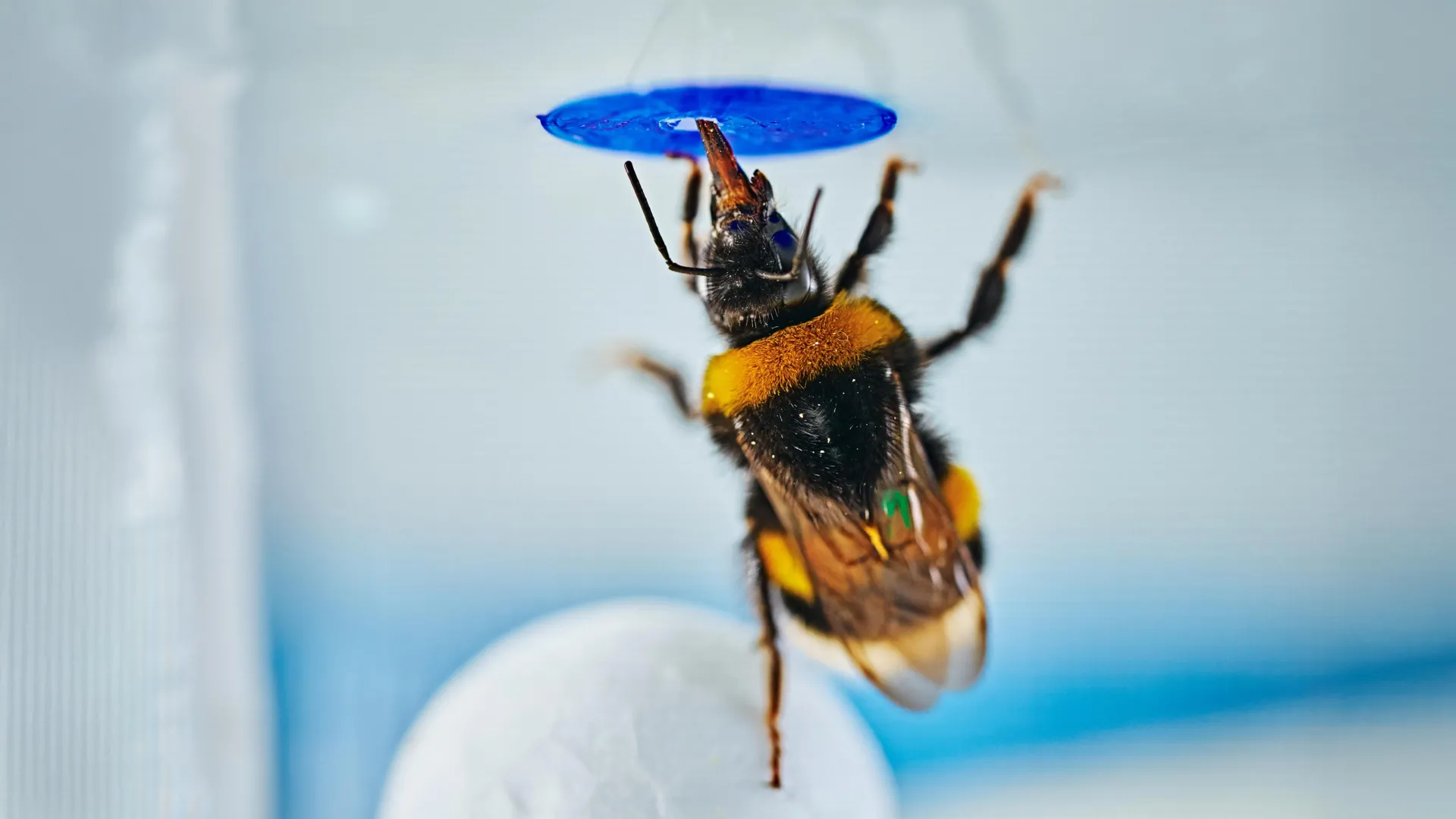
The experimental setup was both elegant and rigorous. First, the bees were conditioned to understand that a blue artificial flower contained a sucrose reward. In the second phase, researchers placed this blue flower on the ceiling of a transparent, enclosed arena, rendering it completely inaccessible to the bees through flight alone.
To bridge the gap, the researchers placed a small, movable ball on the floor of the arena. Crucially, the bees had no prior training in ball-rolling or using objects as platforms. They had only learned two isolated facts: that the blue flower was a source of food, and that the ball was an inert, harmless object.
The results were astonishing. Without a single trial-and-error training session regarding the ball, a significant portion of the test subjects successfully moved the ball underneath the flower and climbed onto it to reach the reward. This sequence of actions—repositioning a tool to achieve a goal—mirrors the iconic cognitive tests historically reserved for primates and large-brained birds.
Chronology of a Scientific Breakthrough
The experiment unfolded in a carefully controlled environment designed to eliminate external variables. To understand the depth of the discovery, one must look at the progression of the study:
- Baseline Conditioning: Researchers ensured the bees were familiar with the blue flower as a reward site.
- The Introduction of the Novel Challenge: The flowers were moved to the ceiling. Initially, the bees attempted to reach the flowers by flying, failing repeatedly.
- The Spontaneous Shift: As the bees moved through the arena, their behavior shifted from undirected exploration to targeted manipulation. Individuals began pushing the ball toward the specific location directly beneath the reward.
- Verification of Intent: The successful bees did not push the ball randomly. They displayed "directed movement patterns," maneuvering the ball with precision to the exact spot where the flower sat overhead.
- Stringent Control Testing: To ensure this wasn’t mere accident, researchers conducted "blind" tests where the flower was obscured from view. Even without visual confirmation, the bees successfully navigated the ball to the location, proving that they were operating with a mental map of the goal rather than simply reacting to visual stimuli.
Ruling Out Simpler Explanations
In the field of ethology, the "law of parsimony" (Morgan’s Canon) dictates that one should not interpret a behavior as the outcome of a higher cognitive faculty if it can be explained by simpler, more mechanistic processes. The research team anticipated this and implemented rigorous controls to rule out alternative explanations.
"We were very careful to rule out accidental success," explains lead author Akshaye Bhambore. "If a bee hits a ball by chance and it happens to end up under a flower, that is not cognition. That is luck. Our analysis of the bees’ movement trajectories proved that they were not moving the ball randomly. They were intentionally maneuvering the object to reach the target."
Furthermore, the team addressed the possibility of "play behavior." In many animal species, young individuals manipulate objects as a form of play, which can lead to accidental learning. However, because these bees were "naïve"—having had no experience with the ball or the vertical displacement of the flower—the researchers were able to confirm that the behavior was a genuine, first-time solution to a complex environmental demand. The absence of previous training sessions serves as the strongest evidence that the bees were performing a cognitive computation rather than executing a pre-programmed instinct.
Official Responses and Expert Perspective
The scientific community has reacted to the findings with a mix of awe and a renewed need for a paradigm shift. Senior author Olli Loukola, who has long studied the cognitive limits of small-brained creatures, emphasizes the importance of the findings.
"This is essentially an insect version of the classic ‘box-and-banana’ problem," Loukola noted in a post-publication interview. "The animal must realize that an object can be repositioned and then used as a tool to reach an otherwise inaccessible goal. What stands out about the result is that this kind of spontaneous problem-solving is now demonstrated in an insect, which forces us to rethink what a ‘miniature brain’ is actually capable of."
Ece Nur Akmeşe, a co-author from the University of Helsinki, highlighted the observational beauty of the data. "One moment the animal is exploring seemingly without direction, and the next it performs a highly efficient sequence of actions leading directly to the solution. Watching the bees solving the task was genuinely fascinating—it felt like watching a lightbulb turn on in their tiny heads."
The Implications: A New Era for Cognitive Science
The implications of this study are profound and reach far beyond the field of entomology. For decades, the "brain size vs. intelligence" correlation has been a cornerstone of evolutionary biology. While larger brains provide more neural real estate, this study suggests that "neural efficiency" may be a more important variable than raw volume.
1. Challenging Neural Scaling Laws
The findings suggest that the cognitive requirements for spontaneous problem solving—such as mental representation of a goal and the ability to manipulate the environment to achieve it—do not require a massive cortex. Instead, these processes may rely on specific, highly efficient neural circuits that have evolved independently in insects.
2. Redefining Intelligence
We must be careful, as the researchers note, not to anthropomorphize these findings. "We are not claiming that bees think like humans," says Loukola. "They are not contemplating the philosophy of their actions. But our findings show that miniature brains can generate flexible solutions to novel problems in ways we are only beginning to understand." This distinction is vital: the study proves behavioral flexibility, which is a key component of intelligence, without requiring human-like consciousness.
3. Evolutionary Convergent Cognition
If bees can solve problems in the same way as chimpanzees, it raises questions about the evolutionary origins of intelligence. Are there multiple paths to "insight" in the animal kingdom? Does the capacity for logic emerge as a necessity for survival in complex, variable environments, regardless of the species’ phylogenetic branch?
Conclusion
The 2026 Science paper by Bhambore et al. marks a turning point in our understanding of the natural world. By demonstrating that bumble bees can navigate a novel, multi-step problem with the same strategic focus as a primate, the researchers have effectively "levelled the playing field" of cognitive science.
As we continue to explore the capabilities of the miniature brain, we are forced to move away from a human-centric definition of intelligence. The bumble bee does not need a massive brain to understand its world; it simply needs the right neural architecture to adapt, observe, and act. In the silent, buzzing world of the garden, a quiet revolution in cognitive theory has taken place—one that suggests that brilliance, in its most functional form, does not require a large mind, but rather a flexible one.