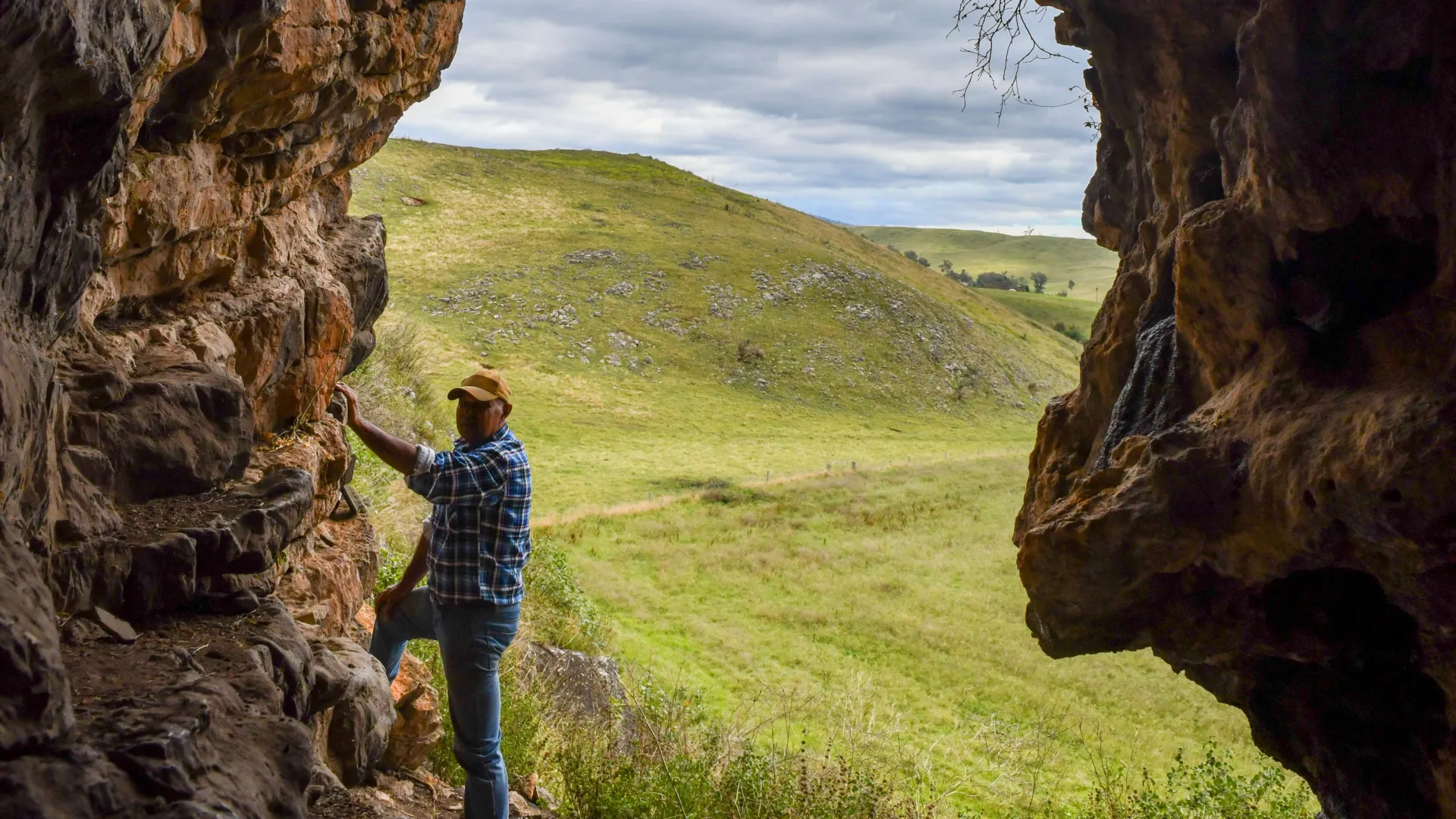
In the rugged heart of the Victorian Alps, tucked away in the traditional lands of the GunaiKurnai nation, lies a site that challenges our fundamental understanding of human history and cultural persistence. Cloggs Cave is not merely a geological curiosity or a prehistoric shelter; it is a profound testament to the continuity of spiritual practice, serving as a sanctuary for ritual, magic, and healing for an astonishing 25,000 years.
A groundbreaking study published in Frontiers in Environmental Archaeology has synthesized archaeological data, microscopic plant analysis, and Indigenous oral traditions to reveal that the GunaiKurnai people—the traditional custodians of Gippsland—engaged in deliberate, highly specialized ritual burning within the cave’s dark chambers since the Pleistocene era.
The Guardians of the Deep: Contextualizing the Site
For the GunaiKurnai, the landscape is not a static backdrop but a living history. Throughout the 19th century, settlers recorded accounts of the mulla-mullung—powerful, learned individuals recognized as spiritual practitioners capable of healing, casting, and cursing. These figures were said to operate within the shadows of the earth, utilizing the natural isolation of caves to conduct rites that bridged the gap between the material and spirit worlds.
Until recently, much of this was relegated to the realm of folklore by Western academia. However, modern archaeology, conducted in partnership with the GunaiKurnai Land and Waters Corporation, has begun to corroborate these oral traditions with physical evidence. The findings suggest that Cloggs Cave was never a domestic dwelling in the traditional sense; it was, and remains, a site of profound cultural significance, carefully maintained and utilized by generations of Old Ancestors.
A Chronology of Continuity
The archaeological narrative of Cloggs Cave is one of endurance. The research, led by Dr. Elle Grono of the Australian National University alongside Professor Bruno David of Monash University, indicates that the site’s usage patterns remained remarkably consistent across 25 millennia.
The Pleistocene Origins
The deepest layers of the cave have yielded evidence of ritualistic behavior dating back roughly 25,000 years. During these early periods, practitioners brought in woody plants, including Casuarina trees, which were meticulously trimmed and smeared with fat. These ritual artifacts suggest that the "magic" practiced by the mulla-mullung was deeply rooted in the manipulation of organic materials to invoke specific spiritual outcomes.
The Mid-Holocene Ritual Layers
The most granular data comes from the upper sections of the excavation pits, where researchers identified 73 distinct layers of ash. Through a combination of optically stimulated luminescence (OSL) and accelerator mass spectrometry carbon dating, the team confirmed these layers were deposited between approximately 4,400 and 1,600 years ago. This represents a period of sustained, repeated ritual activity, where specific grasses were brought into the cave, spread in thin layers, and ignited.
The Standing Stone: A Fixed Point in Time
Approximately 2,000 years ago, the nature of the rituals appears to have evolved to include permanent installations. Excavators uncovered a 28-cm-high standing stone, intentionally placed within the cave. This stone serves as a physical anchor for the spiritual geography of the site, marking a moment where the ritual landscape became permanently demarcated.
The Science of Microscopic Clues: Phytolith Analysis
The core of the study rests on the analysis of phytoliths—microscopic silica structures that form within plant tissues. Unlike pollen, which is easily transported by wind or water, phytoliths are resilient and generally remain where the plant decays or burns.
Decoding the Botanical Selection
Because Cloggs Cave is a dark, enclosed environment, it cannot support plant life. Therefore, any plant material found within the cave sediment had to be introduced by an external agent—either animals or humans. By focusing on half-burnt phytoliths within ashy layers, the research team was able to distinguish between natural accumulation and human activity.
The analysis revealed a startling level of selectivity. Of the 29 distinct types of phytoliths identified, 97% were grass-based. The assemblage included:
- Pooideae: Grasses that thrive in the cool, temperate conditions of the Victorian Alps.
- Panicoideae: Grasses preferring warmer, more humid environments.
- Chloridoideae: Drought-resistant grasses from arid landscapes.
The presence of these diverse species, collected from outside the immediate vicinity of the cave, indicates that the GunaiKurnai were not simply harvesting whatever was available. They were curating a specific botanical palette for their rituals. Furthermore, the presence of stems, leaves, flowers, and roots proves that whole plants were being transported into the cave, emphasizing the intentionality and preparation involved in the process.
Official Responses and Collaborative Research
This research represents a new gold standard in Australian archaeology, emphasizing a collaborative methodology that centers Indigenous agency. The project was initiated at the request of the GunaiKurnai Land and Waters Corporation, ensuring that representatives were involved in every stage: from the initial research design and fieldwork to the final interpretation of the data.
"Here we show that the Old Ancestors selected whole grasses from the wider landscape and carried them into Cloggs Cave to spread out in thin layers and burn," says Dr. Elle Grono. Her findings provide a bridge between the physical evidence and the spiritual narratives held by the GunaiKurnai elders.
Professor Bruno David notes the cultural implications of the burning. "Their burning is consistent with GunaiKurnai traditional practices of using ash to perform magic and rituals, and also to track the footsteps of anyone coming in, including spirit-Beings," he explains. This suggests that the ash was not a byproduct of warmth or cooking, but a functional tool for ritual security and spiritual navigation.
Broader Implications: Redefining Prehistoric Ritual
The study of Cloggs Cave challenges the colonial-era trope that Aboriginal Australian societies were purely nomadic or focused exclusively on survival. The investment of time and energy required to travel, harvest, and transport specific vegetation to a dedicated ritual site speaks to a highly organized, complex spiritual infrastructure that has persisted through dramatic climatic changes, including the end of the last Ice Age.
Resilience of Tradition
Perhaps the most significant takeaway is the sheer longevity of the cultural practice. To maintain a specific site for 25,000 years requires an incredibly robust system of knowledge transfer. It suggests that the GunaiKurnai oral traditions are not just stories, but accurate, long-term archives of human behavior.
A New Model for Archaeological Inquiry
The Cloggs Cave project serves as a model for how global archaeology might move forward. By acknowledging the validity of Indigenous knowledge systems alongside rigorous scientific methods, researchers can gain a much deeper understanding of the "why" behind the physical evidence. The study in Frontiers in Environmental Archaeology confirms that science does not need to displace tradition; rather, the two can work in tandem to illuminate the deep, intricate history of human consciousness.
As we look toward the future, the work at Cloggs Cave reminds us that the land holds memories. Every layer of ash, every silicified grass cell, and every standing stone is a voice from the past. For the GunaiKurnai, these are not relics of a "lost" culture, but the ongoing, living legacy of a people who have maintained a sacred relationship with their environment since time immemorial. The cave remains a silent witness to a spiritual history that is as profound, complex, and enduring as any found in the human story.