For years, the filmography of South Korean auteur Hong Sangsoo has been likened to the inevitability of death and taxes. Much like the prime career output of Woody Allen, Hong’s work is defined by a remarkable regularity, a consistency of voice, and a recurring ecosystem of motifs—soju-fueled conversations, chance encounters, and the cyclical nature of human longing. Yet, 2024 has seen a curious shift in this established rhythm.
Following the experimental, somewhat blurred-lens abstractions of The Day She Returns, which premiered at the Berlinale earlier this year, there was a palpable anxiety among critics that Hong might be drifting into a phase of impenetrable avant-garde abstraction. When his 35th feature was announced with the haunting, existential title Nowhere to Lay My Eyes, many braced for another dive into stylistic opacity. Instead, they were met with something far more profound: a return to the crystalline, biting, and bittersweet comedy that first solidified Hong as a titan of contemporary arthouse cinema.
The Return of the Muse: Kim Minhee’s Masterclass
At the heart of this return to form is Kim Minhee. Since 2017, the Handmaiden star has been the indispensable anchor of Hong’s creative world. However, in recent entries, her roles have shifted toward the peripheral, sometimes relegated to off-screen narration or understated supporting parts. Nowhere to Lay My Eyes serves as a corrective, positioning Kim at the center of the frame and allowing her performance to dictate the film’s atmospheric temperature.
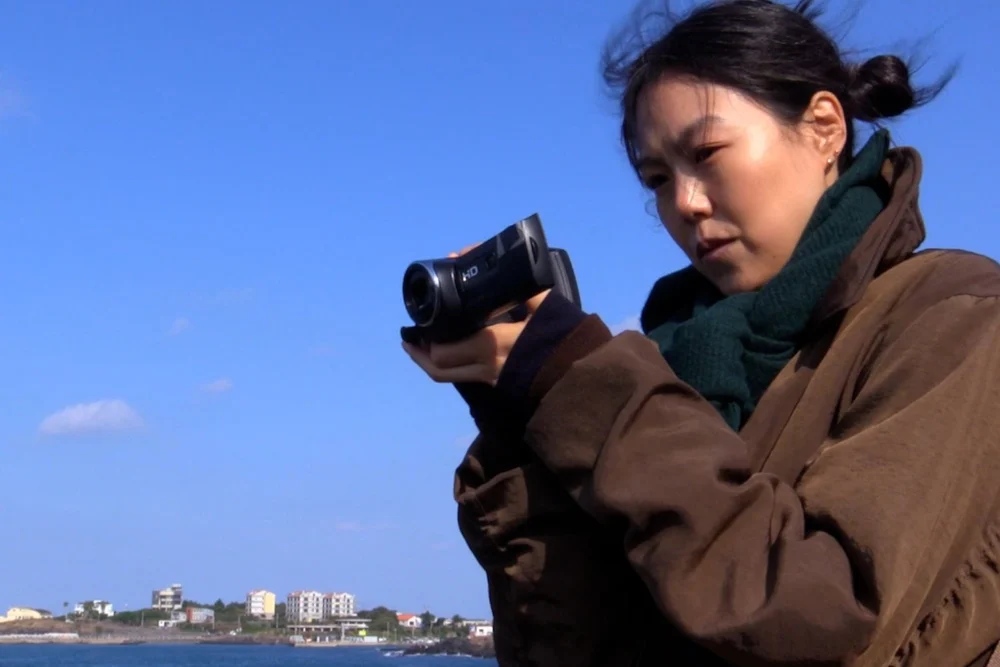
Kim plays Sanghee, a woman navigating the precarious balance between a mundane office job as a snack importer and a secret life as an experimental filmmaker. Her performance is a masterclass in economy. She does not reach for the histrionics of traditional drama; instead, she uses her eyes—watchful, porous, and weary—to convey the deep-seated melancholy of a woman who feels perpetually out of step with her family. The film’s emotional weight rests entirely on her ability to mask disappointment behind a veneer of polite, familial stoicism.
Chronology of a Fraught Reunion
The film unfolds over a tense, two-day visit to the picturesque, windswept shores of Jeju Island. Sanghee travels from Seoul to visit her estranged mother (played by veteran television star Choi Myeonggil), bringing along her brother, Shin Seokho. The reunion is intended to be a bridge-building exercise, yet the architecture of their relationship has been eroded by a decade of physical and emotional distance.
The narrative is structured around the mundane rituals of a weekend visit: shared meals, tentative walks through lush landscapes, and the inevitable, slightly excessive consumption of alcohol that has become a hallmark of Hong’s directorial style.
- Day One: The arrival on Jeju Island sets the tone. The audience is introduced to the mother’s new life—a home that includes a holiday rental cottage. The dynamic is immediately clear: the mother favors the son, treating him with a reverence she denies her daughter. The stepfather, played by Hong regular Kwon Haehyo, offers a mirror to the director himself—a mild-mannered, thoughtful documentary filmmaker who acts as a soft foil to the mother’s sharp, passive-aggressive critiques of Sanghee’s life choices.
- Day Two: The tensions simmer as the group engages in long, rambling conversations that oscillate between the trivial and the profound. They discuss the quality of imported European furniture, debate the merits of different documentary filmmaking techniques, and, in a rare, startling departure for Hong, touch upon the geopolitical weight of the war in Gaza. These conversations serve as the backdrop for the real drama: the unspoken resentment between a mother who values success in concrete terms and a daughter who seeks meaning in the ephemeral.
Supporting Data and the Ensemble Cast
The strength of Nowhere to Lay My Eyes lies not just in its leads, but in its perfectly calibrated ensemble. Kwon Haehyo provides the "comforting gang’s-all-here" air that Hong’s dedicated audience has come to cherish. His performance is essential; as a proxy for the director, he brings a dry, observational humor that prevents the film from slipping into pure melodrama.
The newcomer, Choi Myeonggil, is a revelation. Her portrayal of the mother is devoid of caricature. She is not a villain, but a woman who has built a world based on specific metrics of success that her daughter simply does not share. The friction between her and Kim is the engine of the film, a passive-aggressive dance that feels achingly familiar to anyone who has navigated the complexity of adult-child-parent relationships.
The inclusion of Park Miso as the shy, younger stepsister provides a necessary third perspective. Her admiration for Sanghee’s films creates a secondary conflict—Sanghee, who is struggling to accept her own identity, finds it difficult to accept the admiration of someone who views her as an idol.
Implications: The Evolution of a Style
The film’s 72-minute runtime is a testament to Hong’s mastery of the "less is more" philosophy. By stripping away excess, he focuses on the small, satisfying moments of release: a perfectly prepared noodle soup, a comical pratfall, or a quiet moment of reflection on a porch.
Crucially, the film utilizes a voiceover—a device less common in Hong’s work—that allows the audience to hear the "lyrically wounded woman" beneath Sanghee’s exterior. This narrative choice provides a rare window into the interiority of a Hong protagonist, effectively bridging the gap between the character’s perceived aloofness and her true emotional state.
The film has already garnered significant attention on the international festival circuit. Following its premiere at the Locarno Film Festival, it is slated for the main slate of the New York Film Festival, alongside The Day She Returns. The Cinema Guild, Hong’s long-standing North American distributor, will handle the release, ensuring that even if Hong is no longer looking to recruit new converts to his aesthetic, the "faithful"—the dedicated cinephiles who have followed his work for decades—will find much to celebrate.
Conclusion: A Mirror to Loneliness
Ultimately, Nowhere to Lay My Eyes is an exploration of the various "flavors" of loneliness. It does not seek to solve the problems it presents; instead, it finds pleasure in the observation of the human condition. It captures the sadness of familial distance, the regret of lost time, and the accidental, fleeting bliss of a weekend spent in the company of people who are both intimately known and utterly foreign.
In an era where cinema is increasingly preoccupied with spectacle, Hong Sangsoo remains committed to the microscopic. By choosing to look at the "nowhere" where his characters find themselves, he has paradoxically created a place where the audience can find a profound sense of recognition. It is a slim, quiet, and deeply effective piece of filmmaking that confirms Hong’s status as a director who, even when he seems to be following a familiar path, remains capable of sly, beautiful, and devastating surprises.