At 53 years old, I have spent a lifetime governed by the principles of fiscal conservatism. My financial philosophy has always been built on the bedrock of long-term planning, modest living, and the suppression of impulse. But recently, I found myself standing at a crossroads where the logic of the spreadsheet collided with the reality of human joy. This is the story of how a routine errand turned into a major life event, leading me to abandon a vehicle I merely tolerated in favor of a machine I truly love.
The "Maxi Cooper" Dilemma: A Case of Compromise
In July 2020, at the height of the global pandemic, I purchased a used 2019 Mini Countryman SE All4 for $35,990. My original intention had been to replace my aging 2004 Mini Cooper with a newer iteration of the same model. Instead, I allowed myself to be persuaded by the utility of a compact SUV. I nicknamed the vehicle the "Maxi Cooper," but the moniker was tinged with irony.
While the Countryman was technically a competent machine, it was a profound mismatch for my personality. I have always been a "small-car guy." For two years, I treated the SUV as a necessary compromise, but it never felt like my car. It was a vehicle of convenience that lacked the soul and driving dynamics I craved. I had prioritized the "sensible" choice over the one that would actually bring me satisfaction.
The Market Miracle: An Unforeseen Opportunity
The turning point arrived last month during a routine oil change. While I sat in the dealership waiting room, a representative approached me with a proposition: they wanted to buy back my Countryman.
I was initially skeptical, but the offer was staggering. They were willing to pay $33,000 for a car I had purchased 26 months prior. To put this in perspective, the U.S. used-car market has been in a state of unprecedented volatility. According to data from the U.S. Federal Reserve, used vehicle prices have surged 55% since July 2020, while new car prices have climbed by roughly 18%.
I reached out to a contact of mine, a former automotive salesman named Jeremy, to get a professional reality check. "It’s not just a good deal," he told me bluntly. "It’s a miracle. You’ve effectively leased that car for $115 a month. Take the offer now, before they realize what they’re doing."
The Pivot: Embracing "Self-Centered" Shopping
With the sale of the "Maxi Cooper" finalized, I was faced with a blank slate. For the first time in my life, I decided to adopt a "self-centered shopping" strategy—a concept I often write about—where the priority is not what is most practical for the world, but what is most aligned with one’s own values and desires.
I spent an intense 24 hours researching the automotive market. I considered going car-free, relying on my 1993 Toyota pickup for heavy lifting and walking or biking for my daily commute in Corvallis. However, I eventually decided that I wanted to use this specific financial windfall to finally stop compromising. I wanted a car that balanced modern reliability with the spirited, nimble handling of the classic small cars I have always loved.
Data-Driven Decision Making
To narrow down my search, I utilized the Consumer Reports car finder tool. The parameters were simple: agility, driver engagement, reliability, and size. The tool suggested a list of candidates, including the Kia Niro Electric, the Ford Mustang Mach-E, the Mazda Miata, the Tesla Model 3, and the Hyundai Ioniq 5.
Through a rigorous process of elimination, I discarded the SUVs (the Mach-E), the vehicles with questionable long-term reliability (Tesla), and those lacking in owner satisfaction (Kia and Hyundai). This left me with one clear winner: the Mazda MX-5 Miata.
The Miata is the antithesis of the "Maxi Cooper." It is small, loud, and inherently impractical. It seats only two, offers minimal cargo space, and demands that you accept the noise of the road. Yet, every professional review and enthusiast forum I consulted echoed the same sentiment: it is one of the last truly intimate driving experiences available on the modern market. It provides "fun-per-dollar" that is virtually unmatched.
The Negotiation: Standing My Ground
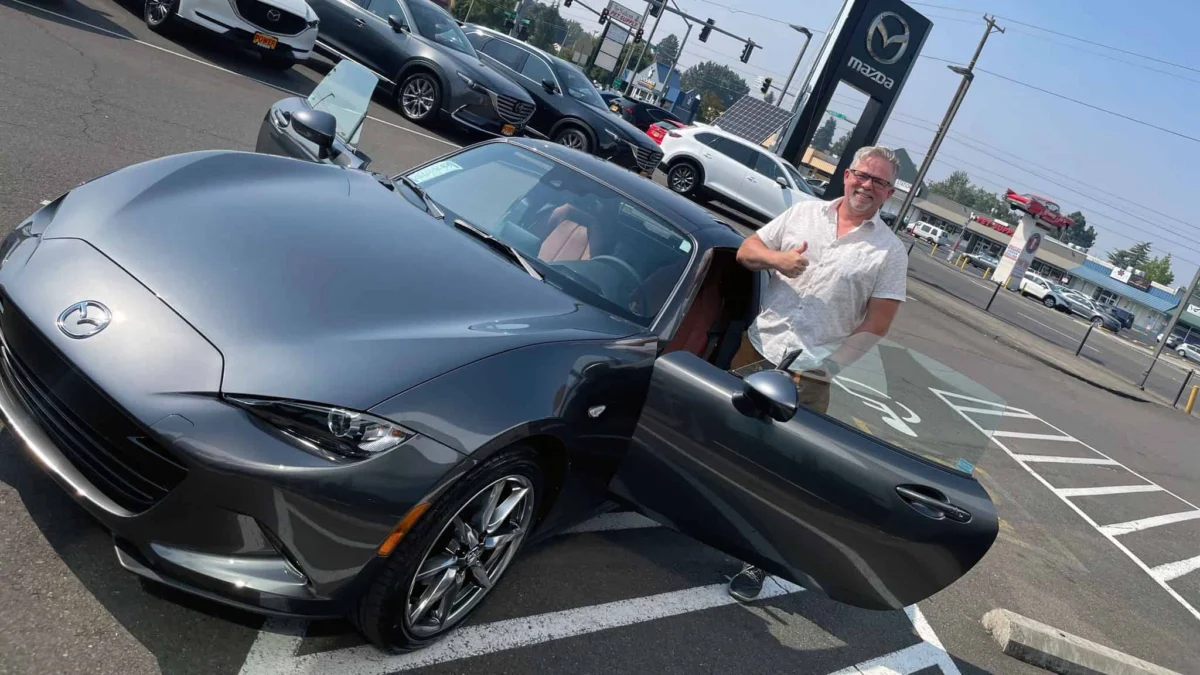
On the last Thursday of August, I visited a Mazda dealership in Salem. I had done my homework and knew exactly what I wanted: a gray hardtop manual transmission.
When I arrived, the dealer attempted the classic "four-square" sales tactic, trying to push me into one of the automatic, soft-top models currently sitting on their lot. I held firm. "I’m not going home with a car today," I told the salesman. "You don’t have the car I want."
I showed him a printout of the specific configuration I had found in transit. We agreed on a price—$39,245, including a $1,995 market adjustment—and shook hands. It was a refreshing departure from the usual high-pressure environment of car buying. I wasn’t just being sold a car; I was procuring a specific tool for my own happiness.
The Financial Implication: What is a "Rich Life"?
Throughout this process, I grappled with the lingering guilt associated with my upbringing. Growing up with limited means often makes the act of purchasing "nice things" feel like a moral failure. However, I chose to frame the purchase through the lens of Ramit Sethi’s philosophy: money should be a tool to build a "rich life."
I asked myself the ultimate question: Would I rather have the 2019 Countryman and $7,000, or a brand-new 2022 Mazda Miata? The answer was immediate. The Miata represents a deliberate choice to prioritize my own joy over the passive accumulation of cash.
When the car finally arrived, it had only five miles on the odometer—a record for the finance manager who processed my paperwork. The drive home from Salem to Corvallis was a revelation. With the top down and the wind hitting my face, the anxieties of the past few years seemed to dissipate.
Final Reflections
There is a profound difference between being "frugal" and being "cheap." Being frugal means spending intentionally on the things you value and cutting ruthlessly on the things you don’t. For years, I had spent money on a car I didn’t care about, which is the definition of waste.
By selling the car that didn’t fit and purchasing the one that did, I didn’t just buy a new vehicle; I bought a lesson in self-permission. At 53, I have learned that while saving money is vital, the ultimate purpose of that savings is to give you the agency to make decisions that enhance your quality of life. The Miata is more than just a car—it is a reminder that, occasionally, it is perfectly acceptable to ignore the spreadsheet and follow your heart.