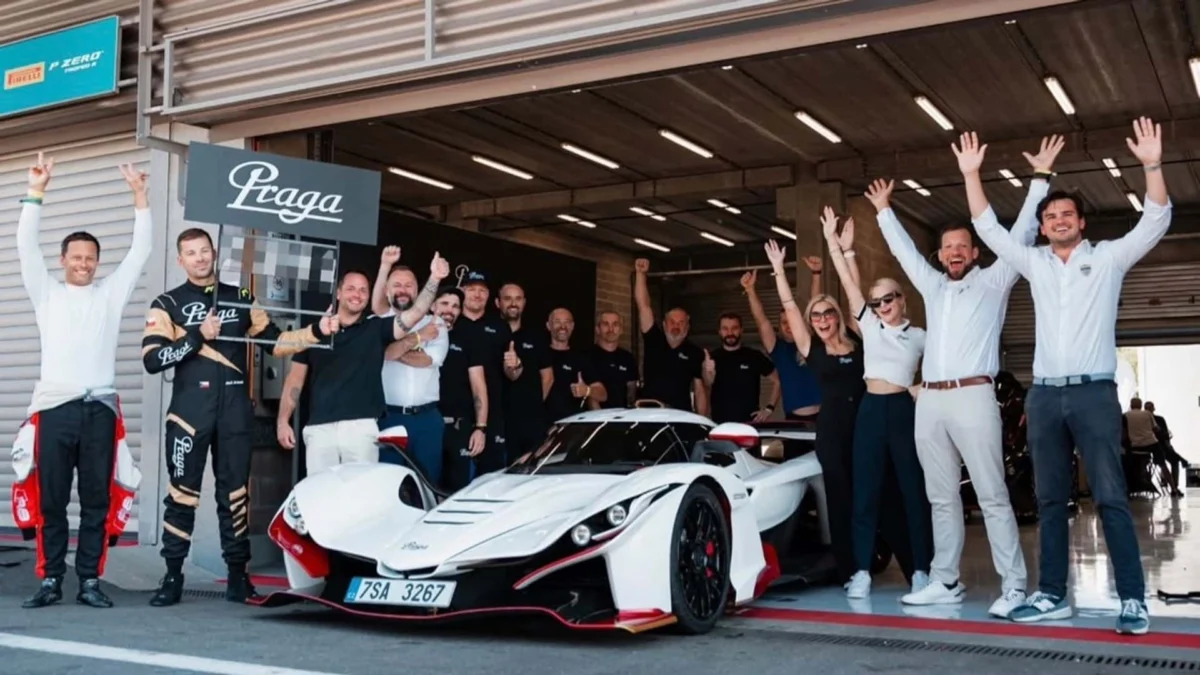
In the rarefied air of the hypercar world, where multi-million-dollar machines often serve as static showpieces or investments for climate-controlled garages, a new challenger has emerged to disrupt the status quo. Praga, the historic Czech manufacturer, has sent shockwaves through the automotive enthusiast community following reports that its road-legal Bohema hypercar has conquered the legendary Circuit de Spa-Francorchamps in a blistering 2 minutes and 21.42 seconds.
This unofficial lap time, if verified, places the Bohema firmly in the crosshairs of the world’s most prestigious track-focused road cars. More importantly, the manner in which the time was achieved—during a standard customer track day, on road-legal tires, and amidst normal traffic—suggests that the Bohema is not merely a theoretical exercise in engineering, but a visceral, high-performance tool built for the discerning driver.
The Chronology of a Potential Record-Breaker
The event in question took place during a Curbstone track day at the Belgian circuit, a venue globally recognized as the "ultimate test" for any performance vehicle due to its mix of high-speed corners, significant elevation changes, and unpredictable weather.
According to reports, Praga development driver Aleš Jirásek was behind the wheel when the telemetry captured the 2:21.420 lap. Unlike traditional record attempts, which are typically characterized by closed tracks, warm-up laps, bespoke race-compound slicks, and aggressive weight-reduction measures, the Bohema was operating under "as-shipped" conditions. It was running on its standard, road-legal tires and navigating the track alongside other enthusiasts.
To place this in context, the Pagani Huayra Roadster BC—a titan of the hypercar industry—set a benchmark time of 2 minutes and 23.081 seconds at Spa in September 2020. At the time, Pagani touted this as a record for globally homologated road-legal cars. The Praga Bohema’s reported time, while currently lacking the official certification of a timing body or the circuit’s own administrative validation, is over 1.6 seconds faster than the Pagani.
The Anatomy of the Bohema: Engineering for the Track
The performance of the Bohema is not an accident of circumstance; it is the result of a singular, uncompromising engineering philosophy. While many modern hypercars have gravitated toward heavy electrification and massive luxury appointments, Praga has doubled down on the principles of Colin Chapman: simplify and add lightness.
The Power-to-Weight Advantage
At the heart of the Bohema lies a 3.8-liter twin-turbocharged V6 engine, sourced from the Nissan GT-R powertrain architecture and extensively tuned by Litchfield. The engine produces 690 horsepower and 535 pound-feet of torque. While these figures are competitive within the segment, the true genius lies in the chassis. Praga has managed to keep the car’s curb weight under 2,200 pounds (approximately 982 kilograms).
This featherweight construction gives the Bohema a power-to-weight ratio that rivals dedicated GT3 racing machines. At Spa, where the climb through the daunting Eau Rouge and Raidillon requires immense agility and acceleration, this weight advantage becomes a force multiplier.
Aerodynamic Efficiency
Speed is only as useful as the grip that enables it. The Bohema produces a staggering 1,984 pounds (900 kilograms) of downforce at 155 mph. This allows the car to carry immense speed through high-speed sweepers like Blanchimont without the need for the sheer mechanical tire width that might otherwise compromise the car’s handling dynamics.
While its top speed is electronically capped at 186 mph, Praga’s engineers were clearly not chasing a V-max vanity metric. By prioritizing downforce and mid-range acceleration, they have optimized the Bohema for the reality of modern road-circuit racing, where high-speed cornering stability is the true arbiter of a fast lap.
Official Responses and the "Record" Dilemma
Despite the excitement surrounding the 2:21.42 lap, both Praga and the racing community remain cautious regarding the "record" designation. As of now, there is no official timing sheet verified by independent timekeepers or a sanctioning body that formally recognizes the feat.
"We were not at Spa to chase a record," stated development driver Aleš Jirásek in the wake of the news. "We were there with customers to enjoy driving one of the greatest circuits in the world."
This sentiment is crucial for understanding the brand’s positioning. Praga emphasizes that the car was not subjected to any "special preparation." In the world of automotive performance, this is a significant claim. Often, record attempts involve stripping interior components, using specialized tire compounds not available to the public, or employing "trick" setups that would be undriveable on the street. By performing this lap in a customer-delivery-spec vehicle, Praga is attempting to signal to the market that their performance claims are genuine and replicable by any owner who possesses the requisite skill.
The Wider Implications for Boutique Hypercars
The rise of the Bohema represents a broader shift in the hypercar market. For years, the segment was dominated by established legacy manufacturers—Ferrari, Lamborghini, and Porsche—who used their massive R&D budgets to dominate the conversation. Today, boutique manufacturers like Praga, Czinger, and others are proving that a focused, agile, and relatively small-scale operation can outperform the giants.
The Death of the Spec-Sheet War
For a long time, potential hypercar buyers were driven by raw horsepower figures and top-speed benchmarks. The market is currently undergoing a paradigm shift where "track capability" has become the new currency. Potential buyers are no longer satisfied with a car that can do 250 mph on a runway; they want a car that can set a competitive time at the Nürburgring, Spa, or Laguna Seca.
The Bohema’s performance is a wake-up call to larger manufacturers. By building only 89 units of the Bohema, priced at approximately 1.28 million euros ($1.4 million), Praga is targeting a niche of "driver-collectors." These are individuals who intend to drive their vehicles, not just hold them as static assets. When a car is delivered that can genuinely perform at a track-day event, it transforms the vehicle from an object of luxury into an instrument of athletic achievement.
Looking Ahead: Can the Bohema Sustain Its Status?
The question remains: will Praga pursue an official, sanctioned lap record to solidify the Bohema’s place in history? While the current claim is unofficial, it has already achieved the brand’s primary goal: it has established the Bohema as a serious contender in the hypercar conversation.
As the industry moves toward electrification, the pure, raw, internal-combustion-driven performance of cars like the Bohema is becoming increasingly rare. The fact that this performance is achieved on road-legal tires, in traffic, and with no special prep, speaks volumes about the maturity of modern automotive engineering.
For the enthusiast, the Bohema represents a return to the roots of sports car manufacturing. It is a reminder that when you strip away the excess, focus on the fundamentals of weight, aerodynamics, and balance, the results on the stopwatch—even when no one is officially "chasing a record"—speak for themselves.
If this performance is confirmed, the Praga Bohema will likely be remembered not just as a limited-run hypercar, but as a standard-bearer for a new era of boutique performance. Whether or not it holds the official crown at Spa is perhaps secondary to the undeniable reality: the bar for what constitutes a "road-legal" track weapon has just been raised significantly.