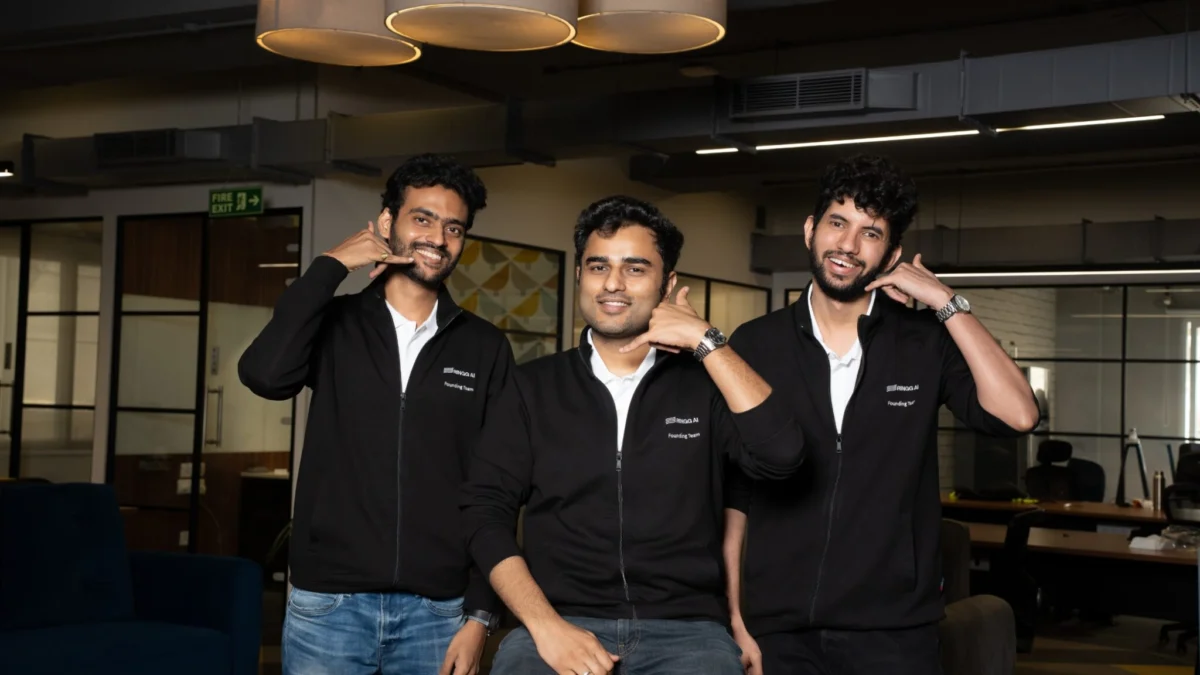
In a digital era dominated by messaging apps and automated chatbots, the humble phone call remains the king of consumer preference in India. According to recent data from Truecaller, over 76% of Indian consumers still prefer to resolve issues or engage with businesses via a direct voice call. This lingering reliance on voice creates a massive, untapped frontier for enterprise automation. Enter Ringg, an AI startup that is rapidly scaling to bridge the gap between human-centric communication and machine-led efficiency.
With a fresh $10 million injection from Peak XV Partners, Ringg has signaled its intent to dominate the voice AI space. This extension to its Series A round, which brings its total funding to $15.5 million, underscores a growing investor confidence in the startup’s transition from a niche text-to-speech player to an enterprise-grade orchestration powerhouse.
The Evolution: From DesiVocal to Enterprise Orchestration
Ringg’s journey is a case study in strategic pivoting. The company originated as "DesiVocal," a venture focused on building proprietary text-to-speech models. However, the founders quickly encountered the harsh economic reality of the AI sector: training large-scale, high-fidelity speech models from scratch is an extraordinarily capital-intensive endeavor.
Recognizing that the true value lay not in the underlying architecture alone, but in the application of that technology to solve complex business problems, the team shifted their focus. They moved "up the stack," transitioning from a model-provider to an enterprise voice AI agent provider. This pivot proved successful, attracting heavyweights like the Indian fintech unicorn Cred, and subsequently, a roster of industry giants including Flipkart, Practo, Groww, and PolicyBazaar.
"At the start, we were doing high-volume, low-complexity use cases like outbound calling, lead qualification, and loan collection," explains co-founder Siddharth Tripathi. "We quickly realized these are not sticky use cases, and so it’s always going to be a price game." By moving toward high-value, complex workflows, Ringg has successfully differentiated itself from the sea of commoditized voice-bot providers.
Strategic Chronology: Building Momentum
The trajectory of Ringg reflects the rapid maturation of the Indian AI ecosystem:
- Foundation Phase: The startup launches as DesiVocal, focused on basic text-to-speech capabilities.
- The Pivot: Realizing the prohibitive costs of pure-model training, the founders shift to building voice agents for enterprises.
- Early Adoption: Fintech giant Cred becomes the first major client, validating the startup’s ability to handle high-stakes financial interactions.
- Expansion: The company secures $5.5 million in a Series A round earlier this year, fueling development in healthcare and e-commerce.
- The Breakthrough: Ringg achieves a processing milestone of 20 million call attempts per month.
- Series A Extension: Peak XV Partners contributes an additional $10 million, cementing Ringg’s position as a serious contender in the Indian AI market.
Complex Workflows: Moving Beyond the "Price Game"
Ringg’s current strategy is defined by "stickiness"—the ability to become indispensable to an enterprise’s operations. While many competitors remain trapped in the "low-complexity" cycle of automated cold calls, Ringg is tackling workflows that require human-like nuance and deep integration.
Healthcare and Patient Engagement
The startup’s collaboration with Practo, a leading health-tech platform, is a prime example. Ringg’s voice agents now operate across 1,200 clinics, managing the delicate process of appointment scheduling and post-visit follow-ups. This requires not just speech recognition, but an understanding of medical context, patient scheduling logic, and the ability to handle sensitive information with consistency.
E-commerce and Fintech
Beyond healthcare, Ringg is optimizing high-conversion tasks such as:
- Abandoned-cart recovery: Engaging shoppers at the precise moment they drop off, using a personalized voice interface to address friction points.
- KYC (Know Your Customer) Onboarding: Automating the identity verification process for fintech apps, ensuring regulatory compliance without the need for a massive human call center.
While 70% of Ringg’s business remains tied to voice, the startup has begun expanding into omnichannel support, including WhatsApp and browser-based AI support for companies like Shell. Tripathi emphasizes that their goal is to function as a "platform for outcomes," prioritizing results over mere technical novelty.
The Competitive Landscape: A Crowded Arena
The market for Voice AI is currently a battleground. Global players like Deepgram, ElevenLabs, and Cartesia are pushing the boundaries of what models can do, while local Indian powerhouses like Sarvam AI (which recently achieved unicorn status) and Smallest.ai are capturing market share with specialized, ultra-fast voice solutions.
Ringg finds itself in the "orchestration" layer. Rather than being tied to a single model, Ringg functions as an intelligent router. It directs tasks to the best-performing models based on the specific use case, infrastructure, and cost constraints. This approach is highly defensible: while models may eventually become commoditized, the ability to manage the "customer relationship and the outcome" is where the long-term value resides.
Rishen Kapoor, a principal at Peak XV, highlights why Ringg stands out despite the competition: "Because of their technical depth, they can actually execute these hard-won enterprise workflows end-to-end. They can complete high-value tasks like merchant onboarding and L1/L2 support with a level of quality and consistency that standard bots simply cannot match."
Implications: The Future of Global Capability Centers
Perhaps the most interesting aspect of Ringg’s growth strategy is its relationship with India’s Global Capability Centers (GCCs). Rather than attempting to disrupt the U.S. market directly—a move that would require massive investment in local sales and infrastructure—Ringg is positioning itself as an automation partner for these offshore hubs.
Multinational corporations use GCCs to manage their back-office and support operations. By partnering with these centers, Ringg can deploy its voice AI alongside human agents, providing a "hybrid" model. This allows the AI to handle the repetitive or high-volume queries while humans focus on complex, high-empathy scenarios. This B2B2B strategy effectively leverages existing enterprise infrastructure to scale rapidly.
Challenges and Future Outlook
Despite the recent funding success, the road ahead is not without obstacles. The cost of running high-fidelity AI models remains a primary concern for the entire industry. Ringg is currently in a hiring phase, looking for "forward-deployed engineers" who possess both the technical acumen to build and the product-management skills to ensure these models actually solve real-world problems.
Furthermore, the research team is dedicated to a critical objective: reducing the cost of inference. As the cost per call drops, the barrier to entry for businesses of all sizes will lower, potentially opening up the market to smaller SMEs that are currently priced out of advanced AI.
Ringg’s transition from a speech-synthesis startup to a mission-critical enterprise orchestrator represents a broader trend in the AI sector. The "AI gold rush" is evolving into a more mature phase where the winners will not necessarily be those with the flashiest models, but those who can most effectively integrate AI into the messy, high-stakes, and highly valuable workflows of global enterprise. As the company continues to process millions of calls, its focus on "getting things done" will likely be the ultimate metric of its success.