For a man who famously purged his private garage of its most extravagant machines, the decision to acquire a Ferrari F40 was not merely a transaction—it was a homecoming. Lewis Hamilton, the seven-time Formula 1 world champion, has long been synonymous with elite performance and, more recently, a minimalist approach to material excess. Yet, among the sea of supercars he once owned, one nameplate remained the elusive exception: the Ferrari F40.
In a move that has electrified the automotive world, the incoming Scuderia Ferrari driver has finally secured his dream machine. Far from a turnkey purchase, the car represents a historical rescue mission, with Hamilton recently sharing intimate glimpses on social media of the iconic supercar undergoing a meticulous, comprehensive restoration at the hallowed Maranello factory.
The Chronology of a Dream
The seeds of this acquisition were sown long before Hamilton officially inked his historic deal to join Ferrari for the 2025 season. For years, the British racing icon had been thinning his collection, citing a desire for a lighter footprint and a more focused lifestyle. However, he consistently maintained that should the right F40 emerge—a car that represented the pinnacle of analog engineering—he would not hesitate.
The timeline of this pursuit accelerated in early 2025. Upon his first official visit to Ferrari’s Maranello headquarters as a team member, Hamilton was photographed alongside an F40. While many assumed it was a PR exercise, the image was, in reality, a signal of intent.
The vehicle in question had an ignominious recent history. For over three decades, the car sat dormant in a garage, a silent victim of neglect since the 1990s. With its Italian license plates suggesting it had never truly left the home of its birth, the car remained a "sleeping beauty" until it caught the eye of the F1 legend. Recognizing the significance of a chassis that holds the distinction of being the final vehicle personally signed off by Enzo Ferrari himself, Hamilton took ownership, initiating a restoration process that has effectively brought the car back from the dead.
The Engineering Pedigree of the F40
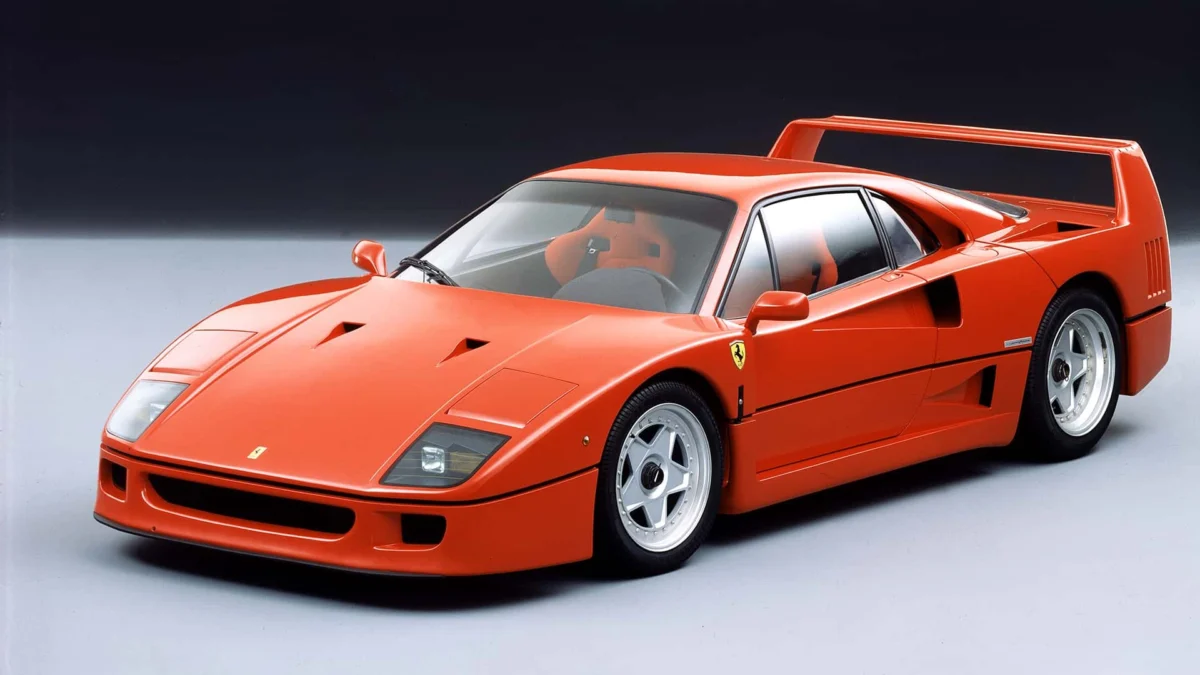
To understand why Hamilton, a man who has driven the most advanced racing cars on the planet, is so enamored with the F40, one must look at the vehicle’s place in automotive history. Produced between 1987 and 1992, the F40 was the 40th-anniversary celebration of Ferrari. It was the last car to be overseen by "Il Commendatore" himself.
Equipped with a 2.9-liter twin-turbocharged V8 engine, the F40 is raw, visceral, and famously unforgiving. Unlike the electronically aided supercars of today, the F40 features no anti-lock brakes, no traction control, and a manual gated shifter that demands total commitment from the pilot. It is an analog instrument in a digital age, representing the zenith of late-80s performance technology. With just over 1,300 units produced, the F40 is not just a car; it is a blue-chip asset that bridges the gap between classic design and modern speed.
The "F44" Vision: A Modern Reinterpretation
Hamilton’s fascination with the F40 extends beyond historical preservation. The driver has been vocal about his desire to collaborate with Ferrari’s design team on a modern homage to the platform. During recent interviews, Hamilton floated the concept of the "F44"—a project that would utilize the baseline architecture of the F40, integrated with modern materials and, crucially, a manual gearbox.
"One of the things I really want to do is I want to design a Ferrari," Hamilton remarked. "I want to do an F44. Baseline of an F40, with the actual stick shift. That’s what I’m gonna work on for the next few years."
This aspiration suggests that Hamilton views the F40 not just as a static piece of art for a collection, but as a dynamic teaching tool. By restoring his own example to factory specifications, he is effectively studying the masterwork that he hopes to eventually evolve into a contemporary masterpiece.
Financial and Cultural Implications
While the exact purchase price remains shrouded in confidentiality, the market for the F40 is well-documented. In April, RM Sotheby’s facilitated the sale of a pristine, low-mileage F40 (with only 1,118 miles) for approximately €4.3 million ($5 million). Hamilton’s specific example, given its long-term storage and the subsequent "engine-out" restoration at the Maranello factory, likely commands a valuation in the same, if not higher, echelon.
The cultural implication of this purchase is significant. Hamilton’s transition to Ferrari is arguably the biggest transfer in the history of Formula 1. By aligning himself with the F40, he is signaling a deep respect for the brand’s heritage. It is a departure from his previous affinity for modern, high-tech hypercars like the Pagani Zonda—a car he notoriously described as "terrible to drive." In contrast, the F40 represents a challenge, a machine that forces the driver to earn every mile.
The Restoration: A Meticulous Recommissioning
The photographs shared by Hamilton on social media illustrate that this was no mere detailing job. The restoration, conducted under the watchful eyes of Ferrari’s Classiche department, involved a deep-tissue overhaul. The engine-out procedure, which involves removing the entire powertrain for inspection and rebuild, ensures that the vehicle will be mechanically reliable for years to come.
This level of detail is necessary. Cars that sit for thirty years suffer from decaying rubber components, fuel system corrosion, and electrical gremlins. By bringing the car to the factory, Hamilton has ensured that his F40 is not just a museum piece, but a functional machine capable of handling the rigors of high-performance driving.
The Verdict: A Perfect Match?
There is a poetic irony in Lewis Hamilton, a man who has broken nearly every record in modern F1, finding his mechanical soulmate in a car from 1987. The F40 is the antithesis of the hybrid, high-downforce, sensor-heavy cars he currently races. It is a car that requires the driver to be the primary processor of information.
Critics often argue that modern drivers have lost their connection to the "art" of driving due to the sheer volume of driver aids. Hamilton’s move to acquire and restore an F40 suggests he is looking to ground himself in the fundamentals of his craft. As he prepares to represent the Prancing Horse on the track, the F40 stands as a silent sentinel in his garage—a reminder of where Ferrari came from, and a testament to the timeless nature of pure performance.
Conclusion: Looking Ahead
Whether or not the "F44" project ever leaves the drawing board remains to be seen. However, the acquisition of this specific F40 provides a concrete anchor for Hamilton’s new chapter. It is a sign that he is fully immersing himself in the ethos of Maranello.
For the legions of fans who follow both the man and the marque, this is more than just a billionaire’s hobby. It is the beginning of a synergy between one of the greatest talents in motorsport history and the most storied manufacturer in the industry. As the restoration concludes and the F40 returns to the open road, it marks the end of a thirty-year slumber and the beginning of a new, high-octane legacy. Hamilton has finally found his dream car, and in doing so, he has reminded the world that even in the age of automation, there is no substitute for the raw, unadulterated soul of an analog supercar.