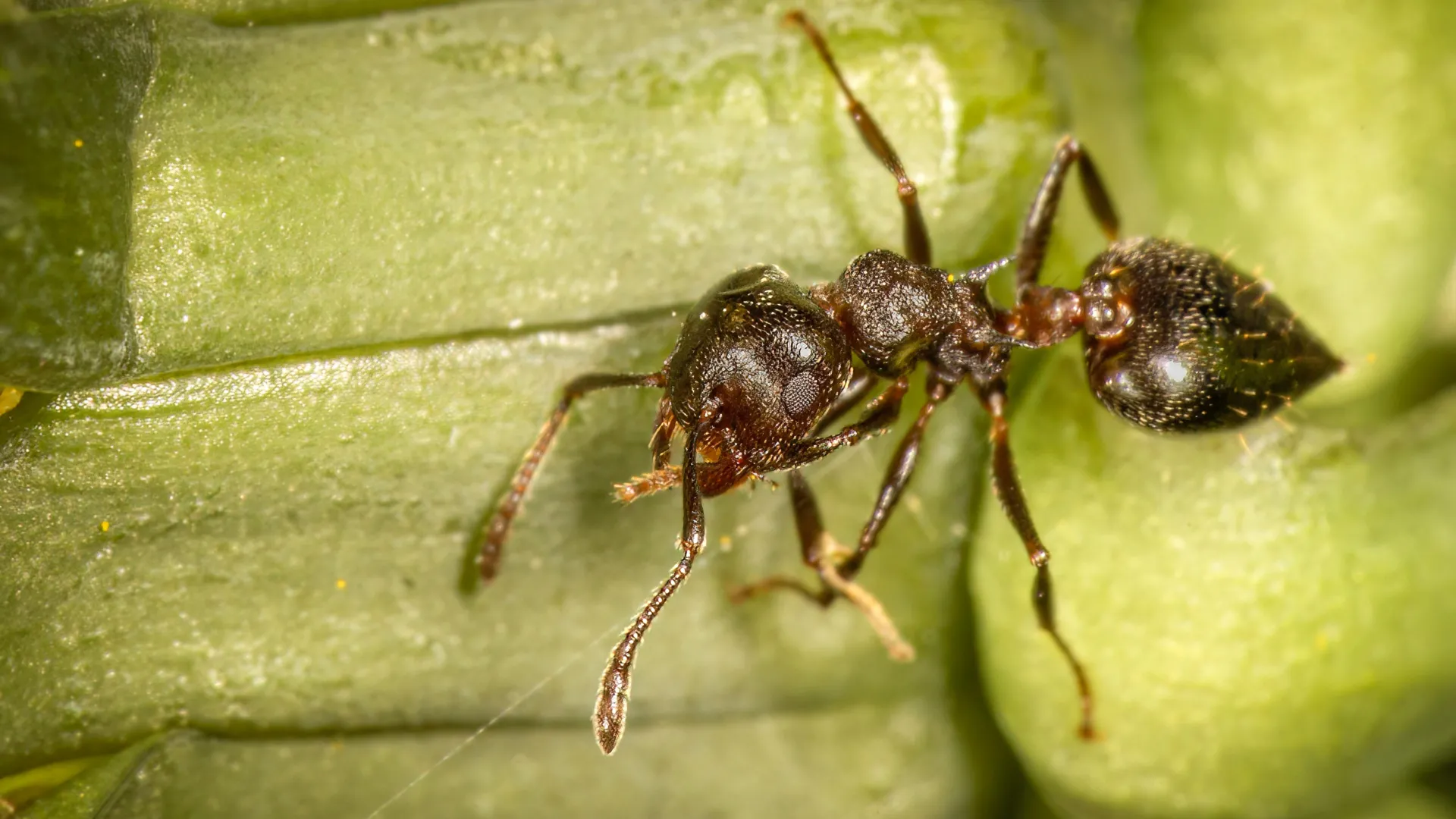
In the lush, verdant canopy of Malaysian Borneo, a silent, microscopic drama is unfolding that threatens to destabilize one of nature’s most enduring biological alliances. For at least 10 million years, the tropical plant Macaranga pearsonii has engaged in a sophisticated evolutionary contract with colonies of protective ants. The plant provides bespoke housing in the form of hollow stems—known as domatia—and a steady supply of nutrient-rich food bodies. In return, the ants act as a relentless security force, patrolling the leaves and aggressively fending off herbivorous insects that would otherwise devour the plant’s foliage.
However, an international team of researchers—comprising experts from Queen Mary University of London, the Royal Botanic Gardens, Kew, and the Biology Center of the Czech Academy of Sciences—has uncovered evidence that this ancient pact is fracturing. In a study recently published in the journal PeerJ, scientists report that predatory wasps are hijacking these specialized plant chambers, effectively repurposing a defensive fortress into a larval nursery. This shift, which appears to be exacerbated by human-driven habitat alteration, suggests that the "subtle" consequences of environmental degradation may be far more complex and damaging than the simple loss of biodiversity.
Chronology of a Displaced Partnership
The discovery began during routine field surveys conducted in the logged forests and sprawling oil palm plantations of Borneo. Lead author Mr. Lestina, who spearheaded the fieldwork, initially noticed an anomaly in the architecture of the Macaranga plants. While surveying the flora, he observed that many of the stems, which should have been bustling with the frenetic activity of resident ant colonies, appeared hollowed out in a distinct, unconventional manner.
Upon dissecting these stems, the research team made a startling find: the cavities were not occupied by the expected ant defenders, but were instead packed with the paralyzed bodies of flies—a larder for predatory wasp larvae. The wasps were utilizing the plant’s evolutionary investment as a storage unit for their own offspring.
This observation marks a significant departure from the established ecological norm. Historically, the Macaranga-ant relationship has been a benchmark for mutualism, a biological "win-win" scenario. By converting these homes into wasp nurseries, the invaders are not merely occupying space; they are actively disrupting the protective infrastructure of the plant. The data indicates that this phenomenon is not isolated. Instead, it follows a clear spatial pattern linked to the intensity of human land use: the more degraded the environment, the higher the frequency of wasp occupation.
Supporting Data: The Impact of Disturbance
The researchers quantified the extent of this disruption by comparing Macaranga specimens across a spectrum of human-altered landscapes. Their findings present a compelling correlation between human activity and the collapse of the ant-plant partnership.
The Plantation Effect
Plants situated within oil palm plantations—monoculture environments characterized by low structural complexity and high chemical usage—showed significantly higher rates of wasp infestation compared to those in logged forests. This suggests that the wasps are not only opportunistic but are actively thriving in environments where the natural ecological checks and balances have been stripped away.
Ant Colony Suppression
The presence of wasps was inversely proportional to the health and size of the resident ant colonies. In stems where wasps had established nurseries, ant populations were consistently smaller or entirely absent. While the researchers caution that longitudinal experiments are required to establish a direct causal link, the data strongly suggests that the wasps are effectively displacing the ants. The wasps are not just coexisting; they are replacing the plant’s primary defense system with a neutral or potentially parasitic occupant.
The Role of Macaranga as a Pioneer
The ecological stakes are heightened by the role Macaranga plays in forest succession. As a pioneer species, Macaranga is often among the first to colonize areas after clearing or logging. They are the "rebuilders" of the rainforest. If these plants are robbed of their ant bodyguards, their vulnerability to herbivory increases significantly. A weakened Macaranga population could face higher mortality rates, slower growth, and reduced reproductive success, ultimately stalling the natural regeneration of the forest.
Official Perspectives: The Evolutionary Consequences
The implications of these findings extend far beyond the specific interaction between one wasp species and one plant genus. The research team, led by senior author Dr. Fayle, views this as a sentinel event—a warning of how ecosystems shift under pressure.
"When mutualistic benefits break down, it can drive long-term evolutionary change," Dr. Fayle noted in a post-publication briefing. "If these structures become less valuable to the plants because wasps exploit them, the plants may stop investing in them. These subtle, long-term consequences of human activity are far less understood than straightforward biodiversity loss."
Dr. Kalsum M. Yusah, a co-author of the study, emphasized the inevitability of these shifts in the Anthropocene. "Human activities are transforming habitats worldwide, and this kind of shift in species interactions is exactly what we expect to see. We don’t yet know whether this wasp is native or introduced, but its spread is clearly linked to disturbed landscapes."
According to the team, the danger lies in the "destabilization of partnerships." Even if the species involved are native to the region, the disruption of the "service contract" between the plant and the ant creates a ripple effect. If plants like Macaranga are forced to divert energy away from ant-nurturing traits, or if they suffer from unchecked herbivory, the competitive landscape of the tropical forest could shift entirely, favoring species that are less dependent on complex inter-species relationships.
Implications for Global Ecosystems
The Macaranga study serves as a microcosmic look at the silent unraveling of tropical ecosystems. Tropical rainforests are defined by their complexity; they are built upon a foundation of thousands of tightly interwoven partnerships, from pollination networks to soil-fungi symbioses.
The Threat of "New Invaders"
The study highlights that habitat disturbance creates "ecological vacuums." When humans alter the landscape, the original inhabitants (the ants) may struggle to maintain their territories, leaving an opening for other species (the wasps) that may be better adapted to the new, fragmented environment. This is not necessarily an invasion of an alien species, but rather a "functional invasion" where a native species exploits a niche created by human-induced stress.
The Loss of Defensive Resilience
If the ant defenders are replaced by wasp nurseries, the plants lose their primary immune system. Without the aggressive, patrolling ants, Macaranga leaves are susceptible to a wide array of leaf-eating insects. This increased herbivory can lead to a decline in plant biomass, which in turn reduces the plant’s ability to fix carbon, provide shade, and serve as a habitat for other forest-dwelling species.
The "Slow Burn" of Biodiversity Loss
Most conservation efforts focus on species counts—how many species are present or how many have gone extinct. However, the PeerJ study argues for a focus on "interaction diversity." The loss of an interaction—the breakdown of a partnership—is a precursor to the loss of the species themselves. By the time a species disappears, the ecosystem may have already been rendered non-functional by the loss of the relationships that held it together.
Conclusion: A Warning from the Hollow Stem
The hollow stems of the Macaranga tree are, in a sense, a laboratory for the future of tropical ecology. The fact that an ancient, ten-million-year-old alliance is fraying within the span of a few years or decades due to human-led landscape change is a sobering indicator of the pace of environmental shift.
As the global community continues to debate the best strategies for forest conservation and reforestation, the findings from Borneo suggest that we must look beyond mere reforestation statistics. We must consider the "connectivity" of the forest. Restoring a forest is not merely about planting trees; it is about restoring the conditions that allow for the re-establishment of the intricate, multi-million-year-old partnerships that make those trees viable.
The disruption of the Macaranga-ant relationship may be a "subtle" sign, but in the intricate architecture of the rainforest, subtle shifts are the precursors to systemic collapse. Whether these wasps will eventually be checked by their own natural predators, or whether they will permanently displace the ants and permanently alter the forest’s trajectory, remains an open question. For now, the hollow stems of Borneo stand as a quiet, urgent reminder that when we disturb the landscape, we do not just displace species—we unmake the very systems that have allowed life to thrive for millennia.