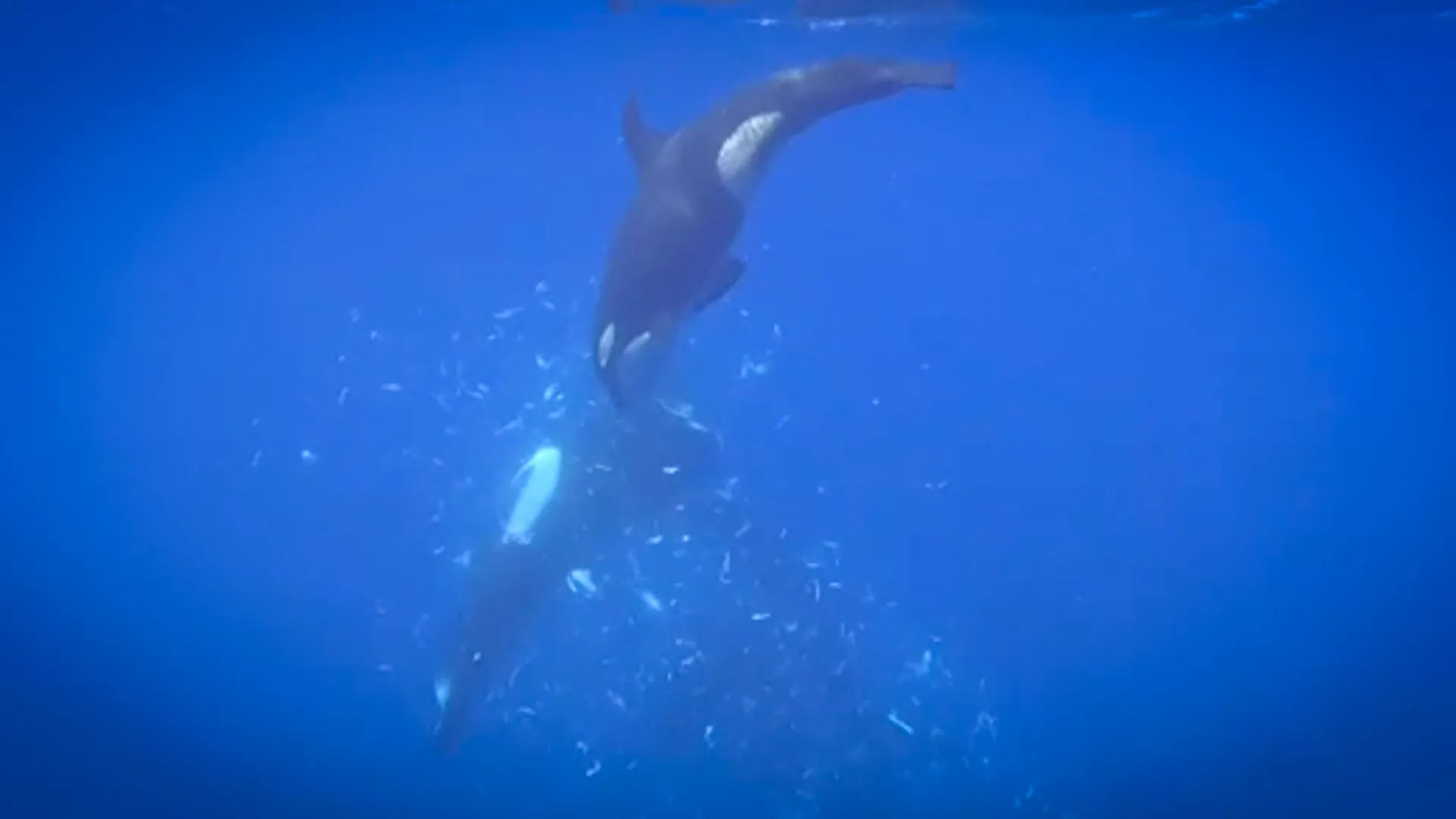
In the vast, blue expanse of the Gulf of California, a sophisticated display of marine intelligence has been captured on camera, offering a rare glimpse into the behavioral evolution of Orcinus orca. Researchers have formally documented a previously unknown hunting and processing technique: the systematic "shattering" of sharp-tail sunfish. By utilizing a high-speed ramming maneuver, these apex predators are not merely hunting—they are demonstrating an advanced method of food processing that challenges our current understanding of cetacean social learning and dietary habits.
The Mechanics of a High-Speed Hunt
The behavior, recently detailed in the journal Frontiers in Ethology, centers on a coordinated "hold-and-strike" maneuver. As observed by Dr. Kathryn Ayres, a lead scientist at the ocean conservation non-profit Beneath The Waves, and her colleagues, the process involves two orcas working in tandem.
One individual secures the sunfish by its robust tail fin, acting as a stable anchor. Simultaneously, a second orca accelerates, charging toward the prey at high velocity. In a precise, split-second release, the first orca lets go of the sunfish just moments before the charging individual delivers a high-impact strike. The resulting collision is catastrophic for the prey; the gelatinous tissue of the sunfish disintegrates into thousands of fragments, which then disperse throughout the water column.
"We document how one orca holds the sunfish and lets go just before another orca hits it at high speed, causing the tissue to break apart into thousands of pieces," explains Dr. Ayres. This is more than mere aggression; it is a calculated manipulation of the environment and the prey to achieve a specific nutritional outcome.
Chronology of a Scientific Discovery
The documentation of this behavior is the result of two distinct field events separated by more than a year, underscoring the potential that this is a learned, cultural tradition within specific orca pods rather than an accidental anomaly.
The July 2024 Encounter
The initial observation occurred in July 2024. Dr. Ayres and her team were tracking a pod of orcas in the Gulf of California. During this observation, the researchers witnessed a group—which included a juvenile member—interacting with a sharp-tail sunfish that had already been incapacitated. A female adult held the carcass steady by its caudal fin, providing a stationary target for a male member of the pod. The subsequent collision pulverized the fish, allowing the juvenile to feed on the smaller, bite-sized fragments while the adults consumed the larger remaining portions.
The September 2025 Confirmation
The validity of the behavior as a repeatable strategy was confirmed in September 2025, when cinematographer Héctor Franz captured high-definition footage of an identical sequence. From the gripping of the tail to the high-speed ramming and the subsequent feeding of younger pod members, the sequence was remarkably consistent, suggesting that the technique is a well-integrated component of the local orca population’s predatory repertoire.
Supporting Data: The Anatomy of the Sunfish
To understand why orcas would go to such lengths to fragment their prey, one must look at the unique biology of the sunfish. Sharp-tail sunfish are behemoths of the pelagic zone, capable of exceeding three meters in length and weighing upwards of 2,000 kilograms. They are often found drifting at the surface, where they bask or allow parasites to be removed by smaller fish—a habit that inadvertently makes them vulnerable to surface-hunting predators.
The sunfish possesses a thick, gelatinous outer layer known as a "capsule." This layer, along with the creature’s skin, hosts a complex and distinct microbiome. When the orcas perform their "shattering" maneuver, they are essentially aerosolizing this biological material. Researchers hypothesize that this act of fragmentation may serve several purposes:
- Nutritional Accessibility: By breaking the tough, gelatinous structure into smaller pieces, the orcas make the internal tissues more accessible, particularly for younger, less experienced hunters who may struggle to tear through the thick skin of an intact sunfish.
- Microbial Exchange: The researchers suggest that the scattering of microbial taxa into the water column could have nutritional or immunological implications. Exposure to the specific microbiome of the sunfish during the feeding process might provide orcas with beneficial bacteria or immune-modulating agents, though further study is required to confirm this hypothesis.
- Social Facilitation: The act of processing prey in a way that allows smaller orcas to feed easily is a classic example of parental investment. Orcas are known for their strong social bonds, and this behavior likely reinforces those bonds while ensuring the survival and growth of the next generation.
Official Responses and Expert Interpretation
The scientific community has greeted these findings with significant interest, noting that "ramming" as a predatory strategy has rarely been formally categorized in cetacean literature. Dr. Ayres notes that while orcas are famous for their playfulness—often tossing prey into the air or carrying it for long distances—this behavior appears to be specifically aimed at food processing rather than play alone.
"Orcas often tear apart prey and share it with other members of the group, including calves and juveniles," says Dr. Ayres. "However, feeding may not have been the only purpose. The interactions could also have had a social function, or the orcas may simply have been playing."
The ambiguity between "play" and "utility" is a hallmark of orca intelligence. In many documented instances, the lines between learning to hunt, bonding through play, and efficient consumption are blurred. For the orcas of the Gulf of California, the sharp-tail sunfish serves as both a primary food source and a canvas upon which they demonstrate their sophisticated social structure.
Implications for Marine Biology
The documentation of this behavior raises several questions regarding the cultural transmission of knowledge among orcas. If this is a learned behavior, it suggests that the orcas in the Gulf of California possess a "technological" culture—a set of skills passed down through generations that allows them to exploit resources in ways that other populations cannot.
The Mystery of the Sharp-Tail Sunfish
Interestingly, this specific method of fragmentation has only been observed with sharp-tail sunfish. Researchers suspect that the specific physical properties of the sharp-tail’s tissue make it uniquely susceptible to this type of impact. Larger, more robust sunfish species might not yield the same "shattering" effect under similar conditions, implying that the orcas have adapted their strategy to the specific physical characteristics of their chosen prey.
Future Research Directions
The primary challenge moving forward is identification. To determine if this behavior is a widespread cultural practice or a skill held by a select group of individuals, researchers require higher-quality photographic evidence. Clear shots of dorsal fins and eye patches are essential to identify individual orcas. By tracking which individuals engage in the "shattering" maneuver, scientists can begin to build a map of how this knowledge travels through the pod.
"Collecting good identification photographs whenever possible is key," concludes Dr. Ayres. "We are still seeing new techniques of how orcas hunt and process their prey. They’re one of the most iconic marine predators in the world, yet they continue to surprise us."
Conclusion
The orcas of the Gulf of California continue to defy simple categorization. By transforming a massive, gelatinous sunfish into a manageable meal through the use of high-speed kinetic force, these predators have proven once again that their survival is not just a matter of strength, but of ingenuity. As researchers continue to analyze the footage from 2024 and 2025, the scientific community is reminded that the ocean remains the final frontier of discovery. Every dive, every observation, and every frame of video brings us closer to understanding the complex,, and often surprising, lives of one of the planet’s most formidable apex predators.
As the study of these marine mammals evolves, it is clear that our understanding of their intelligence is only in its infancy. With each new discovery, the "shattered" remnants of a sunfish serve as a poignant reminder of the intricate, violent, and deeply social world beneath the waves.