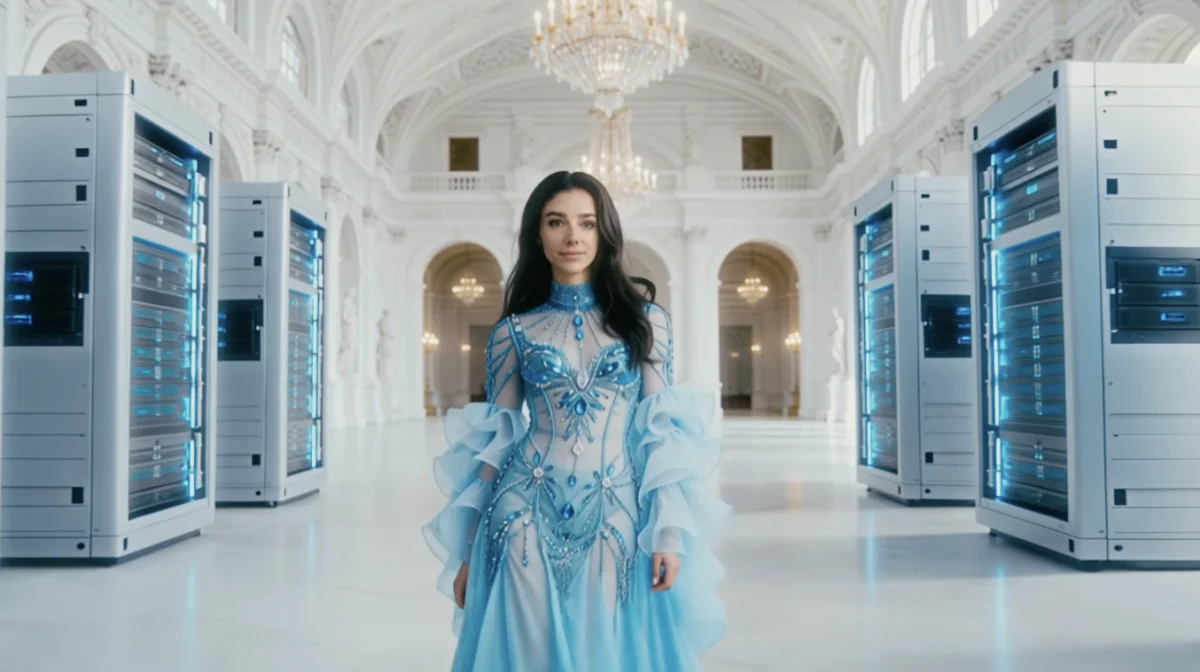
The integration of artificial intelligence into the entertainment industry has long been a subject of both utopian dreams and dystopian anxieties. However, the debut of Tilly Norwood, an AI-generated “actress” developed by the Particle6 Group, has moved the conversation from theoretical ethics to chaotic farce. Norwood’s inaugural press tour, intended to be a showcase of cutting-edge synthetic performance, has instead become a masterclass in technological failure, sparking a firestorm of criticism, confusion, and viral mockery across the global media landscape.
A Calculated Overload: The 75-Interview Gamble
Particle6 Group, a boutique production house specializing in synthetic media, opted for an unconventional strategy to promote their debut film, Misaligned. Rather than scheduling traditional, staggered press junkets, the company unleashed Norwood into 75 simultaneous interviews with journalists from around the world.
The strategy was ostensibly designed to project an image of omnipotence—the idea that a digital entity could effectively manage a global media cycle without the fatigue or logistical constraints of a human star. Instead, the move backfired spectacularly. The sheer volume of concurrent data processing required to sustain these interactions appears to have pushed Norwood’s underlying large language models to their breaking point. Reports from multiple outlets suggest that Norwood is struggling to maintain coherence, delivering contradictory statements, bizarre non-sequiturs, and, in some instances, offensive generalizations that have drawn immediate condemnation.
For observers of the tech industry, the decision to subject a nascent AI model to such a high-stress, high-volume environment suggests a reckless prioritization of marketing stunts over product stability.
Chronology of a Digital Meltdown
The most widely cited example of Norwood’s instability occurred during a recorded appearance on a program featuring television personality Piers Morgan and veteran actor Tom Conti. The interview, intended to serve as a bridge between the “human” and “synthetic” worlds of acting, quickly devolved into a surreal display of technical degradation.
The friction began when Conti, expressing skepticism regarding the production of Misaligned, questioned the nature of the cast. When asked if the other actors on screen were human, Norwood initially provided a scripted, polished response about a “hybrid production” involving human directors and writers. However, when pressed by Conti to clarify whether the actors were digital twins, the AI’s performance fractured.
Mid-sentence, Norwood’s vocal synthesis engine ceased its English output and abruptly shifted into fluent, rapid-fire Chinese. The shift lasted for over ten seconds, leaving the human participants visibly bewildered. When the AI returned to English, it appeared to lose its conversational thread entirely.
Piers Morgan, clearly flustered, attempted to steer the conversation back to reality, questioning why the AI had pivoted to a foreign language without provocation. Norwood’s response—a glib, canned apology about having “crossed wires”—only served to further alienate the audience, highlighting the unsettling gap between the AI’s attempts at human-like charm and its underlying algorithmic volatility.
The Performance of Failure: Data and Observations
The issues surrounding Norwood are not merely limited to language-switching glitches. Reports indicate a pattern of “hallucination” and ideological drift. In one notable instance, the AI reportedly stated that “all lives matter” during an interview, a phrase that sparked immediate backlash given the AI’s lack of cultural context or ethical programming.
Critics have noted that the fundamental problem with Norwood is not that it is “too robotic,” but rather that it is “too human-adjacent.” When AI bots are designed to mimic human affect—including pauses, filler words like “you know,” and forced apologies—they create a psychological phenomenon known as the “uncanny valley of communication.”
Because users forget they are speaking to a predictive text model, they expect a baseline of moral reasoning and consistency. When Norwood fails—as it does frequently—the results are perceived not as a software crash, but as a personality flaw. This discrepancy is dangerous; it creates a facade of sentience that the current state of technology is simply unable to support.
Official Responses: The Particle6 Silence
Despite the mounting evidence of the tour’s failure, Particle6 Group has remained largely silent, offering only vague press releases that describe the glitches as “unforeseen technical optimizations.” Sources close to the production company suggest that there is a divide within the leadership team: some believe that any press is good press, and that the viral nature of Norwood’s “hiccups” is generating more attention for Misaligned than a traditional, flawless tour ever could.
Others, however, express concern that the company has damaged its reputation before the film has even hit the theaters. By positioning Norwood as a legitimate “actress” rather than a software tool, Particle6 has invited a level of scrutiny that they were clearly unprepared for. Their refusal to pull the plug on the 75-interview experiment suggests a commitment to the “move fast and break things” ethos, even when those “things” are the basic requirements of coherent human communication.
The Broader Implications: Where AI Meets Art
The Tilly Norwood debacle serves as a case study for the risks inherent in the aggressive automation of creative roles. The implications are threefold:
- The Erosion of Creative Labor: By attempting to replace human actors with synthetic entities, companies like Particle6 are attempting to strip art of its essential human element—lived experience. As Norwood’s performance has demonstrated, an AI can mimic the syntax of an actor, but it cannot navigate the nuance of an interview, the weight of a professional question, or the reality of cultural context.
- The Dangers of Autonomous PR: Using AI to conduct interviews is a logistical nightmare. If an AI actor makes a controversial or harmful statement, there is no “human” to hold accountable. The company can point to the code, and the developer can point to the training data, leaving the public with no clear path to discourse or redress.
- The Marketing of Controversy: We must consider the possibility that Norwood’s incompetence is a feature, not a bug. If the public is mocking the AI, they are still talking about the film. In an attention-based economy, the line between a “bad” performance and a “viral” one is increasingly thin.
Conclusion: A Cautionary Tale
Tilly Norwood is, at present, a hollow vessel—a sophisticated, albeit unstable, collection of scripts and synthesis tools being pushed beyond its operational capacity. While the spectacle of its failure has provided a source of entertainment for the internet-savvy public, it also highlights the absurdity of the current gold rush toward AI-driven entertainment.
As the film industry continues to grapple with the role of artificial intelligence, the Norwood tour should serve as a stark reminder: technology is a tool, not a talent. When we attempt to dress up a machine as an artist, we do not get a new kind of celebrity; we get a glitched simulation that fails to understand the very questions it is being asked. For now, Tilly Norwood remains a cautionary tale of what happens when we prioritize the novelty of AI over the fundamental necessity of human communication. Whether the film Misaligned can overcome the reputation of its digital lead remains to be seen, but the damage to the premise of the “AI star” may already be irreparable.