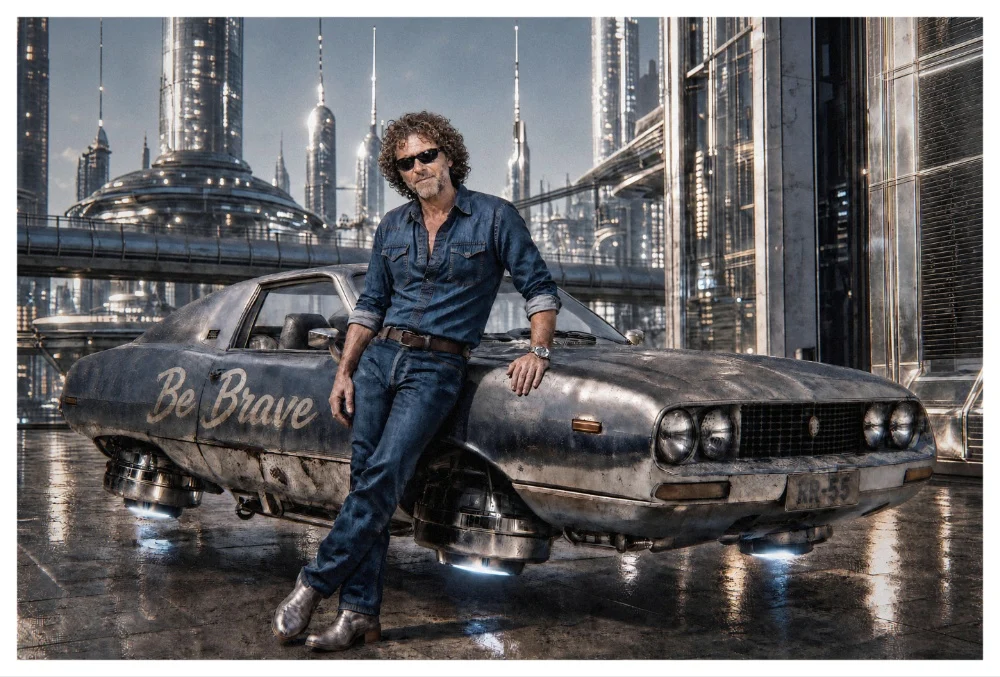
As the film industry grapples with the existential implications of artificial intelligence, Italian director Francesco Carrozzini is stepping onto the Lido at the Venice Film Festival with a project that is as much a technical manifesto as it is a cinematic biography. His latest feature, Be Brave, is an 85-minute portrait of Renzo Rosso, the legendary founder of the Diesel fashion empire. However, the film distinguishes itself from traditional biographical documentaries by a striking departure: the director did not capture a single frame of his subject. Instead, Carrozzini has utilized cutting-edge AI to reconstruct the visionary entrepreneur across various stages of his life.
The project, which has been selected as one of the first AI-driven features to debut at a top-tier international film festival, stands as a testament to the evolving intersection of technology and human storytelling.
The Genesis of Be Brave
The journey of Be Brave began not with a desire to experiment with software, but with a challenge of necessity. Producer Lorenzo Mieli approached Carrozzini with the prospect of documenting Rosso’s life—a narrative arc that spans from humble beginnings in poverty to the helm of a global fashion empire. Initially, Carrozzini was hesitant. Having moved away from the fashion world—a sphere he knew intimately, having directed Franca: Chaos and Creation, the acclaimed documentary about his mother, the late Vogue Italia editor Franca Sozzani—he was focused on narrative film and television.
However, the production constraints became the catalyst for innovation. "There is a lot of archival TV footage of Renzo Rosso, but there are no good interviews, no intimate moments," Carrozzini explained. The team realized they were lacking the visual depth required for a compelling portrait. To solve this, they turned to AI, not merely as a production shortcut, but as a core thematic device. By scripting the film and utilizing AI to fill the gaps in the visual record, the team transformed the lack of archival material into a meta-commentary on how we construct memories and legacies.
Chronology of an AI-Driven Production
The creation of Be Brave was a eighteen-month odyssey characterized by extreme technical volatility. Carrozzini notes that the pace of AI development was so rapid that segments of the film required constant re-rendering. "In the year-and-a-half that we spent making Be Brave, AI changed to a point where what we were doing in the beginning had to be redone," he admits.
The Workflow of Innovation
The technical pipeline was a "nightmare" of trial and error. The process required a sophisticated infrastructure, with the firm Blackstone providing significant support and AI artist Roberto Beragnoli handling the technical heavy lifting. The workflow was categorized into three primary hurdles:
- Visual Reconstruction: The team fed historical images of Rosso into the system, instructing the AI to animate him, change his age, and ensure he spoke the scripted dialogue with precise lip-syncing.
- Behavioral Mimicry: According to Carrozzini, voice and image quality were manageable, but "behavior" was the primary bottleneck. Capturing the specific, nuanced movements of a human being—the way they lean in, the subtle shifts in posture—was the most daunting task for the AI to replicate.
- The Upscaling Challenge: AI tools often operate at low resolution. To make the film viable for a theater screen, every frame had to be meticulously upscaled and color-graded, essentially treating the documentary with the same heavy post-production rigor as a major CGI-laden feature film.
Supporting Data: Beyond the Talking Head
While the film is famous for its AI-generated protagonist, it is not an entirely synthetic creation. Carrozzini maintained a tether to reality by including interviews with real-world figures—traditional "talking heads"—to ground the narrative. This hybrid approach allows the film to oscillate between the "truth" of human witness and the "re-creation" of historical scenes.
The film follows a scripted narrative where Carrozzini appears on screen—also rendered via AI—as an interviewer "chasing" a version of Rosso who seems to be evading him. This device, familiar to documentary buffs, is repurposed here to explore the tension between the filmmaker and his digital subject. As Carrozzini put it, "This film is not a thesis on AI. The only thing that is said toward the end—which I think is really important—is that the human has to come first."

Official Responses and Festival Reception
The inclusion of Be Brave in the Venice Film Festival marks a significant milestone in the festival’s history. Alberto Barbera, the Artistic Director of the Venice Film Festival, highlighted the project’s significance during his announcement.
"I want to put this film forward as an invitation for everyone to think about how AI as a tool can open up new creative possibilities for filmmakers," Barbera stated. By providing a platform for Be Brave, the festival is signaling that the industry is ready to confront the ethics and aesthetics of synthetic media. Produced by the Rome-based Our Films (a Mediawan company), the project is being viewed by industry insiders as a "proof of concept" for the future of non-fiction.
The Philosophical Implications of Synthetic Cinema
The central debate surrounding Be Brave is whether the audience can—or should—distinguish between the real and the synthetic. Carrozzini argues that the "seams" in the technology are less important than the emotional resonance of the story.
The Empathy Gap
Critics of AI in film often point to the "empathy gap"—the fear that once an audience knows a performance is generated by an algorithm, the human connection to the character will evaporate. Carrozzini acknowledges this, noting that he would be reluctant to use AI for a historical drama or a contemporary fiction film featuring actors, as the lack of a "human soul" would likely derail the audience’s suspension of disbelief.
"The empathy you talk about, it’s generated by real people doing things that, despite being more or less made up, are still human," he explains. "That emotion is human. That cry is human. That laughter is human."
A New Medium or a Temporary Trend?
Carrozzini is acutely aware that Be Brave may look antiquated by the time it hits wider distribution. "The moment we will be in the theater it will probably be old already," he says with a mix of irony and excitement. However, he views this volatility as part of the creative process. By embracing a medium that is in a constant state of flux, he is positioning himself at the vanguard of a shift that will likely redefine the documentary genre.
The Verdict on Human Authorship
Ultimately, Be Brave asserts that while the tools of creation are shifting, the role of the director remains anchored in human decision-making. From casting the "look" of extras to choosing the pacing of the narrative, the film remains a deeply personal reflection of Carrozzini’s directorial vision. He emphasizes that the AI is merely a tool, similar to the camera or the editing suite, and that the "humanity" of the piece is curated, not generated, by the algorithm.
As Be Brave premieres in Venice, it offers a glimpse into a future where the line between historical record and creative interpretation becomes increasingly porous. Whether it marks the beginning of a new golden age of documentary filmmaking or a cautionary tale about the limits of synthetic storytelling, one thing is clear: the conversation around AI in cinema has officially moved from the theoretical to the visceral. Francesco Carrozzini has ensured that whatever the future holds, the story of Renzo Rosso will be remembered as the first to test the boundaries of this brave new world.