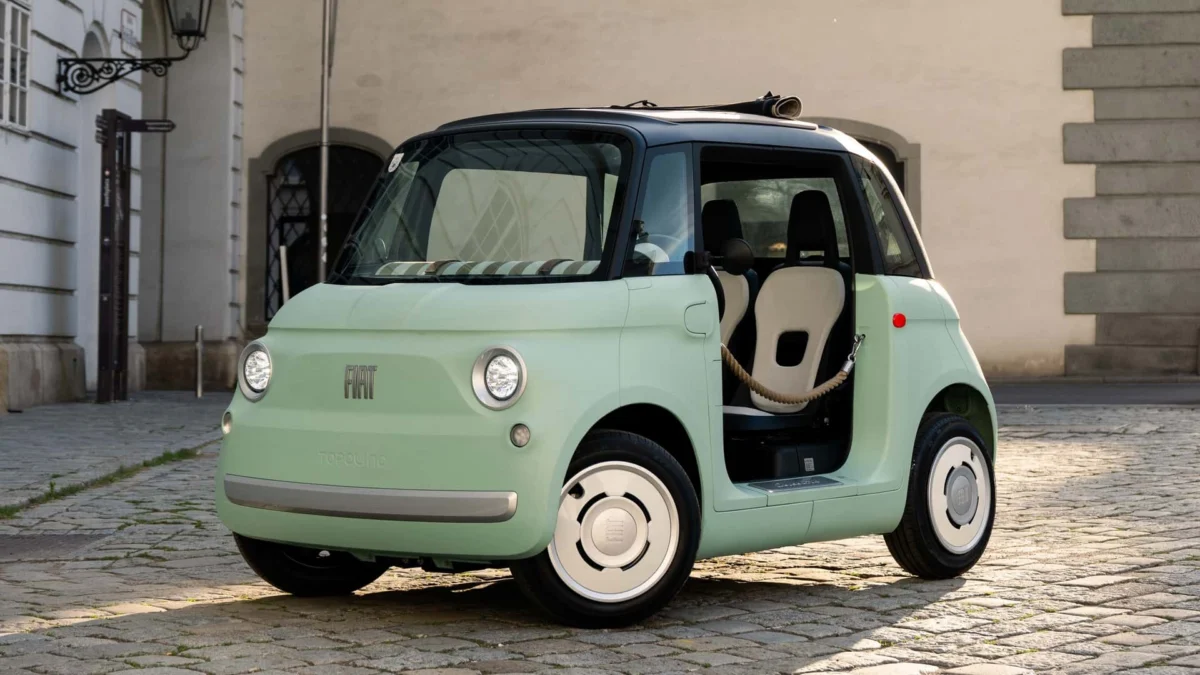
The Fiat Topolino, an icon of Italian charm shrunk down to the dimensions of a micro-mobility solution, has long been viewed as a whimsical curio—a vehicle perfectly at home on the private lanes of a resort or the quiet, sun-drenched streets of a gated community. However, the narrative surrounding this diminutive electric quadricycle is shifting. Fiat has announced a pivotal evolution for the Topolino: an official, no-cost "Street Legal Conversion" kit, set to arrive this fall. This move effectively transitions the Topolino from a glorified golf cart into a federally recognized Low-Speed Vehicle (LSV), opening the door for owners to navigate public thoroughfares with newfound legitimacy.
The Evolution of the "Little Mouse"
The name "Topolino," Italian for "little mouse," is a nod to the original Fiat 500 produced between 1936 and 1955. The modern iteration, which debuted in 2023, was designed as a zero-emissions answer to the claustrophobia of urban commuting. Yet, despite its retro-chic aesthetics and undeniable charisma, its utility was hampered by regulatory limitations.
For many, the Topolino was a "last-mile" solution, restricted to private property or specific low-speed zones. The upcoming conversion kit addresses the primary barrier to entry for the American consumer: legal compliance. By satisfying the requirements for an LSV classification, the Topolino will soon be permitted on public roads with speed limits up to 35 miles per hour, provided the local jurisdiction allows for such vehicles.
Chronology: From Concept to Public Roadway
- May 2023: Fiat introduces the Topolino to the European market, positioning it as an electric mobility solution for younger drivers and urban dwellers.
- Late 2023 – Early 2024: The vehicle generates significant buzz in the United States, with automotive enthusiasts and urban planners alike clamoring for a localized version.
- Summer 2024: Reports emerge confirming Fiat’s intent to bring the micro-vehicle to the North American market, with a price point hovering around $15,000.
- Fall 2024 (Upcoming): Fiat officially announces the rollout of the "Street Legal Conversion" kit, a zero-cost incentive aimed at boosting adoption rates among U.S. buyers.
- 2025/2026 Strategy: Fiat plans to initiate a small-batch launch in the States to test the appetite for the niche vehicle, gauging whether the American market is ready to embrace micro-mobility on a broader scale.
The Technical Specs: What the Conversion Entails
To transform the Topolino from a neighborhood toy into a road-legal machine, the conversion kit focuses on safety and compliance. According to reports from Road & Track, the kit is a comprehensive suite of hardware designed to meet the rigorous (though specialized) standards of Low-Speed Vehicle classification.
While the exact components are being finalized, the kit generally includes enhanced lighting systems (turn signals, brake lights, and reflectors that meet federal requirements), safety-grade glass or reinforced polycarbonate, and the necessary administrative paperwork to secure a VIN (Vehicle Identification Number) for proper registration and insurance.
Performance Constraints
It is essential to manage expectations: the Topolino is not a highway cruiser. It features a top speed of 25 mph. While this is sufficient for quick trips to a local grocer, school drop-offs, or a jaunt to the neighborhood bistro, it is fundamentally incapable of freeway travel. The vehicle serves a specific, limited purpose, and its engineering reflects a philosophy of "slow-living" rather than high-performance transit.
Supporting Data: The Case for Micro-Mobility
The market for vehicles like the Topolino is often dismissed as a niche, yet the data suggests a growing segment of "secondary" vehicle owners. For many households, a primary SUV or sedan is required for long-distance travel, but a micro-EV serves as the "daily errand runner."
- Efficiency: The Topolino draws minimal power, making it incredibly cheap to charge compared to traditional EVs.
- Parking Footprint: At less than 8 feet long, the Topolino can be parked in orientations that traditional vehicles cannot, turning a standard parking space into a multi-car zone.
- Total Cost of Ownership: With a base price of approximately $15,000 and minimal mechanical complexity (fewer moving parts than an internal combustion engine), the maintenance overhead is significantly lower than that of a standard automobile.
Official Responses and Strategic Intent
Fiat’s decision to offer this conversion kit at no cost is a strategic masterstroke. By removing the financial barrier for compliance, Fiat is signaling its commitment to the North American market.
"We recognize that the Topolino is not a replacement for the family car," a Fiat spokesperson noted during a recent briefing. "It is a supplement—a lifestyle choice for those who value efficiency, style, and the sheer joy of driving something that isn’t built to dominate the highway."
Industry analysts at Motor1 have noted that while the initial volume of sales will likely be small, the "cool factor" of the Topolino could create a halo effect for the brand. It positions Fiat as an automaker that is in touch with the evolving needs of urban and suburban environments, where the trend is increasingly moving toward "right-sized" mobility.
Implications for Urban Planning and Daily Life
The arrival of a street-legal, $15,000 Italian micro-car has profound implications for how we view our neighborhoods.
1. Reducing Traffic Congestion
If a significant number of households opt for a Topolino for short-range errands, the number of large-scale SUVs idling in school drop-off lines or grocery store parking lots would decrease. This, in turn, reduces the carbon footprint of the average suburban household.
2. The Golf Course Paradigm
Perhaps the most creative application of the Topolino is its potential as a dual-purpose vehicle. Currently, many golf carts are relegated to the course. The Topolino, once street-legal, becomes a vehicle that can take a golfer from their driveway, onto the local roads, and directly onto the cart path. It eliminates the need for a trailer or a secondary golf cart purchase, blending the lines between recreation and transportation.
3. Safety and Policy
Critics often point to the safety risks of placing small vehicles on roads alongside multi-ton trucks. However, the regulation of LSVs has historically focused on keeping these vehicles on roads with speed limits of 35 mph or lower. As cities increasingly adopt "Vision Zero" policies and lower residential speed limits, the environment becomes naturally safer for the Topolino to coexist with larger traffic.
Final Analysis: Is the Topolino for You?
The Fiat Topolino is not for everyone. If you live in a rural area with 55-mph speed limits or if you have a daily commute involving major highways, the Topolino is entirely impractical. However, for those living in dense urban centers, coastal towns, or planned communities with slower speed limits, it represents a brilliant way to navigate the world.
Fiat is betting that there is a subset of the American public—those with a penchant for European design and a disdain for the wastefulness of massive vehicles—that will find the Topolino irresistible. By offering the conversion kit, they have removed the final hurdle.
The Topolino is more than just a car; it is an experiment in lifestyle. It invites the driver to slow down, enjoy the scenery, and reconsider what is truly necessary for modern transport. For the select few who decide to take the plunge, the "Little Mouse" promises to make every errand, from the school run to the golf course, a little more stylish.
In the words of the Motor1 editorial team: "If a Topolino makes sense in your area, and you can afford to spend $15,000 on an otherwise unnecessary vehicle, we salute your purchase." It is a rare moment in the automotive industry where a brand releases something purely because it is fun, and for that reason alone, the Topolino is a welcome addition to the American road.