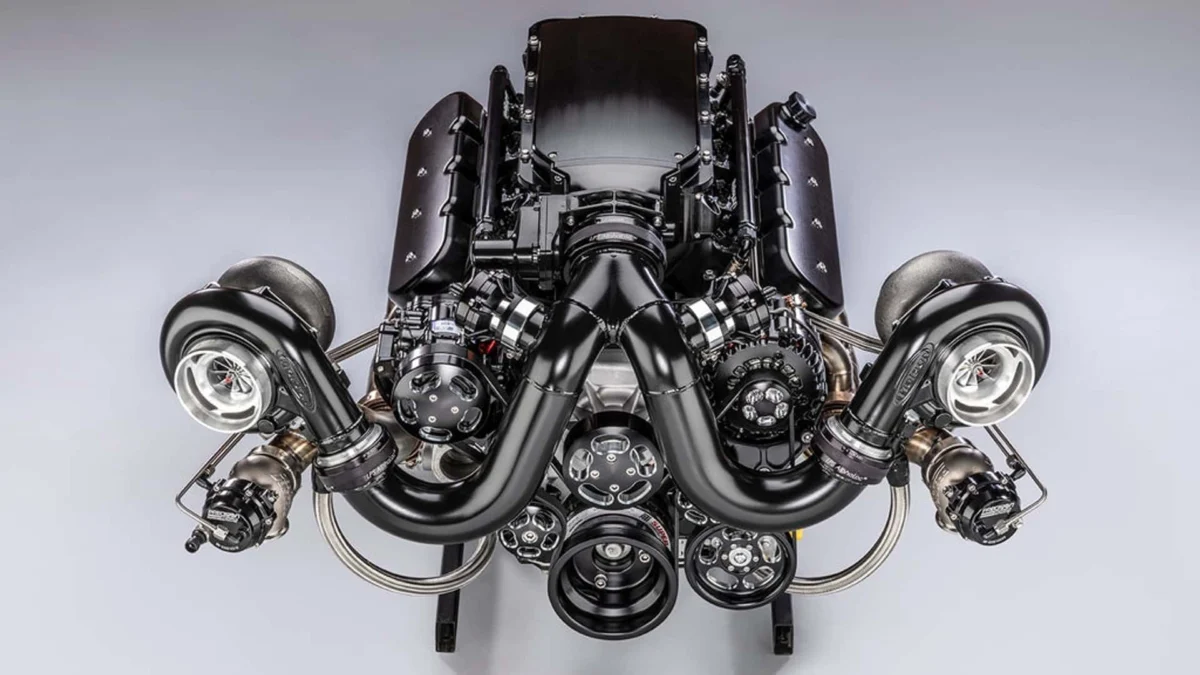
For decades, the pursuit of four-digit horsepower figures in a street-legal vehicle has been synonymous with compromise. Automotive enthusiasts have long accepted the "race-car tax": the necessity of high-octane leaded fuel, a constant stream of teardowns to inspect valvetrains, and the persistent anxiety that a cooling system might fail at the first stoplight. Nelson Racing Engines (NRE) is challenging this paradigm with its latest masterpiece, the Intercooled Outlaw 427. This LS-based, twin-turbocharged powerplant promises to deliver 1,200 horsepower while sipping standard 91-octane pump gas, effectively bridging the gap between a fragile drag-strip prototype and a reliable road-going engine.
The Engineering Philosophy: Performance Without the Pain
The primary barrier to entry for high-horsepower builds has always been detonation. High compression and extreme boost pressures create heat, and heat kills engines. Traditional solutions involve running expensive, hard-to-find race fuel or water-methanol injection systems that require constant monitoring.
Nelson Racing Engines, led by the legendary Tom Nelson, has spent years refining a forced-induction philosophy that prioritizes thermal management and robust architecture. The Outlaw 427 is not merely a high-performance engine; it is a holistic solution for the project car builder who wants to turn the key and drive 500 miles, only to arrive at the track and dominate the competition without changing the spark plugs.
By utilizing advanced intercooling technology and precise engine management, NRE has managed to extract massive power figures while maintaining a compression ratio of 9.0:1—a sweet spot that allows the engine to remain stable on standard gasoline.
Technical Specifications: The Anatomy of a Beast
At its core, the Outlaw 427 is a masterclass in modern American engine building. While it shares the legendary LS architecture—a platform beloved for its compact packaging and immense potential—the similarities to a factory GM block end almost immediately.
The Foundation
The engine starts with a reinforced aluminum block, specifically chosen for its weight-saving properties and thermal conductivity. To prevent the "lifting" of heads under extreme boost, NRE employs a six-bolt head design. This is a critical upgrade over standard four-bolt setups, providing the clamping force necessary to seal the combustion chambers against the internal pressures generated by the twin turbochargers.
Rotating Assembly
Inside the block, the engine is fortified with a billet crankshaft—a piece of precision engineering that provides the structural integrity required to handle the immense torque output. Forged connecting rods and custom-engineered pistons complete the rotating assembly, ensuring that the engine can safely rev to its 7,200-rpm peak without catastrophic failure.
The Forced Induction Suite
The "Outlaw" moniker is earned by the breathing apparatus bolted to the block. The engine utilizes two of Nelson Racing’s proprietary 72.0-millimeter Mirror Image Generation 2 turbochargers. The term "Mirror Image" is a signature NRE touch; by using reverse-rotation turbos, the piping symmetry is maintained, resulting in a cleaner, more efficient intake and exhaust path. These turbos feature billet compressor wheels, which offer superior strength and lower rotational mass compared to cast alternatives, resulting in quicker boost response and improved longevity.
A Chronology of the Build Process
The acquisition of an Outlaw 427 is an experience tailored to the serious enthusiast. Because these engines are not mass-produced on an assembly line, the process is inherently collaborative and rigorous.
- Consultation and Specification: Every order begins with a consultation. NRE evaluates the vehicle chassis, intended use, and desired power curve to ensure the engine is configured correctly.
- Component Selection and Assembly: The engine is built to order using NRE’s inventory of race-proven internal components. This phase involves meticulous blueprinting, where tolerances are measured to the ten-thousandth of an inch.
- Engine Management Integration: The engine is paired with a sophisticated ECU capable of managing dual-boost strategies, ensuring that the 1,200-hp target is reached smoothly without surging.
- Dyno Certification: Perhaps the most vital step in the chronology is the dyno-testing phase. Every Outlaw 427 is run on an engine dyno at the NRE facility. This is not just a "break-in" run; it is a full-load simulation. NRE technicians push the engine to its limit to verify that the cooling system, fuel delivery, and turbocharger synchronization meet the 1,200-hp mandate on 91-octane fuel.
- Delivery and Tuning Support: Once the engine passes certification, it is crated and shipped to the customer, accompanied by the dyno sheets that serve as the "birth certificate" of the unit.
Supporting Data: Why 1,200 HP?
It is fair to ask: why do we need 1,200 horsepower for a street car? In the context of modern automotive engineering, the answer lies in the "usable power band."

While a 1,200-hp engine can be overwhelming, the NRE approach is about providing massive headroom. When you run an engine at 50% of its total capacity, the internal stress is exponentially lower than when running a 500-hp engine at 100% capacity. By building an engine capable of 1,500 hp (on race fuel) and dialing it back to a "conservative" 1,200 hp (on pump gas), the Outlaw 427 operates well within its mechanical limits.
This strategy pays dividends in maintenance intervals. Valve spring fatigue, rod bearing wear, and oil degradation are all slowed significantly when the engine isn’t constantly straining to meet its performance goals.
Official Stance and Market Position
Nelson Racing Engines does not market the Outlaw 427 as a budget-friendly crate engine. With a starting price of $41,999, it occupies the upper echelon of the aftermarket industry. The pricing reflects not only the high-end materials—billet cranks, forged pistons, and custom turbos—but also the hundreds of hours of R&D and the individual attention paid to each unit by NRE’s master technicians.
In response to inquiries regarding the longevity of such a high-output machine, Tom Nelson has frequently noted that his engines are designed for the "driver," not just the "trailer queen." The integration of sophisticated blow-off valves and upgraded wastegates ensures that the boost pressure is not just high, but stable, preventing the violent spikes that typically shatter gearboxes and drivetrain components.
Implications for the Future of Hot Rodding
The existence of the Intercooled Outlaw 427 signals a shift in the hobby. For years, the "big power" segment of the industry was divided between those who spent their weekends fixing their cars and those who hired professional race teams to manage their vehicles. NRE is creating a third category: the high-performance enthusiast who demands hypercar-level output with the reliability of a modern production vehicle.
This development has profound implications for the custom car market. Builders no longer need to worry about the logistical nightmare of sourcing high-octane fuel for long-distance road rallies or the risk of engine failure while miles away from a shop.
Furthermore, the success of this platform may encourage other manufacturers to focus on "pump-gas-friendly" forced induction. As internal combustion engines face increasing pressure from electrification, the engineering focus is moving toward maximizing the efficiency and power density of every drop of gasoline. The Outlaw 427 is a potent reminder that, when engineered correctly, the internal combustion engine is still a long way from being obsolete.
Conclusion: A New Benchmark
Whether the Outlaw 427 finds its home in a 1969 Camaro, a modern Pro-Touring build, or a custom one-off chassis, it brings with it a level of authority that is difficult to ignore. It is not just an engine; it is a testament to the fact that with enough engineering ingenuity, the rules of the road—and the racetrack—can be rewritten.
While the $41,999 price tag will keep it out of reach for the casual builder, for those looking to build the ultimate, "do-it-all" machine, it represents a definitive solution. In the world of high-performance automotive building, Nelson Racing Engines has not only raised the bar—they have moved it to a different zip code. For the enthusiast who wants the best, the most powerful, and the most reliable, the choice has never been clearer.