For generations, automotive enthusiasts have clung to the romanticized notion that older vehicles—heavy, steel-clad, and utilitarian—are inherently safer than their modern, plastic-heavy counterparts. The mantra that cars were "built like tanks" in the 1990s has persisted, often cited as a reason to eschew the complexities of modern engineering. However, a landmark demonstration conducted by the Insurance Institute for Highway Safety (IIHS) has effectively dismantled this long-standing myth, providing a visceral, high-speed reality check that illustrates the staggering evolution of automotive occupant protection.
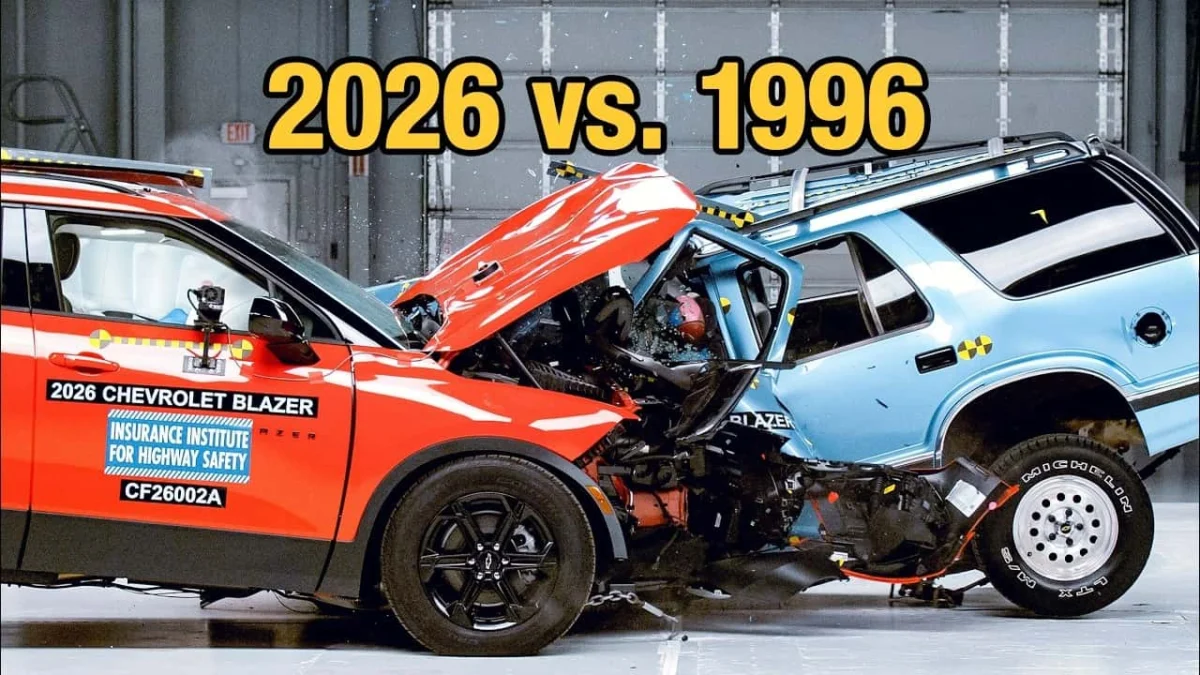
To commemorate three decades of rigorous safety advocacy and testing, the IIHS orchestrated a head-on collision between a 1996 Chevrolet Blazer and its 2026 successor. The results were not merely a win for modern engineering; they were a profound indictment of the past.
The Evolution of the Safety Paradigm
Vehicle safety has undergone a tectonic shift since the mid-1990s. Thirty years ago, safety was largely a reactive discipline, centered on seatbelts, basic airbags, and the structural integrity of the frame. Today, the landscape is defined by "active safety"—a preemptive suite of technologies including automatic emergency braking (AEB), lane-keeping assist, and sophisticated driver monitoring systems designed to neutralize human error before a crash occurs.
According to data from the National Highway Traffic Safety Administration (NHTSA), the per-capita U.S. road fatality rate has trended downward in over 20 of the last 30 years. This statistical success story is a direct byproduct of collaborative efforts between regulatory bodies, automakers, and independent testing agencies like the IIHS. Yet, this progress faces a contemporary challenge: an alarming surge in pedestrian fatalities since 2010. Experts increasingly point to the rising popularity of larger, heavier, and higher-riding trucks and SUVs, which have altered the kinetic landscape of our roadways.
Chronology of the Collision: A Tale of Two Blazers
To highlight the technological chasm between 1996 and 2026, the IIHS staged a moderate-overlap frontal crash test. In this scenario, both vehicles were propelled toward each other at approximately 40 miles per hour, meeting head-on with a 40% frontal overlap. While the physics of the impact were balanced, the biological outcomes for the occupants were vastly different.
The 1996 Blazer: A Structural Failure
The footage from the 1996 Blazer is, by any standard, chilling. Upon impact, the vehicle’s structural integrity immediately faltered. The cabin, lacking the sophisticated load-path management of modern designs, began to deform violently. The roof buckled, and the driver’s door crumpled inward like a soft-drink can.
Inside, the horror intensified. The steering column and dashboard surged toward the driver, effectively erasing the survival space of the cockpit. The driver was subjected to a brutal secondary impact, slamming into the dashboard and seat. IIHS experts concluded that in this scenario, the driver would have suffered "serious, potentially fatal injuries." The "tank-like" metal body did not protect the occupant; it merely became a tomb.
The 2026 Blazer: The Triumph of Crumple Zones
In stark contrast, the 2026 Chevrolet Blazer performed exactly as modern engineering intended. As the front end made contact, the vehicle’s meticulously designed crumple zones engaged, absorbing the kinetic energy of the crash and channeling it around the passenger compartment rather than through it.
The structural rigidity of the 2026 cabin remained largely intact. The driver’s door could be opened with minimal effort following the collision, suggesting that the vehicle maintained enough integrity to allow for emergency extraction. The dashboard and steering column did not intrude into the occupant’s space. According to the IIHS, the driver in the 2026 model would likely have "walked away with bumps and bruises."
Supporting Data and the "Modern Car" Reality
This demonstration echoes a famous 2009 experiment where the IIHS crashed a 1959 Chevrolet Bel Air into a 2009 Malibu. However, the 1996-vs.-2026 comparison feels significantly more poignant because it hits closer to home.
The average age of vehicles on American roads is currently nearly 13 years, with millions of older, less safe vehicles still serving as daily drivers. Many consumers operate vehicles from the late 1990s or early 2000s under the impression that they are safe enough. This IIHS test serves as a sobering reminder that a car’s "heaviness" is a poor substitute for structural design.
In 1995, when the IIHS began its independent crash testing program, the industry was a different place. Automakers were often resistant to stricter safety standards, viewing them as costly obstacles to production. Over the last 30 years, the IIHS has successfully shifted the competitive landscape, turning safety ratings into a marketable commodity. When a car earns an "IIHS Top Safety Pick," it is no longer just a regulatory badge; it is a key selling point that consumers now demand.
Official Responses and the Legacy of IIHS
The IIHS estimates that the safety advances driven by its testing protocols have saved nearly 50,000 lives since its inception. This is not merely an estimate; it is a testament to the influence of data-driven policy.
"These results highlight the role of IIHS ratings in driving many of the key vehicle safety improvements of the past 30 years," said Joe Nolan, the organization’s chief operating officer. "The difference between the two vehicles could not be clearer. We are not just talking about incremental improvements; we are talking about the difference between a trip to the hospital and a trip to the morgue."
Nolan and his team emphasize that while the hardware—airbags, side-impact protection, and seatbelt pre-tensioners—has improved, the software and sensing technology now represent the final frontier of safety. The inclusion of AEB and driver monitoring systems marks the shift from "survivability" to "avoidance."
Implications for the Future
The implications of this test are twofold. First, it underscores the necessity of incentivizing the retirement of older, less safe vehicles from the national fleet. While economic factors make it difficult for every driver to upgrade to a 2026 model, the safety gap is so vast that the societal cost of maintaining unsafe older vehicles warrants public policy discussion.
Second, it challenges the cultural nostalgia surrounding older cars. While classic cars have their place in history, they should not be treated as practical, daily-driver solutions for modern commuting. The physics of energy management has evolved to a point where a modern, lightweight, energy-efficient vehicle is exponentially more likely to keep a family safe than a steel-heavy SUV from 30 years ago.
As we look toward the next 30 years, the focus will undoubtedly move toward full autonomy and V2X (vehicle-to-everything) communication. Yet, as the IIHS has proven, the foundational work—ensuring that the car itself is a fortress for its passengers—remains the most critical element of automotive design.
For the average consumer, the lesson is simple: when choosing a vehicle, do not be fooled by the aesthetic of strength. Safety is not found in the thickness of the steel, but in the intelligence of the engineering. In the race to save lives, the data shows that the future is, quite literally, designed to be safer than the past.