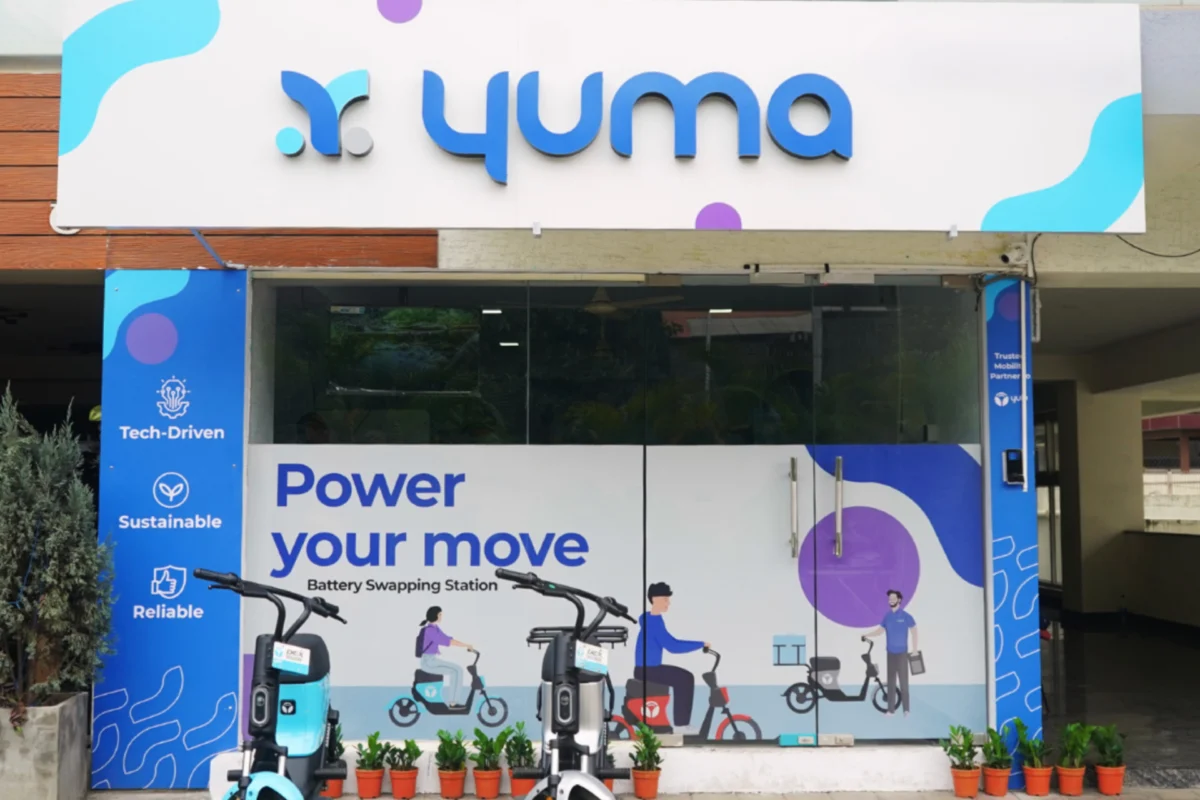
While the global automotive industry has largely pivoted toward plug-in charging infrastructure, a different narrative is taking shape on the bustling streets of India. In a market dominated by millions of two- and three-wheeled vehicles—the lifeblood of the nation’s rapidly expanding delivery and gig economy—battery swapping is not merely a theoretical alternative; it is becoming a strategic necessity.
Canadian automotive giant Magna International is doubling down on this premise, announcing a fresh $35 million investment into Yuma Energy, a Bengaluru-based battery-swapping network. This capital injection, which increases Magna’s majority stake in the joint venture, signals a profound belief that the “swapping-as-a-service” model holds the key to unlocking mass electric vehicle (EV) adoption in one of the world’s most demanding transport environments.
The Genesis of a Specialized JV
The story of Yuma Energy began in early 2023, born as a spin-out from the Indian mobility pioneer Yulu. The joint venture was designed to marry Yulu’s deep understanding of local micro-mobility needs with Magna’s manufacturing prowess and capital muscle.
The initial partnership was cemented in 2022, when Magna committed a total of $77 million across the two entities: $25 million directly into Yulu and $52 million into the battery-swapping joint venture. This move was significant not only for its scale but because it represented Magna’s only direct startup investments in India. By spinning Yuma out, the companies sought to create an independent, AI-powered infrastructure layer that could support not just Yulu’s fleet, but the broader ecosystem of Indian electric delivery riders.
Chronology of a Scaling Venture
- 2022: Magna International commits a combined $77 million to Yulu and the newly conceived battery-swapping joint venture.
- Early 2023: Yuma Energy officially launches, spinning out of Yulu to focus exclusively on the infrastructure side of the business.
- 2023–2025: The network undergoes rapid expansion, integrating AI-driven monitoring to manage battery health and station load balancing.
- March 2026: Yuma concludes the financial year with approximately ₹1 billion (roughly $10.5 million) in revenue, demonstrating the model’s commercial viability.
- August 2026: Yulu secures an additional $93 million in funding to grow its fleet, placing renewed pressure on Yuma to expand its network capacity.
- Late 2026: Magna announces its latest $35 million investment, further diluting Yulu’s minority stake and providing the runway for a massive 18-month expansion plan.
The Economic Imperative: Why Swapping Wins in India
The economic rationale for Yuma’s model rests on the concept of "uptime." In India’s gig economy—which spans food delivery, e-commerce logistics, and ride-hailing—a rider’s vehicle is their primary income-generating asset.
Traditional fast charging, while effective for passenger cars, presents a hurdle for two-wheeler delivery riders. A standard fast charge can take between 20 and 30 minutes, keeping the driver off the road and forcing them to navigate the complexities of finding a compatible plug point. In contrast, Yuma’s swapping model allows a rider to exchange a depleted battery for a fully charged one in under two minutes.
“With Indian gig workers’ high runtime on a daily basis, an EV makes absolute sense in terms of cost of ownership,” says Muthu Subramanian, Managing Director of Yuma Energy. “Uptime is important. When you look at the economics, swapping is not just a convenience—it’s a business requirement for those who need to maximize their daily deliveries.”
Operational Depth and Infrastructure
Yuma Energy distinguishes itself from competitors by maintaining vertical control over its supply chain. Unlike "asset-light" operators that purchase third-party hardware, Yuma designs and manufactures its own battery packs at its facility in Chennai and produces its charging units in Bengaluru.
This level of vertical integration provides a distinct advantage in a market where battery health is critical. By controlling the hardware, Yuma can optimize the charging cycles, monitor thermal performance, and gather data to improve the longevity of the battery packs. Currently, the company operates over 400 stations with more than 2,500 charging units. With the new $35 million investment, Yuma plans to double its fleet of 100,000 batteries within the next 12 to 18 months.
Diversification Beyond the Yulu Ecosystem
For its first two years, Yuma was effectively the internal infrastructure arm for Yulu. However, the company is now successfully pivoting to become a platform-agnostic service provider. While Yulu still accounts for the majority of the 60 million swaps performed to date, Yuma has made significant inroads into the broader market.
In the most recent quarter, approximately 15% to 20% of swaps were attributed to non-Yulu customers. The firm now serves more than five major delivery fleets and has integrated its proprietary batteries with over 10 different vehicle platforms, including models from manufacturers like Kinetic Green, Motovolt, BGauss, and Quantum Energy. Subramanian projects that non-Yulu business will account for roughly 25% of all swaps within the next two years, proving that the network is capable of sustaining itself beyond the success of its parent startup.
Financial Path to Profitability
The battery-swapping sector is notoriously capital-intensive. It requires the deployment of thousands of batteries and charging units well in advance of the revenue they will eventually generate. This "build-ahead" strategy has naturally kept the company in a pre-profit state, but the indicators of fiscal health are improving.
Subramanian confirmed that several of Yuma’s older, more established stations have already reached EBITDA-positive status. The company’s goal is to achieve total EBITDA break-even within the next two quarters. The $35 million infusion from Magna is earmarked specifically to fuel this growth phase, enabling the company to expand its footprint into high-demand cities like Chennai and Pune while increasing station density in its existing 18-city network.
Implications for the Global EV Market
The success of Yuma in India serves as a critical test case for the viability of battery swapping in emerging economies. While North American and European markets have largely prioritized residential and public "plug-in" charging, the high-density, low-margin environment of Southeast Asia and Africa mirrors the conditions in India.
Yuma’s long-term roadmap reflects this potential. While the next 18 months will remain hyper-focused on the Indian market, the firm is eyeing international expansion. Markets such as Vietnam and Thailand, where two-wheelers are the dominant mode of transport, are viewed as natural extensions for the Yuma model. By controlling the entire stack—from the battery pack design to the station network—Yuma has created a blueprint that is exportable to any region where delivery speed and vehicle uptime are the primary drivers of economic growth.
As Magna International continues to pour capital into the venture, the message to the global automotive industry is clear: the path to electrification in the developing world will not be paved with universal charging standards, but with the modular, high-speed convenience of a swapped battery. If Yuma can hit its profitability targets and scale its infrastructure to meet the rising tide of India’s gig economy, it may well prove that the "swapping" model, once dismissed by critics, is the most practical solution for a planet on two wheels.