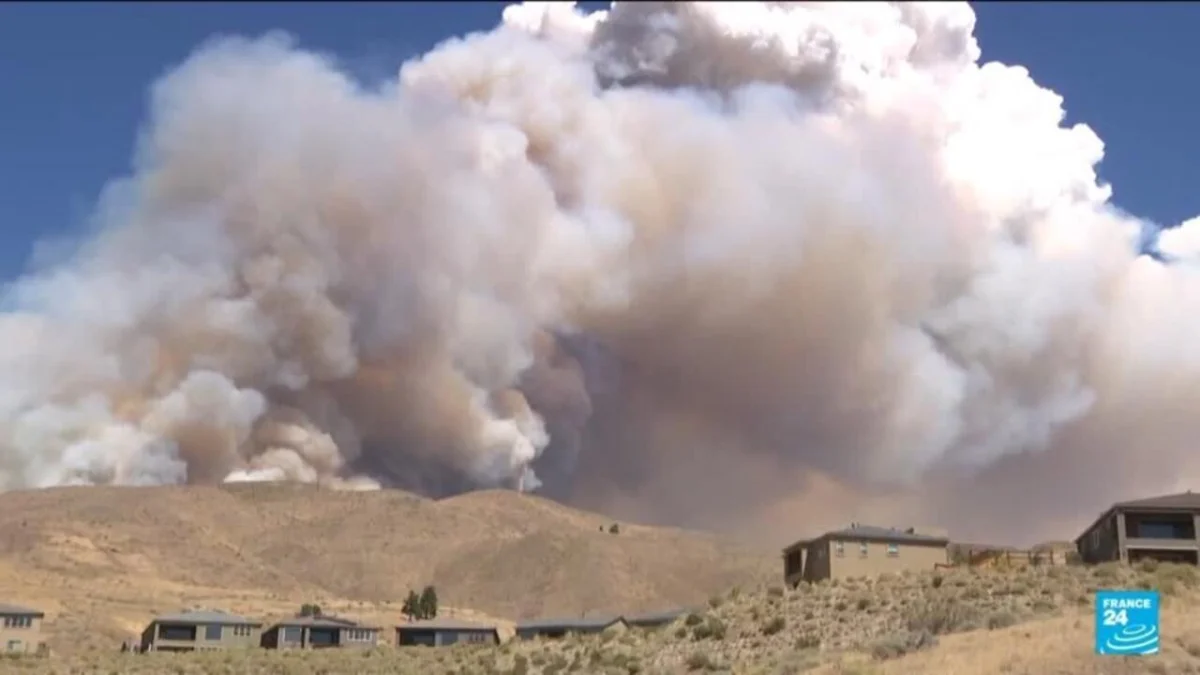
RENO, Nevada – A catastrophic wildfire situation has paralyzed parts of Nevada, prompting Governor Joe Lombardo to declare a formal state of emergency as flames tear through residential corridors, forcing the immediate evacuation of 14,000 residents. The inferno, fueled by record-breaking temperatures and persistent, gusty winds, has overwhelmed local firefighting capabilities, leading to a massive mobilization of state and federal assets.
The Main Facts: A Crisis in Motion
As of Saturday, August 23, 2026, the fire—now dubbed the "Canyon Peak Blaze"—has transformed from a localized brush fire into a regional disaster. Igniting late Friday afternoon, the fire exploited the region’s critically dry vegetation and a sudden shift in wind direction, which propelled the flames toward densely populated suburban zones.
The scale of the displacement is unprecedented for this specific area. Emergency management officials have confirmed that 14,000 people have been ordered to leave their homes immediately, turning quiet neighborhoods into scenes of gridlocked traffic and anxiety. The primary objective for incident commanders remains life safety, with structural protection secondary as the fire continues to exhibit extreme, unpredictable behavior.
"We are dealing with a fire that is moving faster than our initial projections," said one official on the ground. "The fuel moisture levels are at historical lows, and the terrain is making it nearly impossible for ground crews to establish containment lines."
Chronology of the Disaster
The rapid escalation of the Canyon Peak Blaze provides a harrowing look at how modern wildfires operate under climate-stressed conditions.
- August 22, 14:00 (Initial Ignition): Smoke was first reported in the rugged, high-desert foothills near the regional border. Low-level fire crews were dispatched, initially anticipating a routine containment operation.
- August 22, 18:30 (The Wind Shift): A localized thermal anomaly caused winds to shift by 45 degrees, pushing the fire front directly toward a residential development. At this juncture, the blaze entered the "crown fire" phase, jumping containment lines.
- August 23, 02:00 (Emergency Escalation): As the fire jumped the main highway, local law enforcement initiated mandatory evacuation orders. Power grids were preemptively shut down to prevent further ignitions from downed lines.
- August 23, 09:00 (Declaration of Emergency): Governor Lombardo signed the executive order declaring a state of emergency. This move unlocked state-level emergency funding and authorized the National Guard to assist with evacuation logistics and perimeter security.
- August 23, 17:00 (Current Status): The fire is currently 0% contained. Air tankers and heavy-lift helicopters are attempting to drop retardant, but heavy smoke plumes are severely limiting visibility for aerial operations.
Supporting Data and Environmental Factors
The volatility of the current wildfire season in Nevada is not a coincidence. Climatologists have pointed to a convergence of factors that have primed the Great Basin for this type of catastrophic event.
The "Triple Threat" of Fire Weather
- Hydrological Deficit: Nevada has endured a significantly drier-than-average summer. Soil moisture content is currently at 12% of the historical average, leaving the underbrush essentially brittle.
- Heat Dome Persistence: The state has seen 22 consecutive days of temperatures exceeding 100°F (37.8°C). This heat has essentially "cured" the fuels, making them susceptible to ignition from even a single spark.
- Low Humidity and Gusty Winds: Relative humidity levels have plummeted into the single digits, while "diurnal slope winds"—winds that change direction as the sun heats the mountains—have reached speeds of up to 45 mph.
Scientific modeling suggests that the "burn window"—the period during which a fire can burn uncontrollably—has extended by nearly three weeks compared to the 1990s. The Canyon Peak Blaze is a textbook example of a fire that, under previous climate conditions, might have been contained within 48 hours but now threatens entire communities.
Official Responses and Tactical Strategy
The response to the crisis has been multi-jurisdictional. The Nevada Division of Forestry (NDF) is currently coordinating with the Bureau of Land Management (BLM) and local fire departments to create a "defensive ring" around the most vulnerable neighborhoods.
Governor Lombardo’s office issued a statement late Saturday emphasizing the need for public cooperation: "Our primary mission is to ensure that every citizen gets out safely. Property can be rebuilt, but lives cannot be replaced. We are deploying every resource at our disposal, including the Nevada National Guard, to assist with the evacuation and to provide support to those who have been displaced."

The Evacuation Strategy
Evacuation centers have been set up in nearby fairgrounds and high school gymnasiums. However, health officials are already warning about the secondary impacts of the fire. The air quality index (AQI) in the region has reached "hazardous" levels, posing a severe threat to children, the elderly, and those with underlying respiratory conditions.
"We are struggling to manage the logistics of 14,000 displaced individuals while the air quality remains toxic," said a spokesperson for the County Office of Emergency Management. "We are advising people to wear N95 masks if they are in the proximity of the smoke plume and to stay indoors as much as possible."
Long-term Implications: A "New Normal" for the West?
The crisis in Nevada serves as a grim indicator of the shifting reality for Western states. As the fire continues to burn, policymakers are already debating the long-term implications of such events.
Urban Planning and Wildland-Urban Interface (WUI)
One of the most pressing issues is the expansion of housing into the Wildland-Urban Interface (WUI). For decades, Nevada has seen significant population growth in areas that are ecologically predisposed to fire. This creates a dangerous paradox: as housing demand increases, the state is forced to build in high-risk zones, making the mitigation of wildfire damage exponentially more expensive and difficult.
Infrastructure Resilience
The preemptive power shutoffs, while effective at preventing further ignitions, have highlighted the vulnerability of the state’s energy infrastructure. Experts are calling for massive investments in grid hardening—burying power lines and upgrading transformers to withstand extreme heat—but note that such projects take years to complete.
The Economic Toll
While the immediate focus is on the human cost, the economic toll is expected to be staggering. Agricultural losses, the destruction of residential property, and the high cost of emergency response are likely to stress state and local budgets for the remainder of the fiscal year. Insurance premiums in the region are already expected to spike, potentially rendering some areas uninsurable in the near future.
Conclusion
As the sun sets on August 23, the situation remains fluid. Firefighters are bracing for a difficult night, as winds are expected to remain erratic. For the 14,000 people who have fled their homes, the wait for news—of whether their houses still stand or if the path is clear to return—is agonizing.
The Canyon Peak Blaze is more than just a fire; it is a manifestation of a changing climate meeting an expanding urban footprint. As Nevada navigates this emergency, the focus will eventually turn to recovery, but the broader questions regarding fire prevention, climate adaptation, and the safety of residents in the WUI will remain long after the embers are extinguished.
The state of emergency is not merely a legal status; it is a signal that the traditional ways of managing wildfires are no longer sufficient. For Nevada, and indeed the entire American West, the lessons learned from this week’s chaos will undoubtedly dictate the policy landscape for the coming decade.