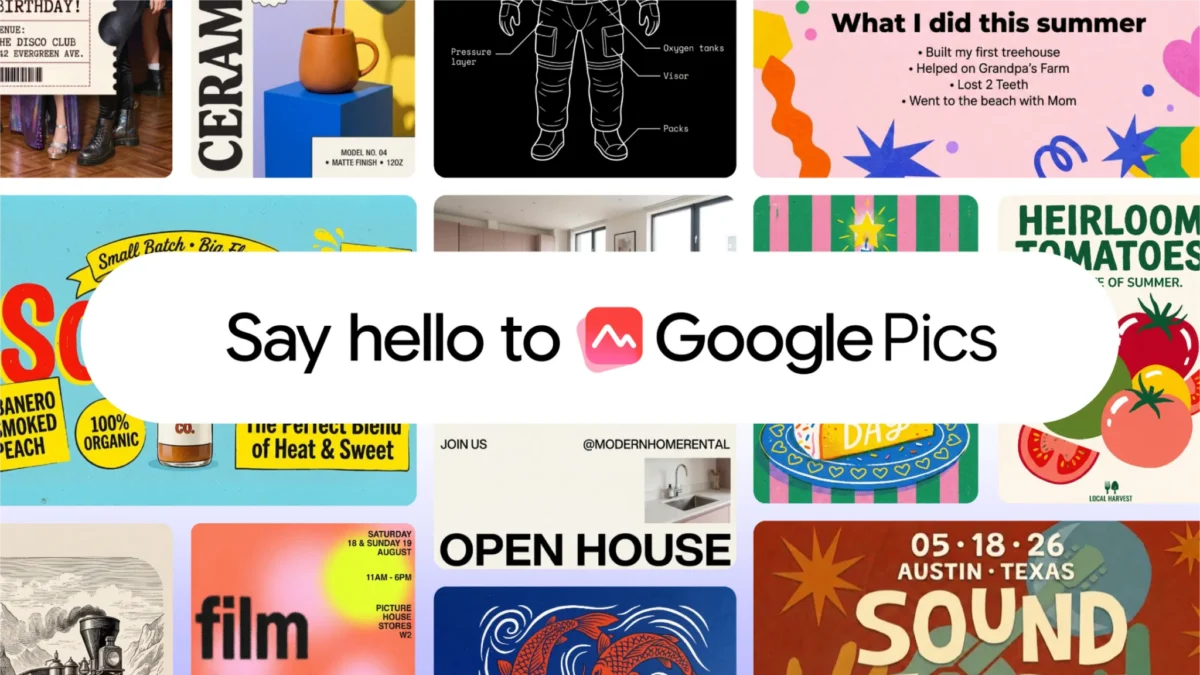
Google is making a definitive move to challenge the hegemony of platforms like Canva and Adobe Express with the launch of "Google Pics." This new generative image creation and editing suite, integrated directly into the Google Workspace ecosystem, marks a significant shift in how enterprise and individual users will handle visual content. Powered by the sophisticated "Nano Banana" image generation model, Google Pics aims to democratize professional-grade visual design through natural language prompts, moving away from traditional pixel-pushing design workflows toward an AI-first paradigm.
The Core Offering: What is Google Pics?
Google Pics is designed to be the "everyday" creative companion for professionals. By embedding a powerful generative AI engine directly into the tools where work happens—namely Google Docs and Slides—the company is eliminating the friction of switching between third-party design platforms and document editors.
At its core, Google Pics is a prompt-based creative engine. Users can request posters, social media banners, marketing illustrations, and conceptual visuals by simply describing them. The underlying Nano Banana model—a model Google claims is optimized for both speed and high-fidelity output—then renders these images in real-time.
Beyond initial generation, the suite includes a robust set of post-production tools. Users can isolate specific objects within an image, perform "magic" edits to transform elements, and leverage built-in text translation and modification tools. This is particularly useful for global teams who need to localize marketing materials or presentations without engaging a professional graphic designer for every minor iteration.
A Chronology of the Launch
The rollout of Google Pics represents the culmination of a multi-year pivot for Google, which has been aggressively integrating its Gemini-class AI models across its entire suite of products.
- Early Development: Following the initial success of its large language models (LLMs), Google pivoted toward multimodal generative AI. The development of the "Nano Banana" model was prioritized to address the specific needs of the Workspace user base—namely, high-quality, professional, and rapid image generation.
- Initial Integration: The rollout begins immediately for Google Docs and Slides, allowing users to generate visuals directly within their active projects.
- The Roadmap: Following the current integration with Docs and Slides, Google has confirmed that the service will expand into Google Drive, effectively turning the cloud storage platform into a centralized hub for managing, editing, and versioning AI-generated assets.
- Phased Rollout: Google has stated that the product will reach the majority of Workspace customers and those with Google AI Pro or Ultra subscriptions over the coming weeks, ensuring that the heavy computational load of the Nano Banana model is managed effectively across its global server infrastructure.
Supporting Data and the Competitive Landscape
To understand why Google Pics is a significant market move, one must look at the current landscape of digital design. For years, the market has been split between two dominant forces:
- The Professional Standard (Adobe): Tools like Adobe Express and Photoshop remain the gold standard for high-end creative work. These platforms are built for "creation from scratch," giving artists total control over every vector, layer, and pixel.
- The Democratized Hub (Canva): Canva revolutionized design for non-designers by offering a marketplace of templates and assets. It thrives on community, allowing creators to earn royalties by uploading their work.
Google Pics occupies a distinct third lane. It is not an Adobe-style professional suite, nor is it a community-driven marketplace like Canva. Instead, it is an "AI-first" utility. By focusing on prompting rather than designing, Google is betting that the average business user cares more about speed and utility than they do about the intricacies of layer management or community-sourced templates.
However, this strategy introduces a point of friction regarding the training data. While Canva incentivizes creators through a royalty-based marketplace, Google’s model relies on vast datasets of existing artwork. This has sparked ongoing debates regarding intellectual property, as the AI was trained on the work of human artists, yet the tool does not provide a mechanism for those artists to monetize their contribution to the model’s intelligence.
Official Responses and Strategic Positioning
Google’s messaging around the launch of Google Pics emphasizes "productivity and collaboration." By allowing multiple users to edit and refine AI-generated images in real-time, Google is positioning this as a team-based tool.
"We are moving from a world of passive consumption to active, real-time visual collaboration," a Google spokesperson noted during the initial reveal. The ability to generate multiple variations of a prompt simultaneously—allowing the user to "pick the best one"—is a direct response to the iterative nature of office work, where feedback loops often dictate the creative direction of a project.
The company has been careful to frame the tool as an assistant rather than a replacement. By positioning it within Docs and Slides, Google is suggesting that Pics is not for the professional graphic designer, but for the project manager, the marketing assistant, or the sales lead who needs to communicate a vision quickly.
Implications for the Creative Industry
The introduction of Google Pics into the Workspace suite has profound implications for several sectors:
1. The Death of the "Stock Photo" Workflow
For many businesses, the daily workflow involves searching through stock photography sites for a generic image that "sort of" fits the need. Google Pics eliminates this step. If a user needs an image of a "team collaborating in a futuristic office with a blue color palette," they no longer need to pay a subscription to a stock site; they can generate it in seconds. This poses an existential threat to low-end stock photography marketplaces.
2. The Standardization of Visuals
With Google Pics, the barrier to entry for high-quality visuals is effectively zero. While this is a massive boon for productivity, it also risks a "homogenization of style." If every business uses the same Nano Banana-powered tool, the internet may soon be flooded with a very specific, recognizable aesthetic, making it harder for brands to stand out visually.
3. Ethical and Intellectual Property Concerns
The fact that Google Pics does not share the same creator-compensation model as Canva is a point of contention. As AI models become the primary engines of content creation, the creative community is increasingly vocal about the "black box" nature of training data. Google will likely face pressure to provide more transparency regarding which artists’ works informed their model and whether a licensing or compensation structure can be established for the creators whose styles the AI mimics.
4. The "Prompting" Skill Gap
We are moving toward a future where "prompt engineering" is a legitimate professional skill. The quality of output from Google Pics depends entirely on the user’s ability to describe their needs. This creates a new divide in the workplace between those who can effectively communicate with AI and those who struggle to turn their ideas into coherent visual requests.
Conclusion: A New Era for Google Workspace
Google Pics is more than just a new feature; it is a signal that Google intends to dominate the generative AI space at the enterprise level. By wrapping the complexity of image generation in the familiar interface of its existing productivity suite, Google is ensuring that it remains the default choice for the modern digital worker.
As the tool rolls out to Drive and expands its capabilities, the focus will likely shift to how well it integrates with other third-party services and how it handles the inevitable legal and ethical scrutiny surrounding AI-generated imagery. For now, the takeaway is clear: the days of searching for the perfect image are ending, replaced by an era of on-demand visual creation. Whether this leads to a renaissance of creativity or a deluge of repetitive AI-generated content remains to be seen, but one thing is certain—the office design workflow has changed forever.