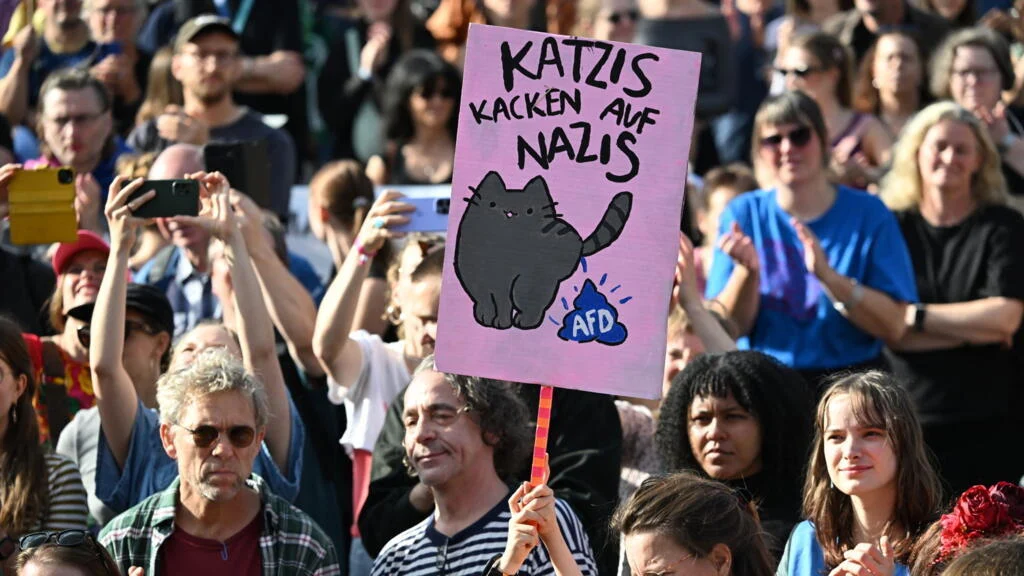
In an unprecedented display of civic mobilization, approximately 150,000 protesters converged on city centers across Germany this past Saturday. The massive demonstrations, spanning from the capital of Berlin to the southern hub of Munich and the northern port city of Hamburg, were a direct response to the electoral surge of the Alternative for Germany (AfD), a far-right party now standing on the precipice of securing its first state government since the end of the Second World War.
The protests, organized by a coalition led by the activist group Pruef, signaled a growing national anxiety regarding the future of German democracy. Carrying placards reading "Ban the AfD Now" and "Democracy Needs No Alternatives," participants represented a broad cross-section of German society, united by the conviction that the AfD’s political trajectory poses an existential threat to the constitutional order established in the post-war era.
The Catalyst: A Seismic Shift in Saxony-Anhalt
The current unrest stems from the electoral earthquake that struck the eastern region of Saxony-Anhalt last Sunday. In a result that stunned political analysts and sent shockwaves through the European Union, the AfD secured nearly 44 percent of the vote, dwarfing the center-right Christian Democratic Union (CDU), which trailed significantly at 17 percent.
While the AfD fell three seats short of an absolute majority, the party has immediately initiated coalition overtures. Their goal is clear: to install the first far-right state government in modern German history. This development has transformed what was once considered a fringe political movement into a formidable power broker capable of shaping regional policy, legislation, and public discourse.
A Chronology of the Escalation
The rise of the AfD is not a sudden phenomenon but rather the culmination of years of political realignment within the German electorate.
- Mid-2020s: The AfD capitalizes on post-pandemic economic malaise, persistent inflationary pressures, and deep-seated dissatisfaction with the federal government’s immigration and energy policies.
- Early September 2026: Election day in Saxony-Anhalt sees the AfD achieve a near-majority, turning the region into a laboratory for far-right governance.
- The Following Week: Calls for a formal government ban on the AfD intensify. Legal experts and civil society groups debate the feasibility of invoking Article 21 of the Basic Law, which allows for the banning of parties that undermine the democratic order.
- Saturday, September 12, 2026: Nationwide demonstrations take place in roughly 20 cities. Berlin sees thousands in the streets, while Hamburg reports an estimated 25,000 protesters and Munich 12,000.
- Ongoing: The AfD continues to hold counter-rallies, positioning itself as a misunderstood movement fighting for the "real" voice of the people against an out-of-touch political establishment.
Supporting Data: The Anatomy of a Breakthrough
The electoral success in Saxony-Anhalt provides a stark map of the party’s reach. By capturing 44 percent of the vote, the AfD has effectively normalized its presence in the regional parliament. The demographic breakdown of their support reveals a deep divide between urban centers and rural, post-industrial eastern regions.
Crucially, the party’s platform—which features a staunchly anti-immigration stance, a "Russia-friendly" geopolitical outlook, and a populist critique of Brussels—has resonated with voters who feel left behind by the green transition and globalist policies.
In Berlin, the AfD has attempted to project confidence, holding counter-demonstrations featuring Kristin Brinker, the party’s lead candidate for the upcoming regional elections. Despite the massive opposition displayed in the streets, the AfD’s leadership argues that these protests are an undemocratic attempt to silence a legitimate political contender.
Official Responses and the "Ban" Debate
The prospect of banning a political party in Germany is a sensitive, highly regulated, and historically fraught process. The Federal Constitutional Court holds the power to outlaw parties, but the threshold for doing so is extraordinarily high, requiring evidence that the party is actively working to dismantle the "free democratic basic order."

Chancellor Friedrich Merz of the CDU has remained notably cautious. While acknowledging the danger the AfD represents, Merz has expressed skepticism regarding a legal ban. His position is one shared by many mainstream politicians: that a ban could backfire, transforming the AfD into a "martyred" movement and further radicalizing its base. Instead, the center-right is grappling with how to win back voters who have drifted toward the far-right, a challenge that requires addressing the very real grievances regarding the economy and security that the AfD has successfully exploited.
"A broad cross-section of civil society is taking to the streets to prevent the enemies of the constitution from gaining government power," said Christoph Bautz of the campaign group Campact. Bautz’s words echo a sentiment shared by many Germans: that the responsibility to atone for the horrors of the Nazi past includes a moral obligation to prevent the re-emergence of extremist ideologies in the halls of power.
Implications for the Future of Europe
The ramifications of this political shift extend far beyond German borders. Germany has long been the anchor of European stability. A state government led by the AfD would likely lead to a policy of obstructionism at the federal level, particularly regarding support for Ukraine and deeper integration within the European Union.
If the AfD successfully forms a government in Saxony-Anhalt, it will serve as a powerful signal to other right-wing populist movements across Europe, including those in France, Austria, and Italy. It demonstrates that a party once considered "un-coalitionable" can, through consistent growth and a refusal to moderate, eventually force its way into the executive branch.
Furthermore, the protests themselves reveal a fractured society. While 150,000 people took to the streets to defend the constitution, the electoral data confirms that a massive, and perhaps equally determined, segment of the population is demanding a fundamental change in the direction of the country.
Looking Ahead
The coming weeks will be critical. If the AfD manages to form a government, Germany will enter uncharted waters. The legal debates surrounding a potential ban will intensify, and the mainstream parties will face a "make or break" moment: continue with current policies and risk further electoral hemorrhaging, or fundamentally reform their approach to governing to address the anxieties of a disillusioned public.
For now, the streets of Germany remain a barometer for the health of its democracy. The citizens who marched this weekend have made their position clear: they are unwilling to let the country slide back into a period of political extremism. However, as the AfD continues its push for power, the question remains whether the democratic process, as it currently stands, has the tools to reconcile a deeply divided nation.
As the political maneuvering continues, the world watches. The events in Saxony-Anhalt and the subsequent outcry across Germany are not merely local incidents; they are a manifestation of the global struggle between traditional liberal democracy and the rising tide of populist nationalism. The resolution of this crisis will likely define the trajectory of German, and by extension European, politics for the next decade.