For over a quarter-century, the Volkswagen Group has maintained a strict internal hierarchy regarding performance. While Audi, Porsche, Lamborghini, and Bugatti have occupied the rarefied air of the supercar and hypercar stratosphere, the Volkswagen brand itself has remained firmly rooted in the realms of the practical, the affordable, and the mass-market. The W12 prototypes of the late 1990s and early 2000s teased a world where the "People’s Car" company could challenge the titans of Maranello and Sant’Agata Bolognese, but that dream was ultimately shelved to preserve brand identity.
Now, a new spark of ambition has emerged from within the halls of Wolfsburg. Fabian Reitz, a design intern at Volkswagen, has captured the imagination of the automotive world with the ID.DIN T14—a concept that dares to envision what a modern, electrified Volkswagen supercar might actually look like.
A Bold Vision from the Drawing Board
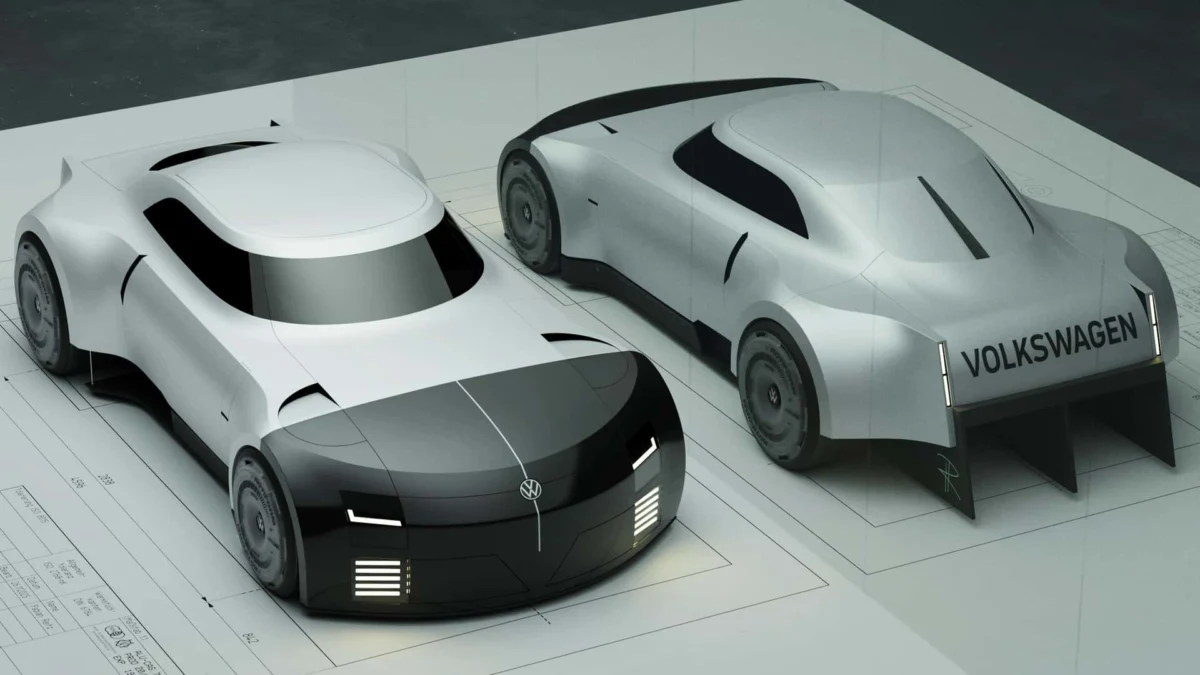
The ID.DIN T14 is not merely a digital rendering or a fleeting sketch meant to occupy space in a portfolio. Under the guidance of Andreas Mindt, the head of Volkswagen Group and Brand Design, the project was elevated to a physical scale model. This process of physicalization speaks volumes about the quality of Reitz’s work; it suggests that the design language holds enough structural and aesthetic merit to warrant a three-dimensional study.
Mindt, known for his rigorous approach to design, took to Instagram to champion the project, describing it as "bold" and praising its "clear proportions, reduced surfaces, and a strong graphic character." By stripping away the clutter that often plagues modern vehicle design, Reitz has managed to create a silhouette that feels both futuristic and fundamentally "Volkswagen."
The Chronology of VW’s Supercar Ambitions
To understand why the ID.DIN T14 is so significant, one must look back at the historical hesitation of the Volkswagen brand to enter the high-performance fray.
The W12 Era (1997–2002)
The late 90s saw Volkswagen experiment with the Nardo W12 concept. It was a technological tour de force, featuring a unique engine architecture that would eventually underpin the Bugatti Veyron. At the time, the automotive press speculated that VW would finally offer a mid-engine supercar to rival the best from Italy. However, Ferdinand Piëch, the mastermind behind VW’s expansion, eventually decided that the supercar segment was better served by the group’s luxury and performance subsidiaries. The W12 became a legend of "what could have been."
The Electric Transition
As Volkswagen pivots toward the ID. series—its dedicated electric vehicle platform—the company has focused on efficiency, range, and accessibility. The ID.DIN T14 represents a departure from this strictly utilitarian focus. It hints that the modular nature of electric drivetrains could theoretically allow Volkswagen to revisit the "supercar" segment without the massive R&D costs associated with internal combustion engine development.
Aesthetics and Aerodynamics: The Design Language
The ID.DIN T14 is striking for its defiance of conventional automotive tropes. While it shares a lineage with the recently unveiled Audi Concept C, the Volkswagen iteration leans into a more aggressive, almost brutalist aesthetic.
Visual Character
The car features slab-like sides that provide a sense of weight and stability, contrasted by an incredibly narrow greenhouse. The wraparound windshield creates a cockpit-like atmosphere, reminiscent of endurance racers or, as some observers have noted, the kind of vehicle one might expect to see prowling the streets of a dystopian Gotham. It is "sinister" in its simplicity, favoring long, uninterrupted lines over the aggressive creases and wings often found on modern performance cars.
Aerodynamic Innovation
Beneath the surface, the design prioritizes laminar flow and downforce:
- Front Fenders: The inclusion of vents at the top of the wheel arches suggests a sophisticated air management system designed to reduce lift at high speeds.
- Rear Diffuser: A massive rear diffuser dominates the tail, signaling that this is a machine designed for high-velocity stability rather than just aesthetic flair.
- The Absence of Mirrors: In a nod to the modern era, the ID.DIN T14 eliminates traditional side mirrors in favor of pop-out Leica cameras. This not only cleans up the bodywork but also significantly reduces the drag coefficient.
- Aero-Covered Wheels: The massive wheels are fitted with aero covers, a design choice that echoes current Formula E and hypercar trends, emphasizing efficiency alongside raw performance.
Official Responses and Internal Sentiment
The reception from leadership within the Volkswagen Group has been telling. By publicly endorsing an intern’s work, Andreas Mindt is sending a message about the culture of creativity he is cultivating within the brand.
In internal corporate environments, a project usually needs high-level sponsorship to move from a sketch to a scale model. By sharing the ID.DIN T14 on social media, Mindt is essentially "testing the waters." He is gauging public interest to see if the brand’s customer base—often viewed as conservative—would be receptive to a high-performance, design-forward flagship.
However, it is vital to temper this excitement with reality. Volkswagen officials have not indicated any intent to put the T14 into production. The company is currently navigating a period of significant structural adjustment, including reports of workforce reductions and factory rationalization. In such an environment, the focus remains on the core lineup: the ID.4, ID.7, and the upcoming ID.2all.
The Implications: Why It Matters
While the ID.DIN T14 will likely remain a design exercise, its existence is highly significant for three key reasons:
1. Brand Identity and Emotional Resonance
Volkswagen has struggled to capture the "cool factor" that comes with performance cars. By showcasing a concept as visually arresting as the T14, the brand creates a halo effect. It reminds the public that VW is capable of designing cars that stir the soul, even if they aren’t the ones currently sitting on the dealership lot.
2. Design Evolution
The design cues seen on the T14—particularly the "reduced surfaces" mentioned by Mindt—may very well find their way into future consumer models. We are likely to see elements of this design language, such as the integrated camera systems or the simplified surfacing, in the next generation of the Golf or the ID. series of SUVs.
3. The Future of the Electric Supercar
As battery technology continues to improve, the barrier to entry for high-performance electric vehicles is dropping. If Volkswagen wanted to, they could leverage the SSP (Scalable Systems Platform) to build a halo performance car far more easily than they could have in the 1990s. The T14 proves that the design talent is there; the only question is whether the corporate strategy will ever align with the creative desire.
Conclusion: A Dream Deferred, or a Blueprint for Tomorrow?
The VW ID.DIN T14 is a triumph of design over corporate monotony. It is a reminder that even in a world obsessed with efficiency and mass production, there is still room for the dreamers—the interns and designers who dare to imagine a Volkswagen that doesn’t just drive, but performs.
While the "Penguin’s ride" will likely never grace a production line, it serves a higher purpose. It forces us to look at Volkswagen not just as a manufacturer of sensible hatchbacks, but as a brand with the potential for boldness. For now, we will have to be satisfied with the scale model, but in the fast-moving world of automotive design, today’s concept is often the seed for tomorrow’s reality.
As the industry stands on the precipice of a full-scale electric transition, perhaps there is a place for a flagship that redefines the VW badge. Until then, the ID.DIN T14 remains a captivating vision—a fleeting, sinister, and brilliant glimpse of what could be if the "People’s Car" decided to let its hair down.