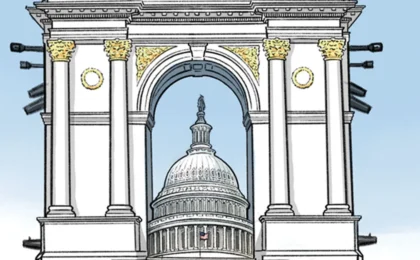
Washington D.C. – July 22, 2026 – As the summer heat bears down on the nation’s capital, a political storm of potentially unprecedented intensity is brewing, threatening to plunge the federal government into a shutdown just months before crucial midterm elections. The iconic image of the U.S. Capitol, as captured in R.J. Matson’s "Capitol Ink" cartoon for CQ Roll Call today, serves as a stark visual metaphor for a government on the brink, caught between competing fiscal ideologies and the harsh realities of a deeply polarized Congress.
Lawmakers are locked in a bitter stalemate over the Fiscal Integrity and National Security Act of 2026, a critical appropriations package that must pass to fund government operations beyond the September 30th deadline. Complicating matters further, the nation’s debt ceiling is projected to be breached in early October, setting the stage for a perilous collision of budgetary deadlines. The House, led by Speaker Ramirez, is pushing for significant cuts to discretionary domestic spending and attaching contentious policy riders, while the Democratic-controlled Senate and President Hayes are advocating for increased investments in social programs, climate initiatives, and a more modest defense budget. With the November midterms looming, neither side appears willing to cede ground, raising the specter of severe economic disruption and further erosion of public trust in governance.
Main Facts: A Government on the Precipice
The current legislative session is dominated by a high-stakes standoff over the federal budget, a perennial flashpoint in Washington that, this year, carries exceptional weight due to converging crises. The primary legislative vehicle, the Fiscal Integrity and National Security Act of 2026, is designed to encompass the twelve annual appropriations bills required to fund the federal government for Fiscal Year 2027, which commences on October 1st. However, negotiations have ground to a halt.
At the core of the impasse are fundamental disagreements over federal spending priorities. The Republican majority in the House, emboldened by a recent wave of fiscal conservatism and strong support from their base, has introduced a package that proposes a 15% reduction in non-defense discretionary spending. This includes significant cuts to agencies responsible for environmental protection, social services, education, and scientific research. Their proposal also includes policy riders aimed at restricting certain regulatory powers, particularly concerning energy and environmental policies, and a measure to codify restrictions on reproductive healthcare access.
Conversely, President Hayes and the Democratic-led Senate, under Majority Leader Albright, are advocating for a budget that reflects their priorities: an increase in social safety net programs, substantial investments in renewable energy infrastructure, and targeted aid to states grappling with climate change impacts. While they acknowledge the need for fiscal responsibility, they argue that the House’s proposed cuts are draconian and would cripple essential government services, disproportionately affecting vulnerable populations. They have also firmly rejected the inclusion of what they deem "poison pill" policy riders, particularly those infringing on established rights or undermining executive agency functions.
The "Capitol Ink" cartoon by R.J. Matson today vividly captures this precarious situation. While the specific imagery is left to the viewer’s interpretation, the very title suggests a satirical take on the escalating tensions. Historically, Matson’s work has often depicted the Capitol as a ship adrift, a battleground, or a house of cards, reflecting the fragility of consensus. On July 22, 2026, it likely portrays the institution caught in a tug-of-war, with legislative deadlines and public welfare hanging in the balance, a poignant commentary on the brinkmanship defining this legislative period.
Adding to the urgency is the approaching debt ceiling. The U.S. Treasury has warned that extraordinary measures, currently being employed to avoid default, will be exhausted by early October, coinciding almost perfectly with the appropriations deadline. This creates a terrifying scenario where Congress must not only agree on how to fund the government but also on whether to raise the national borrowing limit, failure of which would trigger an unprecedented default on U.S. obligations, sending shockwaves through global financial markets. The convergence of these two critical fiscal deadlines amplifies the stakes, transforming a typical budget debate into a potential constitutional and economic crisis.
Chronology of the Crisis
The current budgetary standoff is not an overnight development but the culmination of months of escalating rhetoric and entrenched positions.
Early Warning Signs (Spring 2026)
The first tremors of the impending crisis began in earnest in February 2026, when President Hayes submitted his annual budget request to Congress. The President’s budget, outlining ambitious spending on social programs, climate initiatives, and infrastructure, was immediately met with strong condemnation from House Republicans. Speaker Ramirez dismissed it as "a blueprint for unchecked spending and an economic disaster," signaling the deep ideological chasm that would define the upcoming appropriations process.
In March, the House Budget Committee, under Republican leadership, unveiled its own budget resolution, proposing drastic cuts across numerous federal agencies and advocating for a path to a balanced budget within five years. This resolution served as a non-binding framework but clearly articulated the Republican caucus’s priorities and red lines. Democrats decried it as "heartless" and "fiscally irresponsible" for its proposed impact on essential services, setting a confrontational tone for the legislative year.
Summer Standoff (June-July 2026)
As the legislative calendar advanced into early summer, the rhetoric intensified. Committee markups for individual appropriations bills in the House became highly contentious, often devolving into partisan shouting matches. Republicans successfully passed several individual spending bills out of committee with their proposed cuts and policy riders, largely along party lines. However, these bills faced an immediate blockade in the Senate, where Majority Leader Albright declared them "dead on arrival."
By mid-June, bipartisan efforts to find common ground in the Senate Appropriations Committee began to falter. While some moderate Senators expressed willingness to negotiate on spending levels, the inclusion of specific policy riders by the House proved to be an insurmountable hurdle. Senator Elaine Chen (D-NY), a key negotiator, stated, "We are willing to discuss responsible spending, but we will not compromise on fundamental rights or allow Congress to legislate through appropriations riders."
The first major legislative clash occurred in late June when the House passed a consolidated appropriations bill that incorporated many of its proposed cuts and policy riders. The vote was a narrow 218-217, underscoring the razor-thin Republican majority and the lack of bipartisan support. The bill was immediately rejected by the Senate, which passed its own version with significantly higher spending levels and no controversial riders, largely along party lines. This exchange of non-starters cemented the legislative gridlock.
The Current Impasse (July 22, 2026)
Today, July 22, 2026, marks a critical juncture. With just over two months until the fiscal year ends, no viable appropriations bill is close to passing both chambers. Public statements from leadership reflect the deep chasm. Speaker Ramirez, speaking from the Capitol steps this morning, reiterated his caucus’s commitment to "reining in wasteful spending and protecting American values," warning of the consequences of "uncontrolled government expansion." He suggested that any bill not reflecting the House’s fiscal discipline would be unacceptable.
In a morning press conference at the White House, President Hayes appealed to Congress for "common sense and compromise," urging lawmakers to prioritize the needs of the American people over partisan posturing. He warned that a government shutdown would have "catastrophic consequences for our economy and national security." Senate Majority Leader Albright echoed these sentiments, stressing the urgency of a "clean continuing resolution" if a comprehensive agreement remains elusive, but acknowledging that such a measure might also face resistance from the House’s conservative flank. The immediate path forward remains obscured by deeply entrenched positions and a rapidly dwindling legislative window.
Supporting Data and Expert Analysis
The potential for a government shutdown and, even more critically, a U.S. default, carries dire economic and social consequences, as underscored by numerous reports and expert analyses.
Economists universally warn of the severe economic ramifications of a federal government shutdown. A recent analysis by the Congressional Budget Office (CBO) projected that a shutdown lasting just two weeks could shave at least 0.5% off the nation’s annualized GDP growth, translating to hundreds of billions in lost economic output. Key federal agencies responsible for economic data collection, loan processing (e.g., small business, housing), and scientific research would cease operations, creating a ripple effect of uncertainty and delayed investment. The Office of Management and Budget (OMB) estimates that millions of federal employees would either be furloughed or required to work without pay, significantly impacting consumer spending and local economies across the country. Dr. Eleanor Vance, a senior fellow at the Brookings Institution, stated, "A shutdown in this economic climate, marked by persistent inflation and global instability, would be akin to throwing a wrench into an already delicate machine. It risks consumer confidence, delays critical investments, and could push us closer to a recession."
The implications of breaching the debt ceiling are even more catastrophic. The Treasury Department has repeatedly warned that a default would trigger an immediate downgrade of the U.S. credit rating, send interest rates soaring, and likely precipitate a global financial crisis. The ripple effects would include a significant drop in the value of the dollar, increased borrowing costs for American businesses and consumers, and a potential collapse of the bond market. "The idea of the U.S. defaulting on its debt is not just bad; it’s unimaginable in its potential devastation," said Dr. Marcus Thorne, a professor of economics at Georgetown University. "It would fundamentally undermine the global financial system that relies on the full faith and credit of the United States."
Public opinion polling consistently reflects widespread disapproval of congressional gridlock. A recent Gallup poll conducted in early July showed congressional approval ratings at a dismal 18%, with 70% of Americans expressing dissatisfaction with the way Congress is handling the nation’s problems. A significant majority (65%) also believe that a government shutdown is "unacceptable" regardless of the policy disagreements. These numbers suggest that either party risking a shutdown or default will face severe political backlash from an already frustrated electorate.
Historically, government shutdowns have rarely yielded the desired policy outcomes for the initiating party, often backfiring politically. The 2013 shutdown, for instance, saw public opinion turn sharply against Republicans, despite their stated goals of defunding the Affordable Care Act. Similarly, the 2018-2019 shutdown over border wall funding saw President Trump’s approval ratings dip. Political scientists like Dr. Sarah Miller of American University suggest that "while parties might use the threat of a shutdown as leverage, the public generally perceives it as a failure of governance, penalizing those deemed responsible." The current climate, intensified by the debt ceiling threat and impending midterms, suggests that the political costs for intransigence could be even higher.
Official Responses and Political Maneuvering
The hallways of Congress and the White House are abuzz with frantic activity, as leaders attempt to navigate this perilous political landscape.
Executive Branch Stance
President Hayes has taken a firm, yet conciliatory, public stance. In multiple addresses, he has emphasized the non-negotiable nature of the debt ceiling, stating unequivocally that "the full faith and credit of the United States is not a bargaining chip." While expressing openness to discussions on long-term fiscal responsibility, he has drawn a clear line against using the appropriations process to force through unrelated policy changes or to enact what he deems "extreme cuts" to essential services. His administration has also been actively engaging with business leaders and international allies to underscore the gravity of the situation and prepare contingency plans should a shutdown or default occur. Privately, White House officials are reportedly exploring all legal avenues to prevent a default, though most constitutional scholars agree that the President’s options are limited without congressional action.
Congressional Leadership on the Hill
Speaker Ramirez, facing pressure from a vocal conservative flank within his caucus, has remained steadfast in his demands. He argues that the House’s proposed cuts are necessary to address the nation’s burgeoning debt and curb inflationary pressures. "We were elected to bring fiscal sanity back to Washington," Ramirez declared in a recent press conference. "We will not be intimidated by threats of a shutdown when we are fighting for the financial future of our children." He has also publicly supported the inclusion of policy riders, asserting they reflect the will of the American people and are essential to "reining in an overreaching executive branch." However, cracks have appeared within his own party, with a small but significant group of moderate Republicans expressing discomfort with the prospect of a shutdown and their desire for a bipartisan compromise.
Senate Majority Leader Albright has positioned the Democratic caucus as the voice of reason and stability. She has repeatedly called for a "clean" continuing resolution – a temporary funding measure that maintains current spending levels without controversial policy riders – to avoid a shutdown while long-term negotiations continue. Albright has also been in direct communication with Speaker Ramirez, though these talks have reportedly yielded little progress. Her challenge is to maintain unity within her own caucus, which includes progressive members pushing for even higher spending on social programs and moderates wary of being painted as fiscally irresponsible.
Party Line Divisions
Beyond leadership, the divisions are stark. The House Freedom Caucus, a powerful bloc of conservative Republicans, has vowed to reject any spending bill that does not include substantial cuts and their preferred policy riders, even if it means a shutdown. Their influence on Speaker Ramirez is undeniable, limiting his flexibility in negotiations. On the other side, progressive Democrats in both chambers are advocating for a robust defense of social programs and climate investments, and are equally firm in their opposition to any cuts or riders that would undermine these priorities. The narrow majorities in both chambers mean that a relatively small number of dissenting members can effectively derail any legislative effort, making consensus-building an extraordinarily difficult task. The upcoming midterm elections further complicate this, as members from both parties are increasingly reluctant to make politically unpopular concessions that could be used against them by primary or general election challengers.
Broader Implications
The current budget impasse and debt ceiling standoff carry far-reaching implications that extend beyond the immediate legislative battle, threatening to reshape the American political landscape and its standing on the global stage.
Firstly, the repeated cycles of government shutdowns and debt ceiling brinkmanship profoundly erode public trust in government. When basic functions of governance are held hostage to political maneuvering, citizens lose faith in their elected representatives’ ability to address critical national challenges. This disillusionment can lead to decreased civic engagement, increased political polarization, and a general sense of cynicism that undermines democratic institutions. The "Capitol Ink" cartoon, in its satirical reflection, might ironically become a symbol of this very erosion.
Domestically, the impact on federal services and programs would be immediate and severe. A shutdown would halt non-essential government operations, affecting everything from national parks closures and delays in passport processing to disruptions in scientific research and certain social welfare benefit distributions. Vulnerable populations, reliant on federal aid, would face immediate hardship. The long-term effects could include a loss of institutional knowledge as skilled federal employees seek more stable employment, and a decline in the nation’s capacity to respond to crises or maintain its competitive edge in areas like technology and healthcare.
Internationally, a U.S. default would be catastrophic, severely damaging the nation’s global standing and economic influence. The dollar’s role as the world’s reserve currency would be jeopardized, and America’s reputation as a reliable economic partner would be shattered. This would have ripple effects on global trade, investment, and geopolitical stability, potentially empowering rival nations and undermining U.S. leadership on critical global issues, from climate change to human rights. Even a prolonged shutdown, without a default, signals internal instability and can weaken diplomatic leverage.
Finally, the midterm election ramifications are immense. Both parties are playing a high-stakes game of chicken, betting that the other side will ultimately bear the brunt of public anger if a shutdown or default occurs. However, history suggests that blame is often shared, or can be unpredictable. The outcome of this legislative battle will undoubtedly be a defining issue in the November elections, influencing voter turnout, shaping campaign narratives, and potentially shifting the balance of power in Congress for the remainder of the decade. A party perceived as responsible for economic chaos could face significant losses, while one seen as a steadfast defender of stability might gain an advantage.
As the clock ticks closer to the critical deadlines, the nation watches with bated breath. The "Capitol Ink" image serves as a potent reminder of the fragility of consensus and the high stakes involved when political will falters. The coming weeks will test the resolve, and perhaps the very foundations, of American governance.