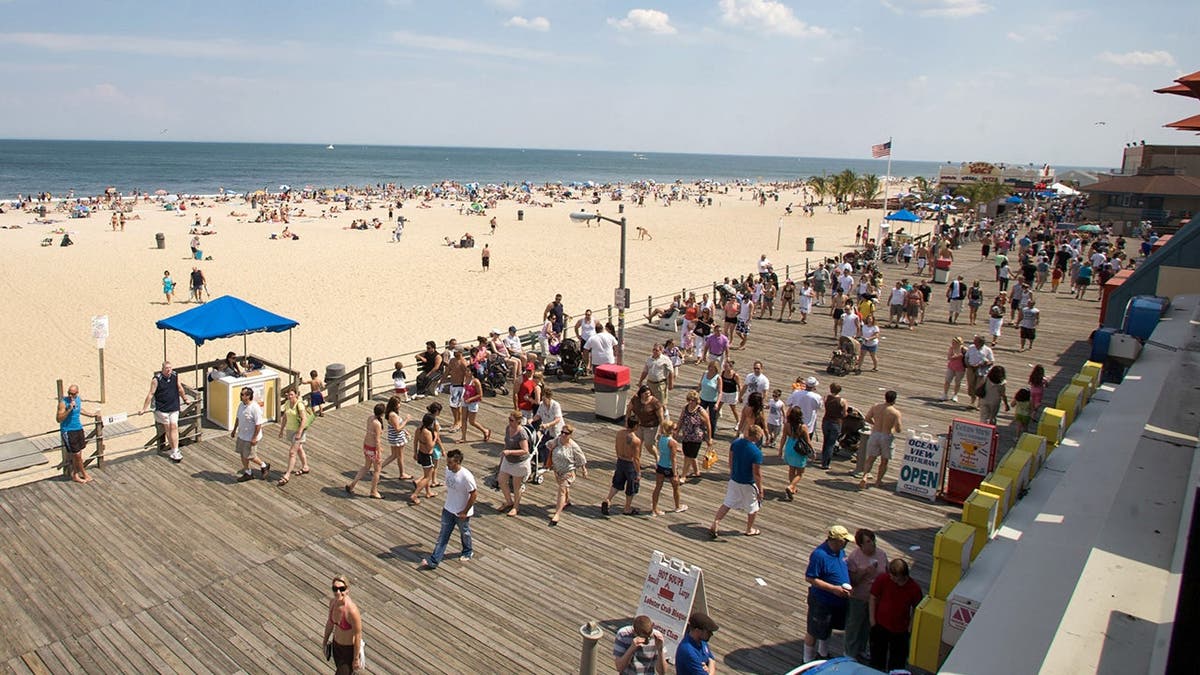
A physical altercation on a New Jersey boardwalk has escalated into a high-profile federal immigration case, drawing national attention to the intersection of political expression, visa enforcement, and local-federal law enforcement cooperation. Kaitlyn Tracey, a 33-year-old Canadian national, is currently held in federal immigration custody pending removal proceedings. Her detention by U.S. Immigration and Customs Enforcement (ICE) follows an alleged physical assault on a teenage girl on the Point Pleasant Beach boardwalk—an incident reportedly triggered by the victim’s companions wearing clothing featuring pro-Donald Trump and pro-ICE slogans.
The Department of Homeland Security (DHS) elevated the public profile of the case by releasing surveillance footage of the altercation on social media, labeling Tracey the "Maple Leaf Menace" and confirming her unlawful immigration status. As federal authorities push for her deportation, the case has ignited fierce debate. Supporters of the enforcement action view it as a necessary application of law and order, while Tracey’s family and legal representation argue that a minor local dispute has been disproportionately politicized and weaponized by online commentators.
Detailed Chronology of Events
[April 14, 2024] - Kaitlyn Tracey enters the U.S. on a temporary visa.
       │
[Sept. 6, 2024]  - Tracey's legal visa status expires; she remains in the U.S. unlawfully.
       │
[Confrontation]  - Tracey confronts teenagers on Point Pleasant Beach boardwalk over "Trump" and "ICE" clothing.
       │
[The Assault]    - Tracey allegedly strikes a teenage girl in the face and body, then flees the scene.
       │
[Identification] - Police identify Tracey via passport entry records and social media.
       │
[Arrest/Transfer]- Local police arrest Tracey on state charges and execute a controlled transfer to ICE.
       │
[August 4]       - Scheduled appearance in Ocean County Superior Court.
Arrival and Visa Expiration
According to official records provided by a Department of Homeland Security spokesperson, Kaitlyn Tracey entered the United States legally on April 14, 2024. She was admitted under a non-immigrant visa program, which authorized her stay in the country until September 6, 2024. Following the expiration of her visa, Tracey did not depart the United States, transitioning her legal status to that of an undocumented overstay.
The Confrontation on the Boardwalk
The incident that led to Tracey’s arrest occurred on the boardwalk of Point Pleasant Beach, a popular coastal resort town in Ocean County, New Jersey. According to a probable cause affidavit filed by local investigators, a group of four teenagers was walking along the boardwalk when they were approached by Tracey.
The affidavit states that Tracey began verbally berating the teenagers, focusing her anger on the attire worn by two members of the group. The teenagers were wearing patriotic-themed sweatpants displaying the words "Trump" and "ICE" (Immigration and Customs Enforcement). As the verbal exchange escalated, Tracey allegedly approached one of the teenage girls in the group, reached out, and struck her once in the face and once in the body.
Surveillance footage captured the moment of the physical contact. The video shows a woman, identified as Tracey, walking up to the teenager, delivering a swift blow, and immediately walking away without pausing to engage further.
Identification, Arrest, and Transfer to Federal Custody
Following the physical altercation, Point Pleasant Beach police officers attempted to detain Tracey on the boardwalk. According to police reports, she refused to cooperate, declined to provide her identification, and continued walking away from the officers.
Unable to secure her identity at the scene, local detectives initiated an investigation. Utilizing local surveillance footage, eyewitness accounts, and social media footprints, investigators successfully cross-referenced her identity with federal passport and entry records from her April 2024 arrival.
Once her identity was confirmed, local authorities issued warrants for her arrest. Following her apprehension on state-level charges of simple assault and child endangerment, the Point Pleasant Beach Police Department coordinated with federal authorities. Due to her expired visa status, local police facilitated a "controlled transfer," placing Tracey directly into the custody of ICE Enforcement and Removal Operations (ERO).
Supporting Data and Legal Framework
The Reality of Visa Overstays in the United States
While public and political discourse surrounding undocumented immigration in the United States frequently focuses on unauthorized border crossings along the southern land border, demographic data highlights that visa overstays represent a substantial portion of the undocumented population.
According to annual reports from the Department of Homeland Security, hundreds of thousands of foreign nationals overstay their authorized periods of admission each year. Canadian citizens represent one of the largest cohorts of non-immigrant visitors to the United States, and consequently, they account for a significant portion of visa overstays. Unlike visitors from countries requiring formal visa applications, Canadian tourists are generally permitted to enter the United States for up to six months without a physical visa stamp, making tracking and enforcement a distinct administrative challenge.
Legal Charges and the Mechanics of ICE Detainers
In New Jersey, Tracey faces two primary state-level charges:
Simple Assault: Typically classified as a disorderly persons offense, carrying penalties of up to six months in jail and fines.
Endangering the Welfare of a Child: A more severe charge under New Jersey law, particularly when the alleged victim is a minor. Depending on the degree of the charge, child endangerment can carry significant prison sentences.
The coordination between Point Pleasant Beach Police and ICE reflects standard operating procedures for municipalities that maintain active communication with federal immigration enforcement. When an undocumented individual is arrested on local criminal charges, ICE routinely issues an immigration detainer (Form I-247A). This detainer requests that local law enforcement notify ICE prior to the individual’s release so that federal agents can assume custody for administrative deportation proceedings.
A DHS spokesperson emphasized that Tracey’s case aligns with ICE’s current enforcement priorities, noting that she belongs to the "nearly 70% of ICE arrests" targeting non-citizens who have either been charged with or convicted of criminal offenses.
Official Responses and Public Reaction
Federal Authorities and Political Figures
The Department of Homeland Security took the unusual step of publicly highlighting Tracey’s arrest on social media. In a post on X (formerly Twitter), the agency shared the surveillance video of the assault, writing:
"This illegal alien who assaulted a teenager has no business being in our country."
The agency’s use of the moniker "Maple Leaf Menace" underscores a deliberate effort by federal authorities to publicize enforcement actions against visa overstayers who commit local crimes.
The post quickly drew reactions from lawmakers on Capitol Hill. Representative Riley Moore (R-W.Va.) shared the video, commenting:
"Oh, Canada. She’s headed back your way! Thank you, @SecMullinDHS!"
"This illegal alien who assaulted a teenager has no business being in our country."
— U.S. Department of Homeland Security
The Defense and Family Perspective
In stark contrast to the narrative presented by federal authorities, Tracey’s husband, Matthew Geroni, has publicly defended his wife, arguing that the incident has been sensationalized for political purposes. Speaking to NJ.com, Geroni characterized the physical altercation as minor and argued that the federal response was disproportionate.
"This whole situation has been blown out of proportion, and a person like Kate does not belong in any facility," Geroni stated. "My wife has never been in trouble in her entire life. She’s never had any kind of situation like this. This one little situation that was really a nothingburger when it happened has been blown so out of control by conservatives online that it has caused my wife to be put in a detention center."
Following her detention, Geroni posted several emotional videos to social media, pleading for assistance in securing an immigration attorney and expressing distress over his wife’s confinement.
The Crowdfunding Debate and GoFundMe’s Intervention
To offset growing legal expenses, Geroni and supporters established a GoFundMe campaign. However, the platform quickly deactivated the fundraiser, sparking further controversy. Geroni claimed the removal was the result of a coordinated reporting campaign by conservative social media groups.
A spokesperson for GoFundMe refuted this claim, clarifying that the campaign violated the platform’s established safety guidelines:
"GoFundMe’s terms of service prohibit fundraisers for the legal defense of violent crimes. Consistent with this long-standing policy, the fundraiser was removed from the platform and fully refunded."
Tracey’s criminal defense attorney, Francis R. Hodgson, declined to comment publicly on the ongoing litigation or the immigration proceedings.
Broader Implications and Sociopolitical Context
Political Iconography as a Flashpoint
The confrontation at Point Pleasant Beach reflects a broader national trend where political clothing, symbols, and slogans serve as flashpoints for physical altercations in public spaces. The polarization of American political discourse has increasingly manifested in spontaneous confrontations, where everyday environments—such as boardwalks, restaurants, and public parks—become arenas for ideological conflict. In this instance, the presence of apparel referencing "Trump" and "ICE" acted as the direct catalyst for a physical response, highlighting how deeply federal policy debates resonate at the individual, community level.
Element
Description
Catalyst
Teenagers wearing pro-Trump and pro-ICE apparel on a public boardwalk.
Response
Verbal confrontation followed by an alleged physical assault on a minor.
Federal Escalation
Direct intervention by ICE due to the suspect’s expired visa status.
Public Discourse
Debate over visa enforcement, political expression, and social media weaponization.
Jurisdictional Variations in Immigration Cooperation
This case highlights the stark differences in how local law enforcement agencies handle immigration enforcement across the United States. In "sanctuary" jurisdictions, local police are often prohibited by municipal or state laws from honoring ICE detainers or facilitating controlled transfers, unless the individual has been convicted of specific serious crimes.
However, in jurisdictions like Point Pleasant Beach, local police maintain cooperative relationships with federal immigration authorities. This seamless handoff from local booking to federal detention illustrates how quickly a minor state-level offense can transition into federal deportation proceedings for non-citizens lacking valid legal status.
Conclusion
Kaitlyn Tracey remains in federal immigration custody as her removal proceedings progress through the executive office for immigration review. Simultaneously, she faces state-level prosecution in New Jersey for assault and child endangerment, with her next scheduled appearance in Ocean County Superior Court set for August 4.
The case stands as a complex study of modern law enforcement, illustrating how a localized boardwalk altercation can rapidly transform into a national focal point involving state criminal law, federal immigration policy, corporate crowdfunding regulations, and highly polarized public debate.