The landscape of American higher education has become an increasingly volatile battleground for the definition of academic freedom, particularly concerning the ongoing conflict in Gaza. At the heart of the latest controversy is Stockton University in New Jersey, where the abrupt removal of content from a departmental website—content that characterized the war in Gaza as a genocide—has ignited a firestorm regarding donor influence, administrative transparency, and the role of public universities in hosting difficult, politically charged discourse.
The incident, which saw the sudden deletion of a director’s message from the university’s Holocaust and Genocide Studies program, has drawn sharp criticism from faculty, free speech advocates, and the scholar behind the text: Raz Segal, a renowned expert in the field. As the university faces mounting pressure to justify its actions, the case has become a lightning rod for broader concerns about whether the financial interests of wealthy benefactors are superseding the foundational principles of academic autonomy.
A Chronology of the Controversy
The conflict began with a statement posted on the Stockton University Holocaust and Genocide Studies program website. In a section titled "Message from the Director," Raz Segal had outlined what he described as "unprecedented challenges" facing the field of study. His commentary linked historical atrocities with contemporary events, explicitly listing Myanmar, Ukraine, Sudan, and Gaza.
Specifically, the text stated: "Israel’s ongoing genocide in Gaza since October 2023 has killed, according to official figures, more than 70,000 Palestinians, including over 20,000 children, leaving almost the entire population of 2.3 million people forcibly displaced."
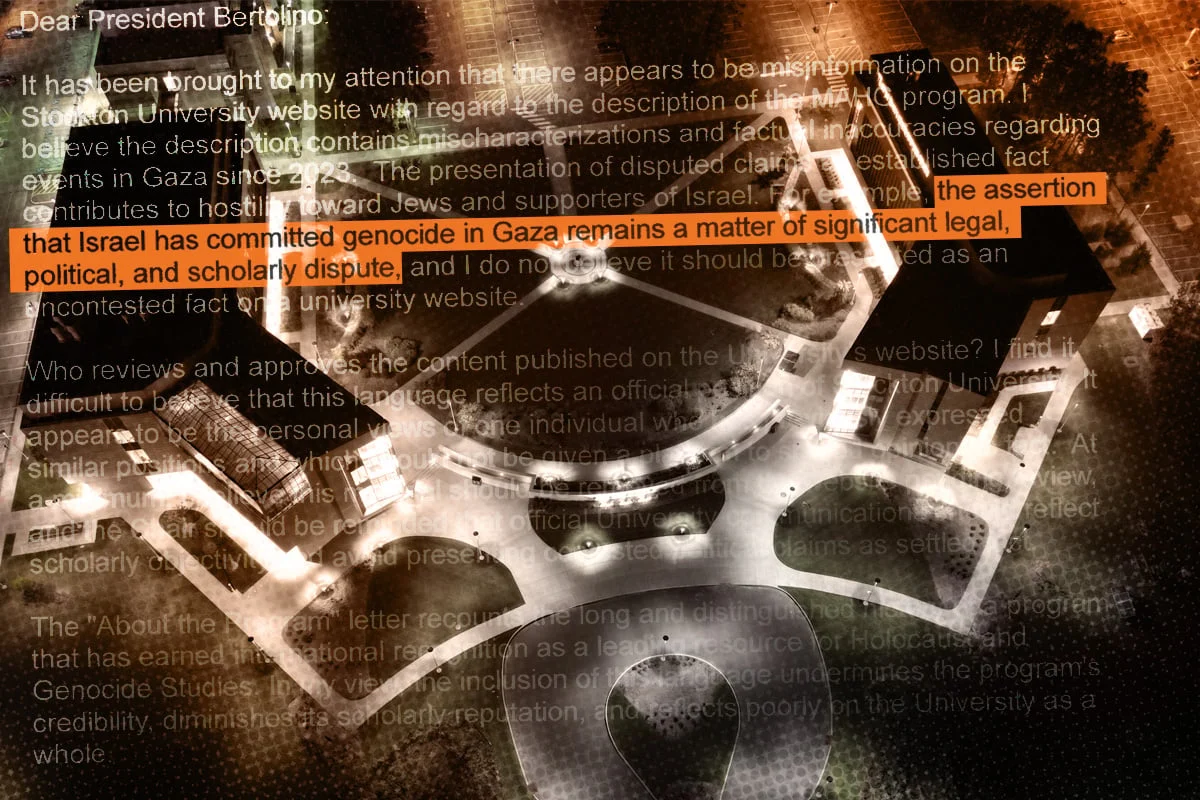
The catalyst for the removal was a letter dated July 31 from John F. Scarpa, a prominent Stockton donor with a history of significant financial contributions to the university and various conservative causes. In his correspondence to Stockton President Joe Bertolino—which was also leaked to The Press of Atlantic City—Scarpa characterized the language as "misinformation" and "factual inaccuracies."
"The presentation of disputed claims as established fact contributes to hostility toward Jews and supporters of Israel," Scarpa wrote. "For example, the assertion that Israel has committed genocide in Gaza remains a matter of significant legal, political, and scholarly dispute, and I do not believe it should be presented as an uncontested fact on a university website."
Within two days of receiving the letter, university officials scrubbed the text from the website. They also removed other materials, including mission statements and updates on current events, without prior notice to the department. While the university initially claimed the action was part of a routine, ongoing review of graduate program webpages, the timing and the lack of consultation with faculty have led many to characterize the move as a capitulation to external pressure.
The Academic Debate: Genocide as Fact or Dispute?
At the core of the disagreement is the classification of the events in Gaza. While Stockton officials and donors frame the term "genocide" as an inflammatory, contested opinion, scholars like Raz Segal argue that such a classification is rooted in established international legal frameworks and a growing consensus within the academic community.
Segal, who is himself Jewish, Israeli, and the grandson of Holocaust survivors, points to the 2024 resolution by the International Association of Genocide Scholars. The organization formally declared that "Israel’s policies and actions in Gaza meet the legal definition of genocide" as outlined in the United Nations Convention for the Prevention and Punishment of the Crime of Genocide.
"This is clearly the university caving to crude donor interference," Segal told Inside Higher Ed. He rejects the notion that the claim is merely a personal opinion, arguing that his message reflected the scholarly consensus of those who study the mechanism of genocide for a living. By deleting the text, Segal argues, the university is not merely maintaining neutrality; it is participating in a form of political censorship that undermines the very purpose of a Holocaust and Genocide Studies program.
Official Responses and Administrative Damage Control
In the wake of the public outcry, the administration of Stockton University has been forced to walk a precarious line. While a university spokesperson maintained that "donors do not have decision-making authority over Stockton’s academic or institutional decisions," the optics of the situation suggest otherwise.
In an effort to quell the rising anger among faculty and students, President Joe Bertolino and Board Chair José Lozano issued a joint message to the university community. While they stopped short of admitting that the donor’s influence was the primary driver of the deletion, they acknowledged that the process had been fundamentally flawed.
"We may not all agree about what belongs on an official University webpage," the statement read. "But we can say this plainly: the process used in this instance should have included more consultation and better communication with the academic units involved."
The leadership vowed to launch an internal review of policies regarding webpage content and promised to find better ways to "highlight faculty scholarship, expertise and public engagement." However, for many faculty members, these assurances come too late. The damage to the university’s reputation regarding its commitment to intellectual independence has already been done.
Broader Implications: The "Good Jew/Bad Jew" Narrative
The controversy at Stockton is not an isolated event for Dr. Segal. In a chilling case of déjà vu, Segal was offered the position of director of the University of Minnesota’s Center for Holocaust and Genocide Studies in 2024, only to have the offer rescinded following intense pressure from donors who objected to his public stance on the conflict in Gaza.
Segal eventually won a $250,000 settlement from the University of Minnesota, and public records revealed a campaign of donor emails that attacked his character and scholarship. The parallels between the two institutions are striking, with both universities seemingly willing to sacrifice academic personnel and integrity to avoid alienating wealthy stakeholders.
Segal views these attacks as a strategic weaponization of antisemitism. "It’s really playing this game of ‘good Jew, bad Jew,’" he explained. "Good Jews are Zionists, good Jews support Israel, and if you don’t then you’re a bad Jew. And playing the good Jew-bad Jew game, as we know, is very real antisemitism."
By framing the disagreement as a conflict between "supporters of Israel" and those promoting "hostility toward Jews," donors like Scarpa are effectively silencing dissent by equating anti-war critique with bigotry. This narrative, according to critics, is not only intellectually dishonest but also dangerous to the climate of free inquiry on college campuses.
The Future of Academic Freedom
The American Federation of Teachers (AFT) New Jersey has emerged as a vocal defender of Segal and the principle of academic freedom. AFT New Jersey President Jennifer S. Higgins did not mince words in her assessment of the situation. "Our public universities must remain an environment for open and free discourse among our students and faculty," she stated. "Allowing donors to dictate what speech or debate is allowable on campus is inappropriate, counterproductive and deeply un-American."
As Stockton University moves forward with its promised review of internal policies, the academic community will be watching closely. The case highlights a systemic vulnerability in the university model: the reliance on private funding in an era where donors are increasingly emboldened to demand ideological alignment from the institutions they support.
If a public university—an entity intended to serve the public interest and foster critical thinking—cannot protect its faculty from the whims of a donor, it risks losing its status as a sanctuary for intellectual exploration. The removal of content from the Holocaust and Genocide Studies website is more than a technical dispute over web layout; it is a signal that the walls of the ivory tower are becoming increasingly porous to the pressures of the political and financial elite.
For scholars like Raz Segal, the message is clear: the fight for academic freedom is inseparable from the fight to define reality. When a university chooses to delete, rather than debate, it abdicates its responsibility to provide a space where the most difficult truths can be examined. Whether Stockton University can recover its standing in the eyes of its faculty and the wider academic community depends on whether it chooses to prioritize the voices of its scholars over the demands of its donors.