
The 2026 Fortune 500 rankings have unveiled a stark paradox at the heart of the American economy. While the nation’s largest corporations are generating unprecedented wealth—shattering records for revenue, profit, and market capitalization—the human engine powering these entities is getting smaller. For the second consecutive year, the total headcount of the Fortune 500 has declined, marking a decoupling of corporate prosperity from job creation that has historically only occurred during periods of severe economic recession.
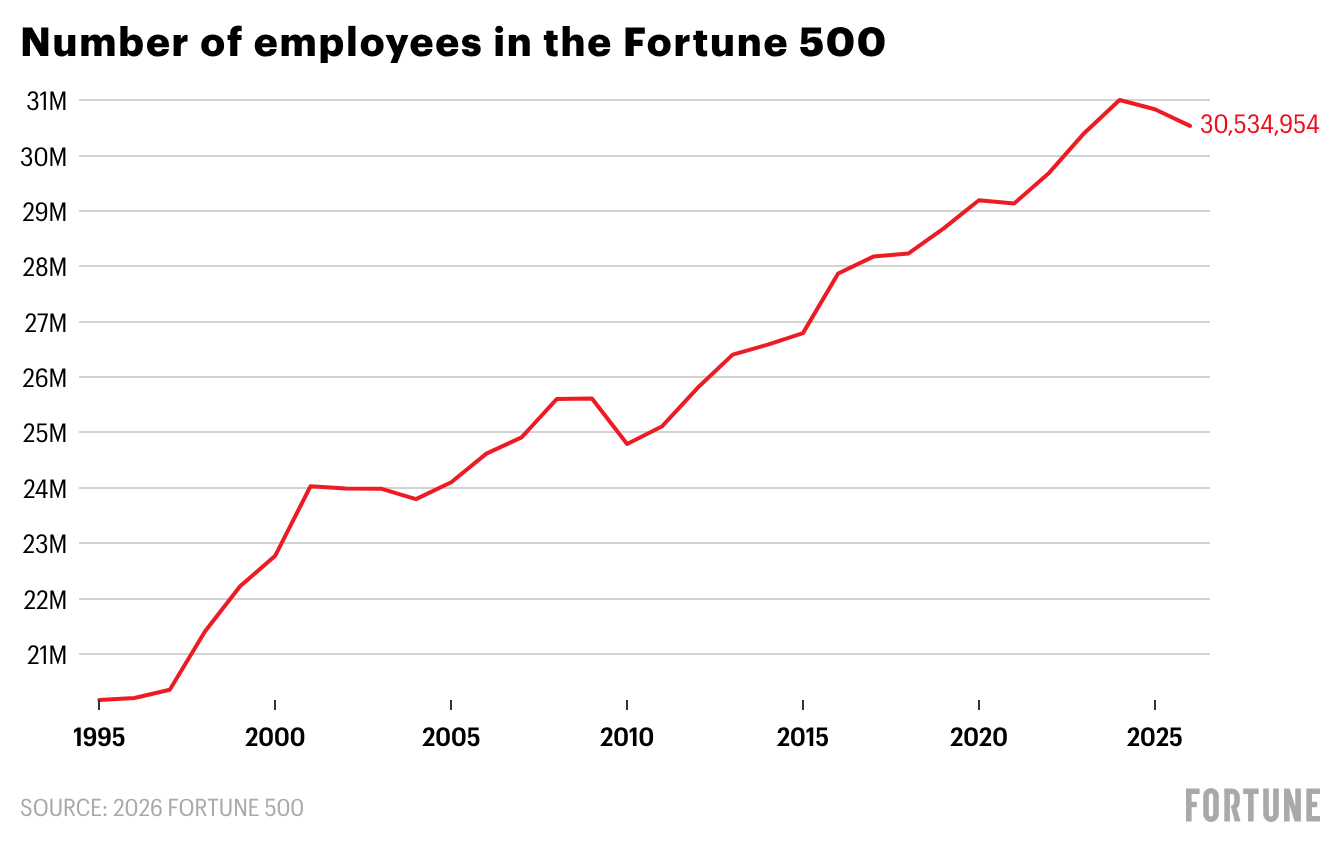
In a fiscal year defined by the aggressive integration of Artificial Intelligence (AI) and a "low-hire, low-fire" labor philosophy, the 500 largest U.S. companies generated a staggering $21 trillion in revenue, a 5% increase from the previous year. Profits saw an even more dramatic surge, ballooning 12% to $2.1 trillion. Investors, buoyed by AI-driven efficiency gains, pushed the collective market cap of these firms up 19% to a total of $55 trillion. Yet, beneath these "up and to the right" metrics lies a troubling trend: the total workforce of these giants fell by 1%, or roughly 301,049 workers, bringing the total headcount down to 30.5 million.
Main Facts: A Record-Breaking Year of Divergent Metrics
The 2026 Fortune 500 data highlights a historic shift in how value is created in the modern economy. The list, which ranks U.S. companies by total revenue, shows that the threshold for dominance is higher than ever, yet the labor requirements to reach that threshold are diminishing.
Key Financial Indicators:
- Total Revenue: $21 trillion (+5% YoY)
- Total Profits: $2.1 trillion (+12% YoY)
- Market Capitalization: $55 trillion (+19% YoY)
- Revenue per Employee: $687,094 (All-time high)
- Profit per Employee: $68,743 (All-time high)
The Labor Contraction:
While the financial figures are booming, the human element is in retreat. The 1% drop in headcount is the second consecutive annual decline. Historically, since 1995—the year the Fortune 500 began incorporating service firms—downward trends in employment have been synonymous with economic contractions. However, the 2026 data reflects a "recalibrated" economy where growth is achieved through technological optimization rather than payroll expansion.
Chronology: From Recessionary Signals to Structural Shifts
To understand the 2026 headcount drop, one must look at the evolution of the Fortune 500 over the last three decades. Between 1995 and 2024, employment growth was generally seen as a sign of corporate health. When headcounts fell, it was almost always a lagging indicator of a recession, such as the 2001 dot-com bubble burst or the 2008 financial crisis.

The current decline, however, is occurring amidst record-breaking profitability. This suggests a structural rather than cyclical change. In 2024 and 2025, many firms began "right-sizing" following the post-pandemic hiring surge. By 2026, this trend evolved into a permanent strategy of lean operations.
A significant portion of the 2026 decline is attributed to "list churn"—the process of companies entering and exiting the rankings. The departure of labor-intensive legacy retailers has significantly altered the list’s total headcount.
- August 2025: Walgreens Boots Alliance, a perennial top-25 employer with 252,500 workers, was acquired by private equity firm Sycamore Partners and taken private, removing it from the 2026 list.
- Late 2025: Nordstrom followed a similar path, exiting the public markets in a take-private deal and taking its 41,000 employees off the Fortune 500 ledger.
- The Net Loss: Collectively, the 22 companies that dropped off the list this year employed 659,640 people. Their replacements—a leaner group of 22 newcomers—employed just 317,414 people, less than half the total of the departing firms.
Supporting Data: Sector Analysis and Corporate Anomalies
The contraction in the workforce is not uniform across all industries, but it is most pronounced in the sectors that have traditionally been the largest employers.
Retail and Tech Lead the Decline
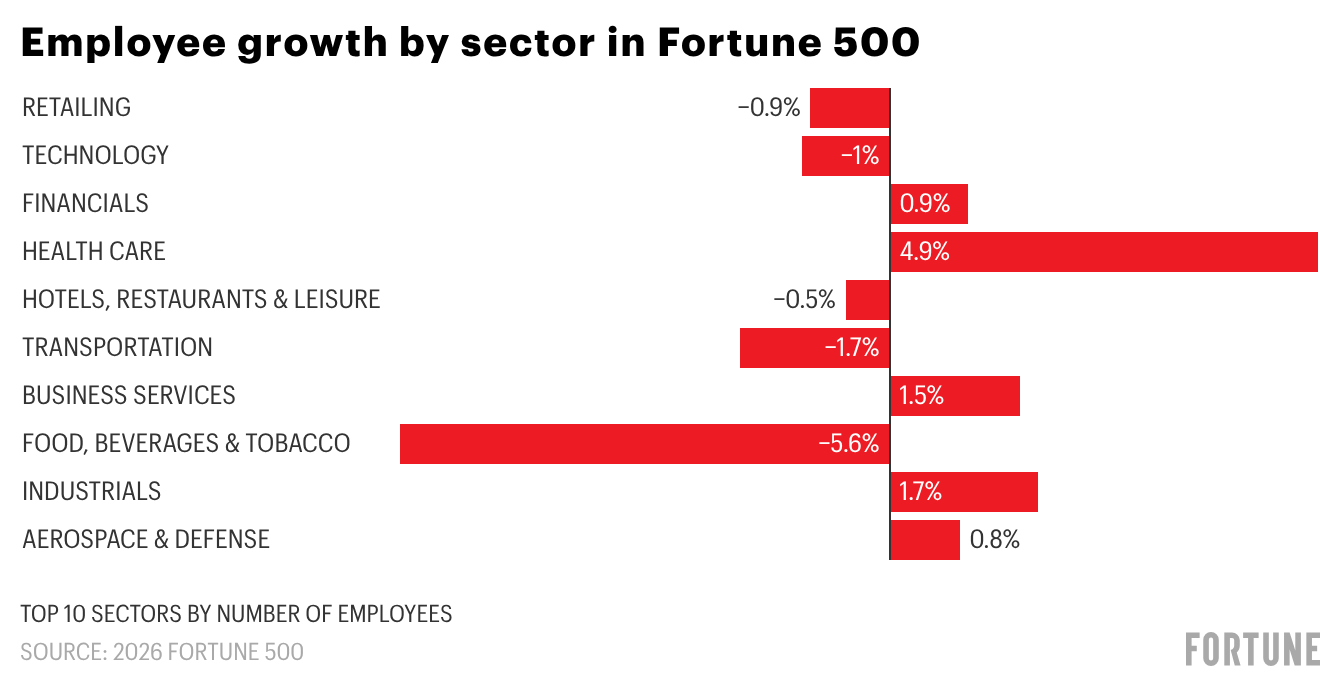
Retailing remains the largest sector by headcount, employing over 7 million people, but its total workforce dropped by 0.9%. This is largely due to the exit of Walgreens and Nordstrom, but also reflects a broader move toward automated checkout and AI-managed logistics.
The Technology sector, the second-largest employer, saw its headcount drop by 1% to 3.8 million. Despite the "AI hype" driving market caps to new heights, tech giants have remained disciplined, favoring automation over new hires. In contrast, the Financials sector saw a modest growth of 0.9%, reaching 3.5 million workers, as banks expanded their advisory and wealth management divisions.
Growth through M&A vs. Organic Hiring
Among the incumbent firms (those that remained on the list from 2025 to 2026), headcount growth was a negligible 0.1%. Where growth did occur, it was often the result of consolidation rather than organic job creation:
- Dick’s Sporting Goods: Recorded a massive 83.1% jump in headcount (31,050 employees) following its acquisition of Foot Locker in September 2025.
- Carvana: The online used-car retailer added 5,700 employees (+32.8%), marking a dramatic comeback after its 2022-2023 stock collapse.
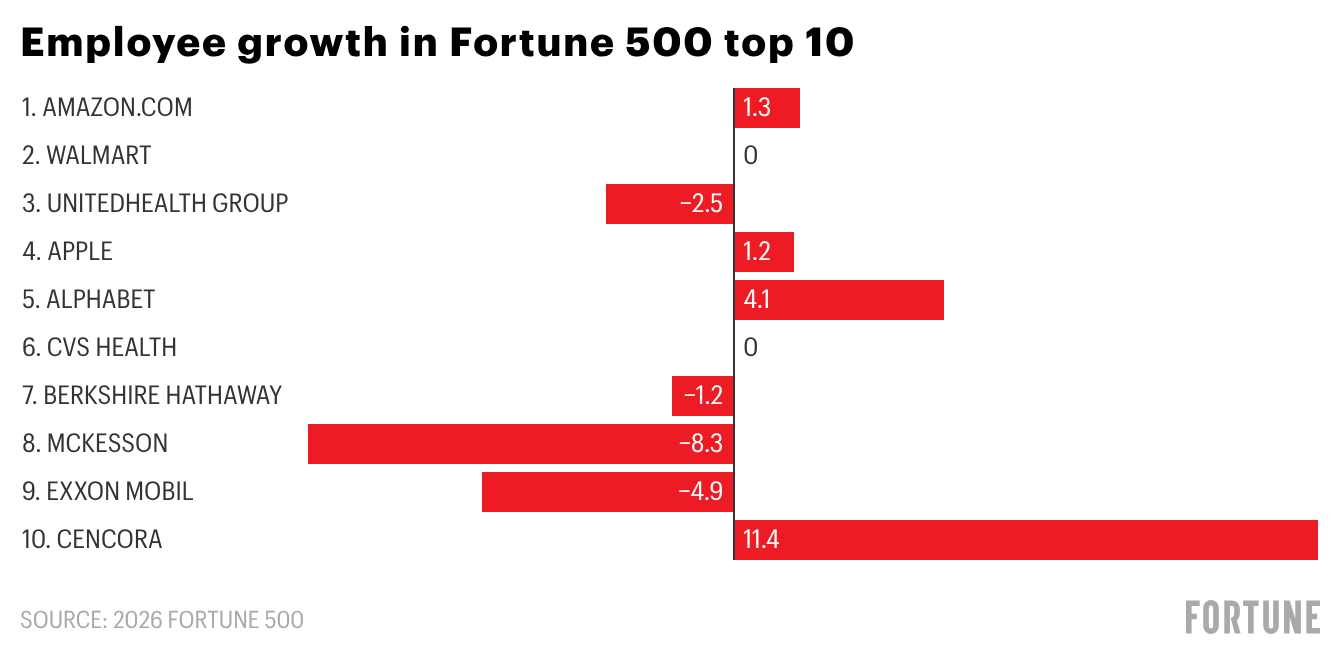
- Amazon: The No. 1 company on the list added 20,000 workers (+1.3%), maintaining its status as a labor juggernaut despite increasing warehouse automation.
- UnitedHealth Group: The No. 3 company saw a headcount dip of 10,000 (-2.5%), signaling efficiency drives in the healthcare services sector.
The Rise of the "Micro-Giants"
Perhaps the most startling data point in the 2026 list is the arrival of ultra-efficient digital asset firms. New York-based Galaxy Digital debuted at No. 76 on the Fortune 100 with only 700 employees. To put this in perspective, the next smallest employer in the top 100 has nearly eight times that many workers. Similarly, Bitgo Holdings landed at No. 278 with a mere 603 employees. These firms represent the pinnacle of the revenue-per-employee metric, generating billions with a fraction of the staff required by traditional industrial or retail firms.
Official Responses and Economic Commentary: The "Low-Hire, Low-Fire" Era
Economists and academics are closely watching this trend, noting that the relationship between corporate success and public welfare is being redefined. Lawrence Katz, an economics professor at Harvard University, describes the current environment as a "low-hire, low-fire economy."
"Large firms have successfully outsourced labor-intensive work while reaping massive productivity gains from technology," Katz explains. "Those factors have meant that sales and value-added have gone up dramatically more than employment for the largest firms."
Katz points out a growing disparity in how these gains are distributed. While "old-style" manufacturing companies or unionized banks once shared productivity gains with a broad workforce, today’s titans operate differently. "They hire professional, talented individuals who are rewarded dramatically, but they’re not sharing the huge productivity gains with the broader workforce in the same way," he says.
Corporate leadership, meanwhile, has defended the lean approach as a necessity for survival in an AI-first world. In annual reports and earnings calls throughout 2025, CEOs across the Fortune 500 emphasized "operational efficiency" and "AI-agent integration." The prevailing sentiment among the C-suite is that the goal is no longer to be the biggest employer, but the most efficient one.
Implications: The Future of Work and the Productivity-Wage Gap
The 2026 Fortune 500 results carry profound implications for the future of the American middle class and the broader social contract.
1. The Widening Productivity-Pay Gap
The math for 2026 is stark: Fortune 500 companies are earning more per employee than ever before—$687,094 in revenue and $68,743 in profit. However, data from the Economic Policy Institute suggests that inflation-adjusted wages for the average worker have stayed relatively flat over the same period. This suggests that the "AI revolution" is primarily benefiting shareholders and high-level executives, while the broader labor force sees fewer opportunities for entry into these top-tier firms.
2. AI as the "New Worker"
As AI agents move from experimental tools to core components of corporate infrastructure, the "employment imprint" of the Fortune 500 is likely to continue shrinking. If a company like Galaxy Digital can crack the Top 100 with 700 employees, it sets a precedent for future startups. We may be entering an era where a company can reach "unicorn" status and beyond with a headcount that would have been considered a small business 20 years ago.
3. The Shift to Private Equity
The exit of Walgreens and Nordstrom highlights a trend where labor-heavy industries are being moved off public ledgers and into the hands of private equity. Private equity firms often implement aggressive cost-cutting measures that public markets may find unpalatable. This "hiding" of large workforces in private entities may make the Fortune 500 appear more tech-centric and efficient than the actual economy, creating a "two-tier" corporate landscape.
4. New Business Dynamics
While the Fortune 500 is shrinking its workforce, Professor Katz notes a "flourishing of smaller-scale enterprises." These startups may be the primary engines of job creation in the future, even if they never reach the revenue heights of the Fortune 500. However, if these new businesses are also "re-engineered to focus on AI agents as their main sort of workers," the total number of available high-quality jobs in the economy may face a permanent downward pressure.
Conclusion
The 2026 Fortune 500 paints a picture of a corporate America that is stronger, richer, and more efficient than at any point in history. However, it also reveals a growing detachment from the traditional role of the corporation as a mass employer. As the "Lean Giants" continue to break financial records with fewer human hands, the challenge for policymakers and society at large will be to ensure that the $21 trillion in wealth generated by these firms contributes to a stable and inclusive economy for the 300 million Americans who don’t work for them.