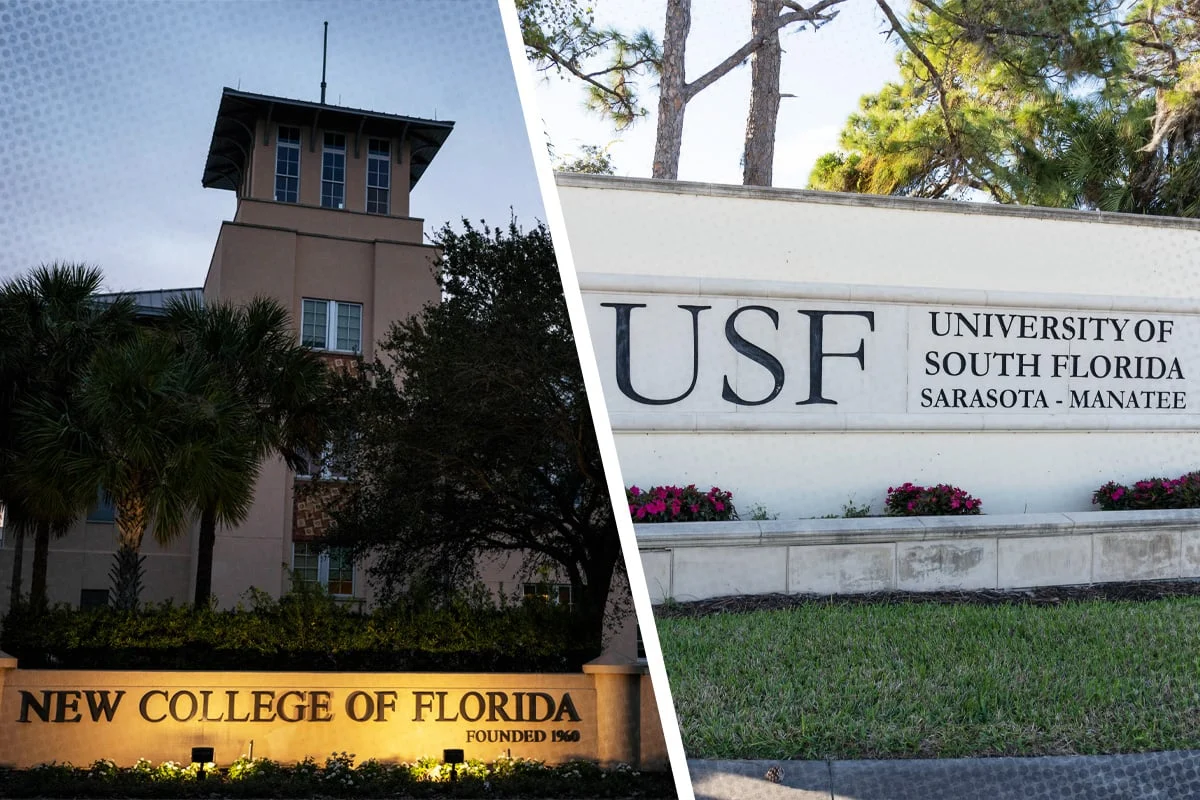
The landscape of higher education in Southwest Florida underwent a seismic shift on July 1, 2026, as the 32-acre University of South Florida (USF) Sarasota-Manatee campus officially transitioned to the jurisdiction of the New College of Florida. This transfer, mandated by state legislation championed by Governor Ron DeSantis, marks a significant expansion for New College, an institution that has become the centerpiece of the governor’s vision for a conservative restructuring of Florida’s public university system.
However, the "takeover" is far from a clean break. Behind the legislative language lies a complex, multi-year logistical undertaking involving over 1,000 students, dozens of faculty members, and a web of financial obligations that threatens to complicate the future of both institutions.
The Mechanics of a Complicated Handover
While the real property of the Sarasota-Manatee campus technically moved under the ownership of New College’s Board of Trustees on the first of July, the reality of the campus operation remains tethered to USF. Under the provisions of House Bill 5601E, signed into law by Governor DeSantis on June 29, USF is required to conduct a "teach-out" for existing students.
This mandate ensures that students admitted to the Sarasota-Manatee campus prior to the July 1 transfer date are permitted to remain on-site to complete their degrees. This process, which could span up to four years, effectively creates a bifurcated campus environment. New College has already begun implementing a floor-plan strategy that designates specific zones as "USF space" (green), "New College space" (white), and "shared space" (pink).
The financial implications of this transfer are equally layered. New College is now responsible for a monthly payment of approximately $167,000 to USF to service existing debt on the facilities. Furthermore, the college faces a looming deadline: by December 31, 2026, it must assume full responsibility for tens of millions of dollars in outstanding facility debt. Should New College fail to meet this obligation, the law dictates that the campus property must revert to USF, casting a shadow of financial uncertainty over the transition.
Chronology: How the Merger Materialized
The path to the transfer was characterized by swift legislative maneuvering and a lack of public discourse that has left community stakeholders searching for answers.
- September 2024: Formal discussions regarding the future of the Sarasota-Manatee campus commenced between USF leadership, New College, the Florida Board of Governors, and the Chancellor’s office.
- January 2025: A draft news release leaked to WUSF revealed that New College had been preparing for the acquisition months before it became public knowledge.
- December 2025: Governor DeSantis formally included the campus transfer in his proposed budget, signaling the executive branch’s intent to push the initiative through the legislature.
- May 2026: Following months of debate and legislative fits and starts, the Florida Legislature passed the budget-session bill authorizing the transfer.
- June 29, 2026: Governor DeSantis signed HB 5601E into law.
- July 1, 2026: Official transfer of the 32-acre property occurred, marking the first day of the multi-year teach-out period.
Supporting Data: Enrollment and Expenditure Concerns
The scale of the "teach-out" is substantial. According to USF President Moez Limayem, more than 1,000 students are currently enrolled in the teach-out program. This number is particularly striking when compared to New College’s own enrollment figures; as of the last report to the Department of Education, New College had an enrollment of just under 900 students. This implies that for the immediate future, USF students will physically outnumber the New College student body on the newly acquired campus.
The financial sustainability of New College remains a point of intense scrutiny. Critics have pointed to data from the Florida Department of Government Efficiency, which found that in fiscal year 2024, New College spent $83,207 per student—a figure significantly higher than the $45,765 spent per student at the University of Florida. Observers, such as faculty critic Jonathan Scott Perry, argue that the added burden of debt service for the Sarasota-Manatee campus could exacerbate these fiscal pressures.

Official Responses and Institutional Positioning
The administrative response to the transition has been one of practiced professional optimism. New College spokesperson Jamie Miller described the process as "extremely smooth and professional," emphasizing that the arrangement allows the college to grow in a "sustainable way" while honoring USF’s obligations to its current students.
USF leadership has focused on the relocation of its faculty and staff. President Limayem stated that the "overwhelming majority" of the 137 faculty members at Sarasota-Manatee have been successfully matched with roles at the Tampa or St. Petersburg campuses. Staff and administrative personnel are undergoing a similar assessment process. David Simmons, president of the USF Faculty Senate, noted that while there is a general sense of disappointment, the university is moving forward, noting that the Tampa and St. Petersburg campuses have a sustained need for instructional talent.
However, internal dissent remains. Jonathan Scott Perry, who was vocal in his opposition to the transfer, remains skeptical of the execution. "They’re going to have to find classes, times, who’s going to teach the class, when," Perry remarked. "I really think this teach-out is going to be a catastrophe."
Implications for the Community and Higher Education
The implications of the transfer extend far beyond administrative logistics, touching upon the regional mission of higher education. The Sarasota-Manatee campus was a vital hub for professional degree programs, including nursing and education—fields that are critical to the local economy.
Nancy Parrish, president of the group "Citizens to Protect the Ringling and USF Sarasota-Manatee," characterized the move as the unnecessary dismantling of a beloved regional institution. "These were the programs this community needed," Parrish said. She argued that New College’s reliance on political support from Tallahassee makes it a precarious entity. "New College has one benefactor—that’s Tallahassee. When lawmakers tire of it, or can’t handle the political blowback from spending more taxpayer money on it, the college will be in serious financial trouble."
Laurey Stryker, the founding president of the Sarasota-Manatee campus in 2006, echoed these concerns. She described the move as a legacy-defining act by a "lame-duck governor," suggesting that the long-term impact on the community will be severe. "There was nothing that ever explained why this was a great idea," Stryker noted, emphasizing that the campus had long served as a vital bridge for working professionals seeking higher education.
Looking Toward the Future
As the 2026-2027 academic year begins, the Sarasota-Manatee campus stands as a physical representation of the current ideological tug-of-war in Florida politics. New College, now armed with a larger footprint, aims to redefine its identity as a growing institution. Meanwhile, USF is forced to balance its institutional integrity during a multi-year exit, and the local community is left to navigate the loss of a regional educational anchor.
The success or failure of this experiment will likely be measured by several benchmarks in the coming months: the ability of New College to manage its debt, the smoothness of the USF teach-out, and whether the regional workforce programs previously housed at the campus can be replicated or replaced. For now, the transition serves as a stark reminder of how political agendas can fundamentally redraw the map of public education, often at the expense of established regional stability.