In an era where Silicon Valley’s venture capital appetite is often satiated by "horizontal" AI tools—general-purpose chatbots and productivity suites for white-collar knowledge workers—a New York-based startup has secured a massive valuation by focusing on the gritty, heavily regulated, and often overlooked "back-office" of the American economy.
EliseAI, the artificial intelligence firm specializing in the automation of property management and healthcare administration, has announced a $350 million funding round, catapulting its valuation to $4 billion. This milestone, shared exclusively with Fortune, represents a near-doubling of the company’s market cap in just over a year, signaling a significant shift in investor sentiment toward "vertical AI"—technology designed to solve specific, deep-seated problems within traditional industries.
I. Main Facts: A Landmark Funding Round in a Tight Market
The $350 million Series F (implied by the progression) was co-led by a powerhouse trio: existing heavyweights Andreessen Horowitz (a16z) and Bessemer Venture Partners, alongside a notable new entrant, the Ontario Teachers’ Pension Plan. The round also saw continued participation from Sapphire Ventures and Navitas Capital.
The capital structure of this round is particularly telling of the company’s internal health. According to CEO and co-founder Minna Song, the $350 million consists entirely of primary capital. In a market where many late-stage startups use new rounds to facilitate secondary sales—allowing early investors or employees to cash out—EliseAI’s decision to keep the capital within the company’s balance sheet suggests a high level of conviction in its future growth trajectory.
Key Financial and Operational Metrics:
- Current Valuation: $4 billion.
- Previous Valuation (2023): $2.2 billion.
- Annual Recurring Revenue (ARR): Surpassed $200 million in June 2024.
- Growth Rate: Five consecutive years of doubling year-over-year revenue.
- Market Penetration: Powering roughly one in six apartments in the United States.
- User Engagement: More than 30 million Americans have interacted with EliseAI’s platform.
- Operational Scale: The platform handles approximately 5 million calls per month across housing and healthcare sectors.
II. Chronology: The Rapid Ascent of a Contrarian Powerhouse
The journey of EliseAI is a study in disciplined execution. Just 13 months ago, the company closed a $250 million Series E round that valued the firm at $2.2 billion. To nearly double that valuation in a climate where "AI fatigue" has begun to set in for some investors is a testament to the company’s tangible bottom-line impact.
The company’s origins are rooted in a "boots-on-the-ground" philosophy. Before writing a single line of code, Minna Song took a job at a real estate firm. This "research phase" was designed to identify the specific operational bottlenecks that drove up costs for landlords and created friction for tenants. This immersion led to the realization that the primary inhibitor of efficiency wasn’t a lack of high-level strategy, but the sheer volume of "phone-based bureaucracy" and repetitive administrative tasks.
Since its inception, EliseAI has methodically expanded its suite of services:
- Early Phase: Focus on automated leasing inquiries and lead management.
- Growth Phase: Expansion into resident services, maintenance requests, and lease renewals.
- Diversification Phase: Launching a dedicated healthcare vertical to manage patient journeys.
- The "Apollo" Era: Launching a unified AI agent capable of cross-functional task completion.
This summer, the company underscored its maturity by moving its headquarters into a 109,000-square-foot office in Manhattan’s iconic former Tiffany & Co. building on Fifth Avenue. The new $350 million infusion will now fund a second engineering hub in San Francisco and an aggressive hiring push across North America.
III. Supporting Data: The Economic Crisis Driving Demand
EliseAI’s explosive growth is not merely a result of clever engineering; it is a response to a dual-sided economic crisis in housing and healthcare.
The Housing Squeeze
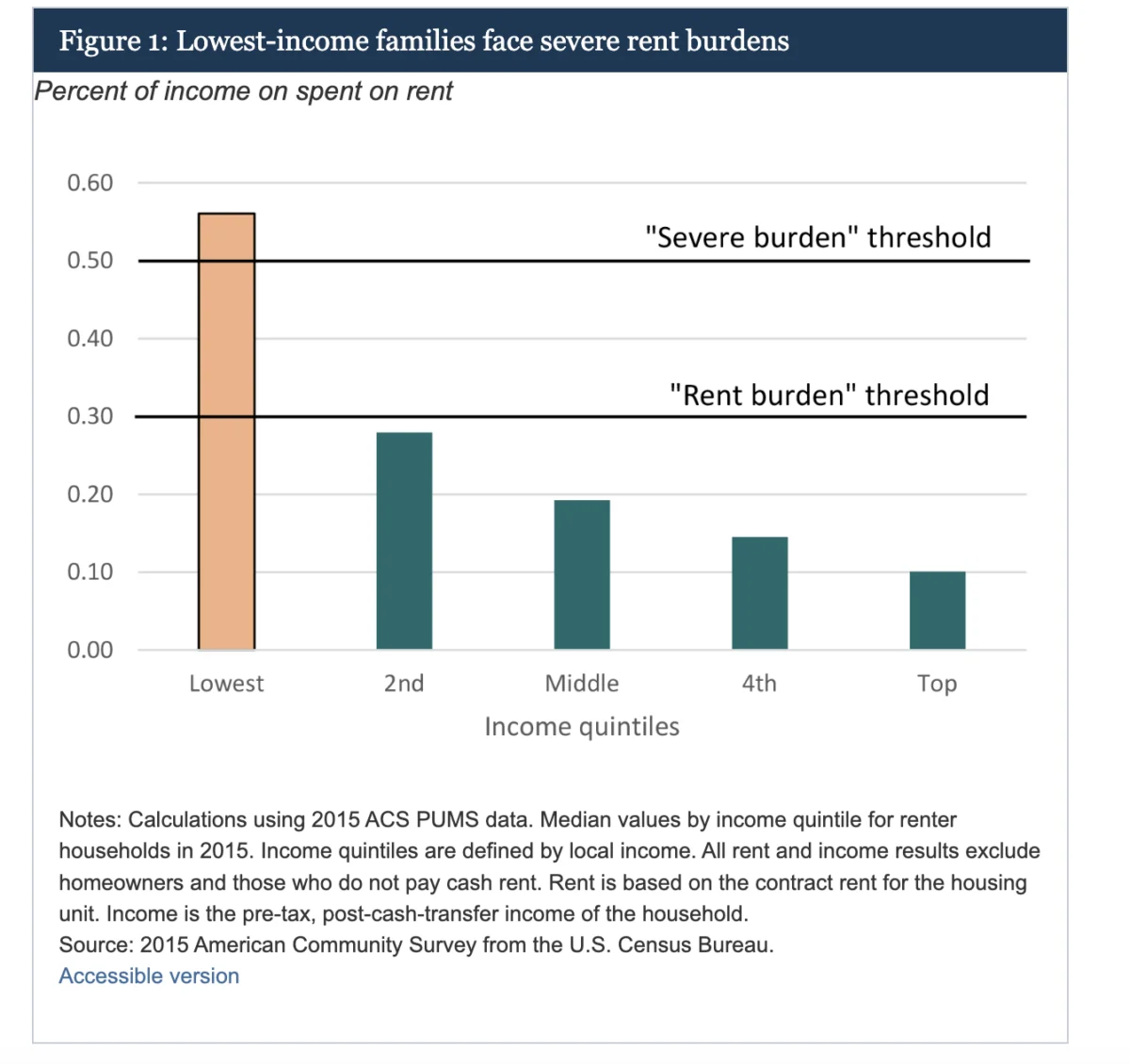
On one side, renters are facing historic affordability challenges. According to a Congressional Research Service analysis of Census data, 66.5% of renter households earning under $30,000 a year spend more than half of their income on rent—a burden described as "severe." Federal Reserve research further notes that the median renter in the lowest income bracket allocates 56% of their monthly income to housing alone.
On the other side, landlords are struggling with skyrocketing operating costs. Data from Yardi, cited by the Pension Real Estate Association, shows that national multifamily operating costs rose 9.3% in a single year (mid-2022 to mid-2023). This was driven largely by an 18.8% spike in insurance premiums. A separate Federal Reserve study found that multifamily insurance costs rose 75% in real terms between 2019 and 2024. Crucially, landlords have absorbed roughly three-quarters of these increases, leading to thinned margins and a desperate need for operational efficiency.
The Healthcare Bottleneck
The healthcare sector mirrors these inefficiencies. KFF polling indicates that 41% of U.S. adults carry medical debt. Much of this debt is exacerbated by administrative overhead, which accounts for a significant portion of healthcare spending in the U.S. By automating the "patient journey"—from the first inbound call through insurance verification and follow-up—EliseAI aims to reduce the "cost to deliver" care.
IV. Official Responses: Leadership on the "Judgment Gap"
CEO Minna Song maintains that the secret to the company’s $4 billion valuation is its focus on the "un-sexy" problems that Silicon Valley often ignores.

"The industries where AI matters most are still not the ones getting the most attention," Song told Fortune. "Housing has enormous problems to solve, and we’ve grown by going deeper with our customers until we solve them at the root."
Song is particularly vocal about the evolution of the software application layer. She argues that traditional software was "reactive," requiring a human to navigate various systems. EliseAI’s new "Apollo" agent flips this script, allowing the AI to recognize what needs to happen and take action within set permissions.
However, Song is careful to address the concerns regarding AI autonomy. "The humans don’t disappear," she emphasized. "They’re still there when something requires judgment or nuance or the human touch. But the AI is handling more and more of the operations and just knows when to bring the person in."
Investor Confidence
Sameer Dholakia, a partner at Bessemer Venture Partners who is joining EliseAI’s board, echoed this sentiment. He noted that the company’s value lies in its deep integration into the day-to-day complexity of the industries it serves. "The company combines exceptional AI research and engineering with a detailed understanding of how properties operate," Dholakia said. "That depth has produced measurable results for their customers, leading to deep customer love."
The involvement of the Ontario Teachers’ Pension Plan as a new lead investor is also strategic. Pension funds, which are major owners of real estate assets globally, have a vested interest in technologies that can preserve margins in their property portfolios while improving tenant satisfaction.
V. Implications: The Future of Vertical AI and the "Human-in-the-Loop"
The success of EliseAI carries several profound implications for the broader technology and economic landscape.
1. The Shift to Agentic AI
The launch of "Apollo" signifies a move toward "agentic" AI—systems that don’t just answer questions but execute multi-step workflows. Unlike a chatbot that might tell a tenant how to file a maintenance request, Apollo can receive the request, check the building’s contractor schedule, verify the tenant’s lease terms, and dispatch a repair person, only flagging a human manager if a high-cost approval is needed.
2. Safeguards and "Binding Decisions"
As AI takes over more of the economy, the "guardrails" become the product itself. EliseAI has built-in checkpoints where "binding decisions"—such as approving or denying a rental application or signing off on a legal lease term—must still go through a human. This hybrid model provides a blueprint for how AI can be integrated into highly regulated industries like Fair Housing and healthcare without running afoul of legal or ethical standards.
3. The OpenAI Partnership
EliseAI’s status as one of the largest voice AI deployments at scale has made it a key partner for OpenAI. By testing OpenAI’s latest voice capabilities in real-world environments (handling 5 million calls a month), EliseAI is helping refine the latency and emotional intelligence of voice AI, which will eventually trickle down to other sectors.
4. Economic "Cost Disease" Mitigation
Economists often cite "Baumol’s Cost Disease," where salaries in sectors without productivity gains (like healthcare and education) rise to keep pace with sectors that have high productivity gains (like manufacturing). By introducing massive productivity gains into property management and clinical administration, EliseAI is attempting to "bend the cost curve" of essential services. As Song put it: "You can’t make housing meaningfully cheaper without making it cheaper to operate."
Conclusion: A Bigger Bet on Complexity
Despite its new $4 billion valuation, EliseAI remains focused on the "hard" problems. The company is currently on a massive hiring spree across New York, San Francisco, Boston, Chicago, Austin, and Toronto.
While many AI startups are currently engaged in a "race to the bottom" on price for simple text generation, EliseAI is betting that the most durable and valuable businesses will be those built inside the industries that have been the hardest to automate. By digitizing the "un-sexy" back-office, EliseAI isn’t just building a software company; it is building the operating system for the physical world. For now, the path to an IPO remains secondary to the goal of solving "important things that have largely been unchanged for decades."