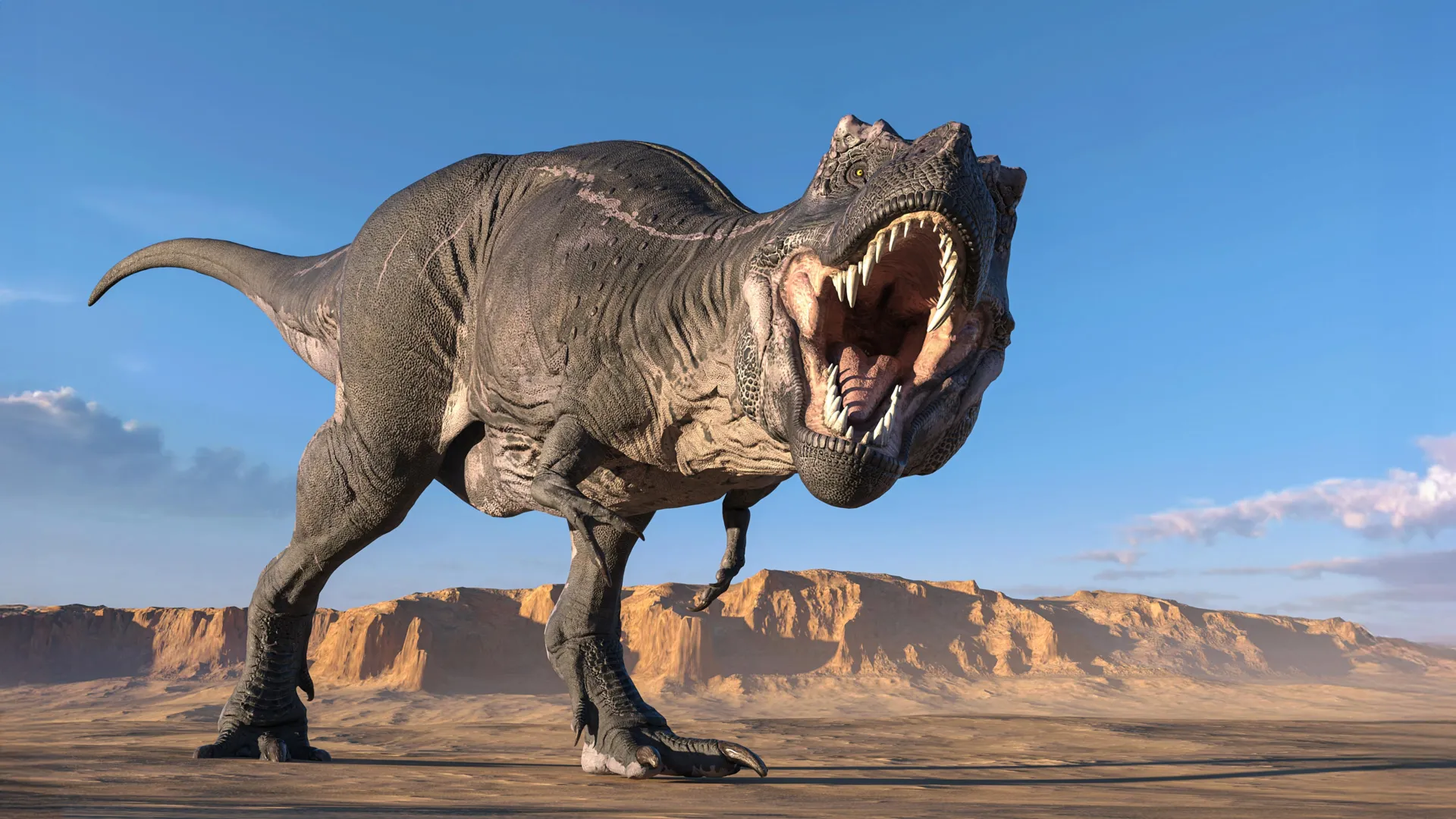
For more than a century, the Tyrannosaurus rex has stood as the undisputed monarch of the prehistoric world. Yet, for all its fame, the biological inner workings of this apex predator have remained shrouded in mystery. Was it a sluggish, cold-blooded giant reliant on the sun’s warmth, or a high-octane, warm-blooded engine of destruction?
A groundbreaking study, published recently in Science Advances, has finally settled the debate. By refining a revolutionary geochemical technique, researchers at UCLA have effectively taken the temperature of the T. rex, placing it at a cozy 97 degrees Fahrenheit—remarkably close to the average human body temperature. This discovery offers the first empirical evidence of the dinosaur’s internal metabolism, reshaping our understanding of how the king of dinosaurs conquered the Cretaceous world.
The Quest to Unmask the Metabolism of Giants
The debate over dinosaur metabolism has persisted since the mid-19th century. Early paleontologists viewed dinosaurs as "terrible lizards"—slow-moving, cold-blooded beasts. By the 1960s, the "Dinosaur Renaissance" began to challenge this, suggesting that dinosaurs were far more active, social, and perhaps even warm-blooded (endothermic).
Evidence for this shift has been mounting for decades. Paleontologists have uncovered T. rex fossils as far north as Alaska, a region that would have been unforgiving for a cold-blooded animal. Furthermore, the evolutionary link between dinosaurs and modern birds—the ultimate warm-blooded creatures—suggested that the thermal transition must have occurred somewhere along the line. However, direct evidence was missing. Measuring the body temperature of an animal that died 66 million years ago was, until recently, considered an impossibility.
A Chronology of Innovation: From Theory to Precision
The journey to this discovery began about a decade ago when a team of geobiologists at UCLA started developing a "paleo-thermometer." The goal was to use the chemical composition of fossils to determine the metabolic state of extinct creatures.
The Early Hurdles
The initial iteration of the methodology was theoretically sound but practically destructive. To get a reliable reading, the team required large amounts of skeletal material. Museums, which act as the custodians of irreplaceable natural history, were understandably hesitant to allow the destruction of rare, high-value specimens. A T. rex tooth is a treasure; destroying a significant portion of it for a chemistry experiment was a non-starter.
Refining the Method
Over the next ten years, the UCLA team, led by geobiologist Robert Eagle and lead author Randy Flores, worked to miniaturize the process. By optimizing the way they extracted carbon and oxygen isotopes from enamel, they managed to reduce the amount of fossil material required for analysis by roughly 90%.
This massive leap in efficiency changed the conversation. Armed with a technique that required only a tiny, non-display sample, the researchers approached the Natural History Museum of Los Angeles County (NHM). Their target: "Thomas," the most complete T. rex skeleton in the museum’s collection.
Decoding the Molecular Secret: The Fossil Thermometer
The "thermometer" itself relies on the microscopic dance of atoms. Within tooth enamel—the most durable part of the vertebrate skeleton—rare isotopes of carbon and oxygen form chemical bonds. The frequency with which these isotopes pair up is dictated by temperature: in cooler environments, more bonds form; in warmer ones, fewer form.
"That’s the basis of using the isotopes as a thermometer," Robert Eagle explains. "In theory, we can make measurements using any part of the skeleton, but the bones in our body are constantly being remodeled and dissolved and replaced. Tooth enamel has large crystalline structures that are extremely durable, making it the part of the skeleton that most resists chemical alteration by the environment over the eons."
To extract this data, the researchers used a precision dental drill to gather a microscopic amount of powdered enamel. This powder was then dissolved in phosphoric acid to release carbon dioxide. Using a mass spectrometer, the team measured the isotope ratios in the gas. By pressurizing the CO2 into a denser stream, they achieved the high-resolution data necessary to calculate the temperature at which those specific bonds were originally formed.
Supporting Data: Comparisons and Controls
To ensure the results weren’t skewed by the geological conditions of the burial site (the Hell Creek Formation in Montana), the researchers performed a critical control study. They analyzed the teeth of ancient crocodilians found in the same strata.
The results were telling. The crocodilians measured in at 30°C (86°F), while the T. rex specimens consistently registered at 36°C (97°F). This discrepancy was vital. If the surrounding environment had altered the chemical signatures of the fossils, both species would have yielded similar numbers. The fact that the T. rex was significantly warmer than the crocodilian—a known ectotherm—provided the researchers with high confidence that they were measuring genuine biological internal heat rather than environmental noise.
Official Responses: The Curator’s Dilemma
The decision to allow destructive testing on a specimen like Thomas the T. rex is never taken lightly. Luis Chiappe, curator of the NHM’s Dinosaur Institute, emphasized the careful balance between preservation and progress.
"We’re asked for fossils for use in destructive analysis all the time," Chiappe noted. "The museum contains tens of millions of specimens of minerals, animals, and fossils that are irreplaceable. We have to make decisions that balance the damage to the specimen against gaining knowledge about the natural world. Sacrificing small portions of two teeth to learn about T. rex’s body temperature is definitely worth the trade-off."
The result has validated the museum’s trust. The findings provide a rare instance where modern technology has unlocked a secret that has been locked away since the end of the Cretaceous Period.
The Evolutionary Implications
What does a 97-degree T. rex mean for the study of paleontology? It bridges a significant evolutionary gap.
An Active Predator
A 36°C body temperature suggests a high metabolic rate. This thermal regulation would have allowed T. rex to remain active for longer periods, providing the energy needed to hunt and scavenge across vast territories. It paints a picture of a creature that was not merely a passive, basking reptile, but a metabolic powerhouse.
Surviving the Cold
Perhaps most importantly, this internal heating explains the geographic range of the tyrannosaurs. During the Cretaceous, Earth was significantly warmer—11 to 25 degrees Fahrenheit higher than today. However, even in a "hothouse" world, high-latitude regions like Alaska would have presented seasonal thermal challenges.
"Now we have empirical evidence using this geologic thermometer," says co-author Alessandro Chiarenza, a paleontologist at University College London. "Using paleoclimate models of the past, we were able to reconstruct a range in North America 66 million years ago that stretched from Mexico to Alaska, based on where T. rex could have survived with a 97°F body temperature."
The absence of other reptiles like turtles and crocodiles in Cretaceous Alaskan fossil beds, contrasted with the presence of T. rex, suggests that the dinosaur’s ability to regulate its own temperature was its "secret weapon" for ecological dominance.
Conclusion: A New Chapter for the King
The T. rex remains a scaly, egg-laying reptile, but this new data forces us to reconsider the definition of "reptilian" in the context of the dinosaur lineage. While the T. rex was not quite as hot-blooded as modern birds—which typically maintain temperatures between 104°F and 109°F—it was far removed from the sluggish, cold-blooded animals we once imagined.
As researchers continue to refine the fossil thermometer, the possibilities for future study are vast. This technique could eventually be applied to a wide array of extinct species, from the gargantuan sauropods to the earliest feathered dinosaurs, finally mapping the metabolic evolution that allowed these creatures to rule the Earth for 165 million years. For now, the king of the dinosaurs has been revealed to be even more sophisticated than we dared to imagine—a warm-blooded titan perfectly calibrated for a lost world.