The global financial landscape faced a day of significant turbulence on Tuesday, characterized by a sharp rise in crude oil prices, a relentless climb in Treasury yields, and a broad-based retreat across major equity indices. As investors braced for the conclusion of the Federal Open Market Committee (FOMC) meeting, a convergence of geopolitical instability and macroeconomic pressure created a challenging environment for market participants.
The Triple Threat: Oil, Yields, and Policy Uncertainty
The trading session was defined by three primary catalysts that dampened investor sentiment. First, energy markets reacted violently to renewed conflict in the Middle East. West Texas Intermediate (WTI) crude oil futures surged 4.5% during the session, peaking at $106.75 per barrel before settling at $105.84 at the closing bell.
This volatility was driven by reports of an attack by an Iran-backed militant group on a critical land-based pipeline. The infrastructure had been a vital component of Saudi Arabia’s strategic efforts to circumvent the volatile Strait of Hormuz. The disruption has reignited fears of a supply-side shock, forcing energy prices higher and stoking fresh concerns about the inflationary impact of elevated fuel costs on the global economy.
Simultaneously, the bond market continued its recent sell-off, pushing yields to levels not seen since 2007. The 10-year Treasury yield, a benchmark for everything from mortgage rates to corporate borrowing costs, hit an intraday peak of 5.041% before closing at 5.002%, a gain of 4.1 basis points. The 2-year Treasury yield also climbed, hitting a new 52-week high, while the 30-year yield rose to 5.367%.
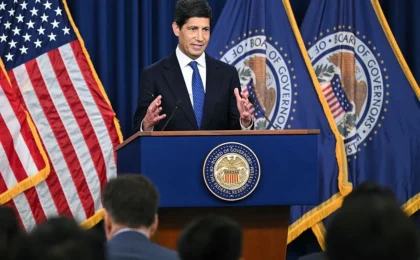
These movements underscore the market’s anticipation of the Fed’s impending policy announcement. According to the CME FedWatch Tool, traders are currently pricing in a 94.5% probability of a 25-basis-point rate cut. While a cut is widely expected, the bond market’s reaction suggests that investors remain skeptical regarding the long-term trajectory of interest rates and the Fed’s ability to balance cooling inflation with the prevention of a hard economic landing.
Chronology of the Trading Day
The day began on a defensive note, with all three major equity benchmarks—the Dow Jones Industrial Average, the S&P 500, and the Nasdaq Composite—opening in the red. The downward trend persisted throughout the session as investors avoided risk-on assets in favor of safety or simply moved to the sidelines.
By the closing bell, the Dow Jones Industrial Average had shed 0.6%, settling at 52,092. The broader S&P 500 index retreated 0.5% to 7,585, while the tech-heavy Nasdaq Composite bore the brunt of the selling, falling 0.8% to 25,981.
The morning session was marked by heavy volume in the energy sector, as Chevron (+2.6%) outperformed its peers on the Dow, bolstered by the rising price of crude oil. Conversely, financial stocks struggled, with Goldman Sachs (-1.2%) acting as a significant drag on the Dow following comments from Bank of America CEO Brian Moynihan regarding a potential slowdown in third-quarter trading and investment banking activity.
The afternoon session was characterized by technical volatility, particularly in the semiconductor space. Skyworks Solutions (+13.6%) and Qorvo (+9.3%) saw significant gains, recovering from a harsh sell-off that occurred just 24 hours prior. Meanwhile, the announcement of a $1 billion convertible notes offering by Axon Enterprise led to a sharp 9.8% decline in its share price, serving as a reminder of how quickly sentiment can shift based on corporate capital allocation news.
Supporting Data and Market Analysis
To understand the current volatility, one must look at the interplay between the "Magnificent Seven" and the broader industrial sector. Nvidia, which has been the bellwether for the artificial intelligence boom, managed to climb 0.6% on Tuesday. This gain came despite a broader market decline, largely due to high-profile public comments made by CEO Jensen Huang regarding the stability and future of the AI industry.
The data surrounding the semiconductor industry remains complex. While the VanEck Semiconductor ETF (SMH) saw a modest gain of 0.1%, the volatility in individual stocks like Skyworks suggests that institutional investors are still recalibrating their portfolios in response to the rapid expansion of data center infrastructure. According to market analyst Louis Navellier, the "AI doomsday" narrative—driven by fears that the pace of AI deployment is unsustainable or inherently dangerous—is fundamentally disconnected from the reality of order backlogs, which currently extend well into 2032.
On the fixed-income side, the rise in yields suggests that the market is beginning to price in a "higher for longer" reality, even in the event of a minor rate cut. The 2-year yield’s persistence in hitting 52-week highs indicates that the short end of the curve is extremely sensitive to any hint of sticky inflation, which could limit the Fed’s future flexibility.
Official Responses and Strategic Alignments
A highlight of the day was the unexpected alignment between corporate leadership and the political sphere. During an appearance on the All-In podcast, Nvidia CEO Jensen Huang and President Donald Trump engaged in a dialogue aimed at calming investors’ nerves regarding the rapid pace of AI integration.
President Trump dismissed recent criticisms of the speed of AI deployment as a "hoax," a sentiment echoed by Huang, who emphasized that the "AI race" in America is a zero-sum game where "everybody wins." This public show of unity was clearly aimed at curbing the recent trend of selling off AI-exposed stocks on the grounds of "safety concerns." By framing AI development as a national priority and an economic engine, the pair sought to provide a floor for technology stocks that had been under pressure throughout the week.
Furthermore, corporate M&A activity remains a point of focus. The consolidation in the chipmaking sector, specifically the pending $22 billion merger between Skyworks Solutions and Qorvo, is being viewed by leadership as a "transformative deal." CEO Philip Brace’s recent confidence in closing the deal this year provides a rare bright spot of long-term planning in an otherwise reactionary market environment.
Implications for the Future
As the market heads into Wednesday, the implications of Tuesday’s session are clear: investors are caught between the immediate fear of geopolitical conflict in the Middle East and the long-term uncertainty of Federal Reserve policy.
- Energy Prices and Inflation: The disruption of Saudi oil transit routes is a reminder of how fragile global supply chains remain. If crude oil prices continue to hover near $106, the Fed may find its goal of 2% inflation increasingly difficult to reach, potentially forcing them to adopt a more hawkish stance in the fourth quarter, regardless of the expected cut on Wednesday.
- The AI Narrative: While the "AI bubble" talk persists, the sheer scale of long-term order backlogs suggests that the industrial shift toward automation is not merely speculative. Investors should monitor how firms like Axon Enterprise manage their capital structure while navigating this growth phase.
- Financial Sector Vulnerability: The weakness in financial stocks like Goldman Sachs is a warning sign. If major investment banks are signaling a slowdown in trading activity, it could indicate that the broader corporate sector is beginning to pull back on M&A and capital expenditures as the cost of borrowing remains high.
- Treasury Market Signals: The fact that the 10-year Treasury yield is testing 17-year highs is the most significant signal of the current era. It suggests that the market is finally losing faith in the "transitory" nature of inflation, potentially leading to a permanent repricing of risk across all asset classes.
In summary, Tuesday served as a microcosm of the current fiscal year: an environment where technological optimism is constantly tempered by the cold realities of energy costs, geopolitical risk, and the limitations of monetary policy. As the Fed prepares to speak, the market remains on a knife’s edge, awaiting a signal that will determine whether the current volatility is a temporary correction or the beginning of a deeper, more structural shift in the global economy.