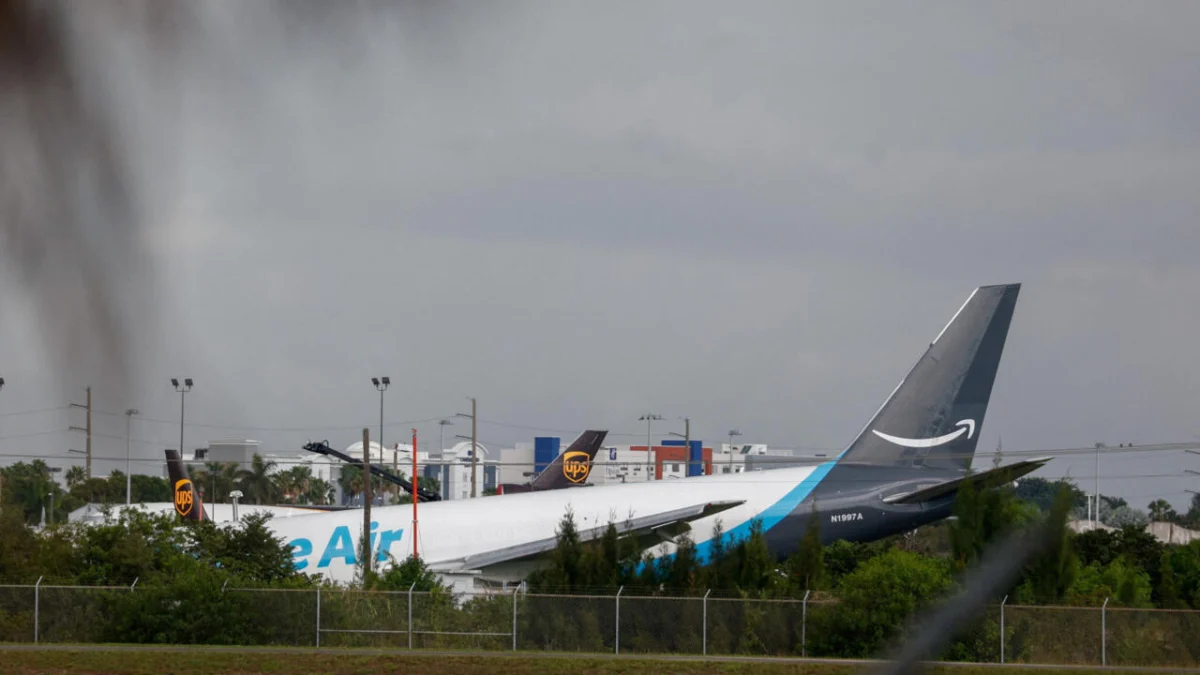
MIAMI — A somber atmosphere descended upon Miami International Airport (MIA) this Sunday as a catastrophic aviation incident transformed a routine cargo arrival into a scene of devastation. An Amazon-branded Prime Air cargo plane, operated by North Carolina-based carrier 21 Air, overran the runway upon landing, careening into a perimeter roadway and colliding with ground vehicles. The resulting inferno and wreckage claimed at least five lives, leaving the local community and the global aviation industry in a state of profound shock.
Main Facts: A Disaster in Transit
The incident occurred at approximately 2:00 p.m. local time on Sunday. The aircraft, a Boeing 767-300 converted freighter, was arriving at Miami International following a flight from San Juan, Puerto Rico. According to eyewitnesses and airport officials, the plane failed to come to a stop within the designated runway parameters, breaching the airport’s perimeter and striking several vehicles located on a nearby service road.
The impact triggered an immediate and intense fire, sending plumes of thick, black smoke into the Florida sky, visible for miles. Miami-Dade County officials confirmed that at least five individuals perished in the collision. In addition to the fatalities, three individuals remain in critical condition, while two others are being treated for non-life-threatening injuries.
At the time of this writing, authorities have declined to specify whether the victims were crew members aboard the aircraft or occupants of the vehicles struck during the runway excursion. The complexity of the scene, which involved a major fire and the entanglement of the aircraft with multiple semi-trucks, has necessitated a meticulous, albeit slow, recovery effort.
Chronology of the Incident
The events unfolded with harrowing speed, leaving little time for ground personnel to react.
- 1:55 p.m.: The flight, operated by 21 Air, initiates its landing sequence at Miami International Airport. Weather conditions at the time were reported as stable, though investigators are currently reviewing atmospheric data to determine if wind shear or mechanical failure played a role.
- 2:00 p.m.: The aircraft touches down but fails to decelerate as expected. It rolls past the end of the runway, breaching the airport’s security fencing and exiting the airfield proper.
- 2:02 p.m.: The plane collides with at least two semi-trucks on a peripheral road. The impact ruptures the aircraft’s fuel tanks, triggering a massive fireball.
- 2:10 p.m.: First responders from Miami-Dade Fire Rescue arrive on the scene. Fire Chief Ray Jadallah describes a chaotic environment where the pilot and co-pilot were trapped within the cockpit, while others were pinned inside or beneath the crushed vehicles.
- 3:30 p.m.: The airport issues a "ground stop," halting all arrivals and departures. The emergency response transitions from a fire-suppression operation to a complex extraction effort.
- 5:00 p.m.: Miami-Dade officials hold a press conference confirming the death toll. Fire crews continue to battle persistent fuel leaks, which present an ongoing ignition hazard.
Supporting Data: The Anatomy of the Aircraft and Disruption
The aircraft involved, a 32-year-old Boeing 767, has a long history in the aviation sector. Data from the flight-tracking platform Flightradar24 reveals that the plane was originally manufactured in the early 1990s as a passenger jet. Over the course of two decades, it served several commercial carriers before undergoing a comprehensive conversion in 2015 to serve as a long-haul freighter.
While the conversion process is standard in the logistics industry, the age of the airframe will undoubtedly become a focal point of the National Transportation Safety Board (NTSB) investigation. The plane was operated under a contract for Amazon’s Prime Air network, a critical cog in the global e-commerce giant’s supply chain.
The impact on Miami International Airport—one of the busiest hubs in the United States—was immediate and widespread. According to FlightAware, roughly 250 flights were delayed or diverted during the peak of the emergency response. The closure of the runway caused a cascade effect, with planes circling the airport for hours and many passengers stranded as ground crews worked to clear the debris. The fuel leak proved particularly challenging, requiring specialized environmental and hazardous materials teams to ensure the scene was stable before investigators could begin a full forensic examination of the wreckage.
Official Responses and Investigative Oversight
The federal government has moved swiftly to initiate a formal inquiry. The National Transportation Safety Board (NTSB) has dispatched a "Go-Team" to Miami, led by Chairwoman Jennifer Homendy. The NTSB investigation will be comprehensive, examining the plane’s "black box" flight data recorder, the maintenance history of the 21 Air fleet, and the specific communications between the flight crew and air traffic control during the final minutes of the descent.
Amazon, the company whose branding adorned the aircraft, issued a somber statement addressing the tragedy:
"We’re heartbroken to learn that five people lost their lives in today’s incident at Miami International Airport. Our deepest sympathies go out to the families, loved ones, and all those affected by this devastating loss. We are cooperating fully with the investigating authorities."
21 Air, the North Carolina-based cargo carrier, has yet to issue a detailed public statement beyond a brief acknowledgment of the accident, citing that they are working closely with federal regulators to understand the cause of the disaster.
The Human Toll and Community Impact
For the local residents and workers near the Miami airport, the crash was a jarring reminder of the proximity of industrial operations to civilian life. Jackson Lee, who operates an electronics repair shop in the industrial corridor adjacent to the airport, described the moment the tranquility of the afternoon was shattered.
"We hear planes taking off and landing every five minutes," Lee told reporters. "I thought I’d gotten used to it—it’s just background noise. But when the ground shook and the sky turned black, I knew this wasn’t just another landing. I never thought it could come this close to us."
The emotional impact on the first responders cannot be overstated. Chief Jadallah noted that the rescue effort was hindered by the structural integrity of the aircraft and the intensity of the flames, requiring responders to navigate through wreckage that was actively burning.
Implications for Aviation Safety
This incident raises urgent questions regarding the safety protocols for cargo operations at high-traffic airports. While cargo planes often operate during off-peak hours to minimize passenger disruption, their landing patterns remain subject to the same atmospheric and logistical variables as commercial flights.
The NTSB’s findings will likely center on three core pillars:
- Pilot Performance and Training: Were the flight crew members under undue pressure to meet delivery deadlines?
- Mechanical Reliability: Did the aging airframe experience a system failure—such as a brake or thrust reverser issue—that precluded a safe stop?
- Airport Infrastructure: Does the proximity of public service roads to the runway end pose an unacceptable risk to ground traffic in the event of a runway excursion?
As the NTSB team arrives on the ground, the focus will shift from rescue to recovery and investigation. The wreckage, currently resting on its belly, will eventually be moved to a secure hangar for detailed analysis.
For the families of the victims, the coming weeks will be defined by the agonizing search for answers. For the aviation industry, the tragedy at Miami International serves as a grim impetus for a review of safety standards, particularly concerning the interaction between heavy cargo logistics and urban infrastructure.
As of late Sunday, the airport had resumed limited operations, but the scars of the day remain visible. The silence of the tarmac serves as a haunting backdrop to an investigation that the world will be watching closely, as officials strive to ensure that such a catastrophic collision never occurs again.