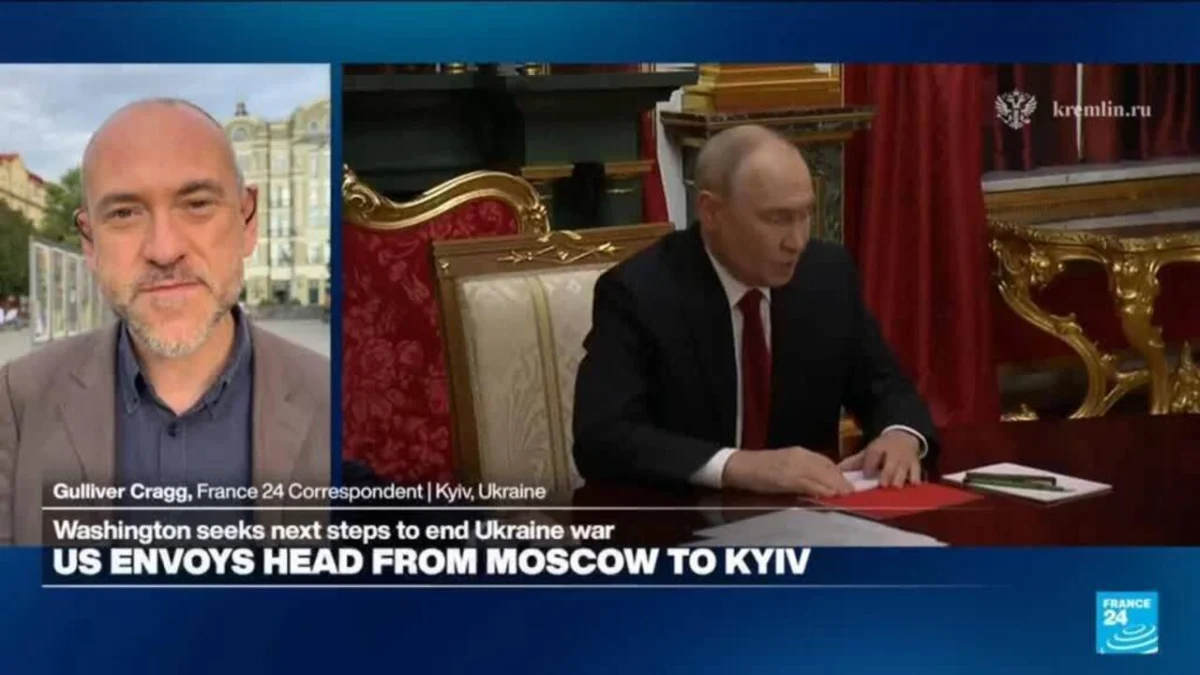
The geopolitical landscape of Eastern Europe shifted with sudden intensity this week as a high-level delegation of United States envoys arrived in Kyiv, marking a critical juncture in the ongoing conflict. Their arrival followed a marathon three-hour summit with Russian President Vladimir Putin—a meeting that has left Western analysts parsing every word for signs of a potential de-escalation, or, conversely, a deepening of the trench warfare that has defined the last two years.
For observers in Washington, Brussels, and Kyiv, the timing is everything. As the front lines remain largely static yet blood-soaked, the diplomatic shuttle service between Moscow and the Ukrainian capital signals that the international community is attempting to move beyond the stalemate, even if the path forward remains obscured by deep-seated mutual distrust.
Main Facts: The Meeting Behind Closed Doors
The delegation, led by senior State Department officials and high-ranking intelligence liaisons, spent 180 minutes in direct negotiation with President Putin. The meeting, which took place in a setting described by insiders as "stark and business-like," represents one of the most significant direct lines of communication opened between the White House and the Kremlin since the onset of the crisis.
While the specifics of the conversation remain under a veil of classified security protocols, official leaks suggest that the discussion centered on three primary pillars: the establishment of a robust humanitarian corridor, the management of nuclear risk in occupied territories, and the potential parameters for a long-term cessation of hostilities.
However, the mood in Kyiv upon the envoys’ arrival was decidedly somber. Ukrainian officials, briefed on the preliminary outcomes of the Moscow talks, have expressed apprehension. A senior advisor to the Zelenskyy administration noted that any dialogue involving the Kremlin without full, transparent Ukrainian participation is viewed with "extreme skepticism." The core contention remains: Can the U.S. negotiate an end to a war that threatens the very sovereignty of its closest partner in the region?
Chronology: A Week of High-Stakes Diplomacy
To understand the current tension, one must examine the rapid succession of events that preceded the envoys’ flight to Kyiv:
- Monday, 08:00 AM: Intelligence reports indicate a significant repositioning of Russian tactical assets near the border, sparking fears of a new offensive.
- Tuesday, 10:00 AM: The U.S. delegation arrives in Moscow for an unannounced visit, signaling a sudden pivot toward direct engagement.
- Tuesday, 02:00 PM – 05:00 PM: The "Three-Hour Talks" take place. Sources describe the atmosphere as "tense but professional," with both sides refusing to budge on fundamental territorial questions.
- Wednesday, 09:00 AM: The delegation departs Moscow, arriving in Kyiv by late afternoon.
- Thursday, 07:00 AM: Initial debriefing sessions begin between the U.S. envoys and the Ukrainian military high command.
This timeline underscores the frantic pace at which the Biden administration is attempting to manage the situation, balancing the necessity of deterrence with the urgency of diplomacy.
Supporting Data: The Cost of the Stalemate
The urgency of the envoys’ mission is fueled by cold, hard data. According to recent intelligence assessments and independent reporting:
- Casualty Estimates: Western intelligence agencies suggest that combined casualties—both killed and wounded—have surpassed 500,000, a figure that continues to climb as artillery exchanges dominate the battlefield.
- Economic Impact: The Ukrainian economy remains under extreme duress, with GDP contraction hovering near 30% since the start of the full-scale invasion. Meanwhile, Russia’s economy, while bolstered by shadow-market oil sales, is increasingly tethered to a wartime production model that is unsustainable in the long term.
- Global Energy and Food Security: The continued disruption of Black Sea shipping routes remains a primary driver of global price volatility. Every day the war continues, the impact on developing nations—particularly in the Global South—intensifies, as food supplies remain bottlenecked by the conflict.
These figures illustrate a grim reality: the status quo is becoming increasingly expensive, not just for the combatants, but for the global community. The envoys’ arrival in Kyiv is a tacit admission that the current trajectory is untenable.
Official Responses: Navigating the Minefield
The reaction to the Moscow-Kyiv shuttle has been polarized.

The Kremlin’s Perspective:
Russian state media has characterized the meetings as an acknowledgment of Russia’s "geopolitical realities." Kremlin spokesperson Dmitry Peskov stated that Moscow remains "open to dialogue, provided that the new territorial realities are recognized." This phrasing, interpreted by Western analysts as a demand for total capitulation, remains the primary roadblock to any formal peace process.
The White House Position:
In Washington, the narrative is more cautious. A State Department spokesperson emphasized that "nothing about Ukraine will be decided without Ukraine." The mission, according to the White House, is not to force a settlement, but to "clarify red lines" and "prevent an accidental escalation into a broader conflict."
Kyiv’s Stance:
Ukrainian President Volodymyr Zelenskyy has remained steadfast. His office issued a statement late Wednesday, reiterating that "peace is only possible when the aggressor withdraws to the 1991 borders." This rejection of any immediate territorial compromise puts the Ukrainian government at odds with those in the West who might be quietly pushing for a "frozen conflict" scenario.
Implications: A "Bad Sign" for the Future?
The phrase "a bad sign" has been circulating among diplomats familiar with the delegation’s debriefings. The concern is that the three-hour talk with Putin may not have been a breakthrough, but a hardening of positions.
The Risk of a Frozen Conflict
Many experts fear that the U.S. and Russia may drift toward a "Korean-style" armistice—a permanent ceasefire without a formal peace treaty. While this would stop the immediate bloodshed, it would solidify the occupation of vast swaths of Ukrainian territory. For Kyiv, this is an existential threat, as it would grant the Kremlin the time to rearm, regroup, and eventually resume the assault from a position of renewed strength.
The Erosion of Western Unity
There is also the risk that these back-channel communications create a wedge between the U.S. and its European allies. Countries on the "front line," such as Poland and the Baltic states, have expressed deep concern that Washington might prioritize its own strategic stability over the long-term security of Eastern Europe. If the U.S. appears to be negotiating "over the heads" of its allies, the coalition supporting Ukraine could begin to fracture.
The Nuclear Shadow
Perhaps most alarmingly, the talks have done little to dampen the persistent rumors regarding Russia’s nuclear posturing. The delegation’s focus on "risk management" suggests that the White House is genuinely concerned about the potential for tactical nuclear weapon usage should the Russian front lines face a significant collapse. This underlying fear continues to dictate the pace and scope of military aid provided to Kyiv, keeping the conflict in a perpetual state of "controlled intensity."
Conclusion: The Long Road Ahead
As the U.S. envoys conclude their stay in Kyiv, the uncertainty is palpable. The diplomacy currently being practiced is not about achieving a grand, heroic peace, but rather about survival—the survival of the rules-based order, the survival of the Ukrainian state, and the prevention of a catastrophic miscalculation.
The visit to Kyiv serves as a sobering reminder that the war is at a crossroads. Whether this flurry of diplomatic activity leads to a genuine shift in the conflict’s momentum or simply provides a brief respite in a long, grinding war of attrition remains to be seen. What is clear, however, is that the eyes of the world are fixed on these quiet rooms, waiting to see if the language of diplomacy can finally silence the guns of war. The silence, for now, remains deafening.