The global financial landscape underwent a significant transformation this week as a combination of geopolitical relief and high-stakes corporate maneuvering propelled U.S. equity markets to record-setting territory. Despite a hawkish undertone from the Federal Reserve, the successful brokering of a 60-day provisional agreement to reopen the Strait of Hormuz provided the necessary catalyst for investors to move past energy-related anxieties.
As the markets closed the books on a holiday-shortened week, the indices reflected a renewed sense of confidence. The Dow Jones Industrial Average clinched a new all-time weekly closing high at 51,565, while the S&P 500 and the tech-heavy Nasdaq Composite posted robust gains, signaling that the "animal spirits" of the market remain resilient in the face of shifting monetary policy.
Chronology: A Week of Highs, Lows, and Diplomatic Breakthroughs
The week began under a cloud of uncertainty, with market participants closely monitoring the inaugural press conference of Federal Reserve Chair Kevin Warsh. His rhetoric—which leaned heavily toward the necessity of maintaining higher interest rates to combat persistent inflation—initially dampened sentiment. However, mid-week developments in the Middle East shifted the narrative entirely.
Monday and Tuesday: The markets traded within tight ranges as investors parsed the implications of the Fed’s two-day policy meeting. The central bank maintained the federal funds rate at 3.50% to 3.75%, but the accompanying statement, emphasizing a firm commitment to price stability, left little room for optimism regarding near-term rate cuts.
Wednesday: The geopolitical breakthrough arrived. News of an agreement to stabilize the Strait of Hormuz—a vital artery for global energy transit—sent shockwaves through the commodities markets. West Texas Intermediate (WTI) crude oil futures, which had been elevated since the onset of regional hostilities on February 27, began a sharp descent, closing down over 10% for the week.
Thursday: The momentum peaked at the opening bell. Stocks gapped up, fueled by optimism regarding oil supply chain security and a high-profile announcement involving domestic semiconductor production. While the 2-year Treasury yield climbed to a 52-week high of 4.177%, the market chose to focus on the long-term potential of domestic tech manufacturing rather than short-term borrowing costs.
Supporting Data: Market Performance and Economic Indicators
The breadth of the rally was evident across the major indices. The Nasdaq Composite led the charge, surging 1.9% on Thursday to finish the week at 26,517—a 2.4% gain over the four-day period. The S&P 500 followed with a 1.1% daily gain, closing at 7,500, while the Dow Jones maintained steady growth, rising 0.1% on the day and 0.7% for the week.
The energy sector’s cooling provided a structural tailwind for broader equities. WTI crude settled at $75.71 per barrel, significantly lower than its recent peaks. This retreat is critical; since February 27, energy prices have been the primary headwind for consumer spending and corporate profit margins. The current price is now just 13% above pre-war levels, suggesting that the "energy shock" is rapidly dissipating.
However, the fixed-income market told a more cautionary tale. The 2-year Treasury yield’s climb from 4.163% to 4.177% underscores the reality that the Federal Reserve remains in a tightening mindset. Market participants are now pricing in a higher probability of at least one rate hike by the end of the year, provided that inflation remains sticky and above the Fed’s 2% target.
Official Responses and Corporate Strategy
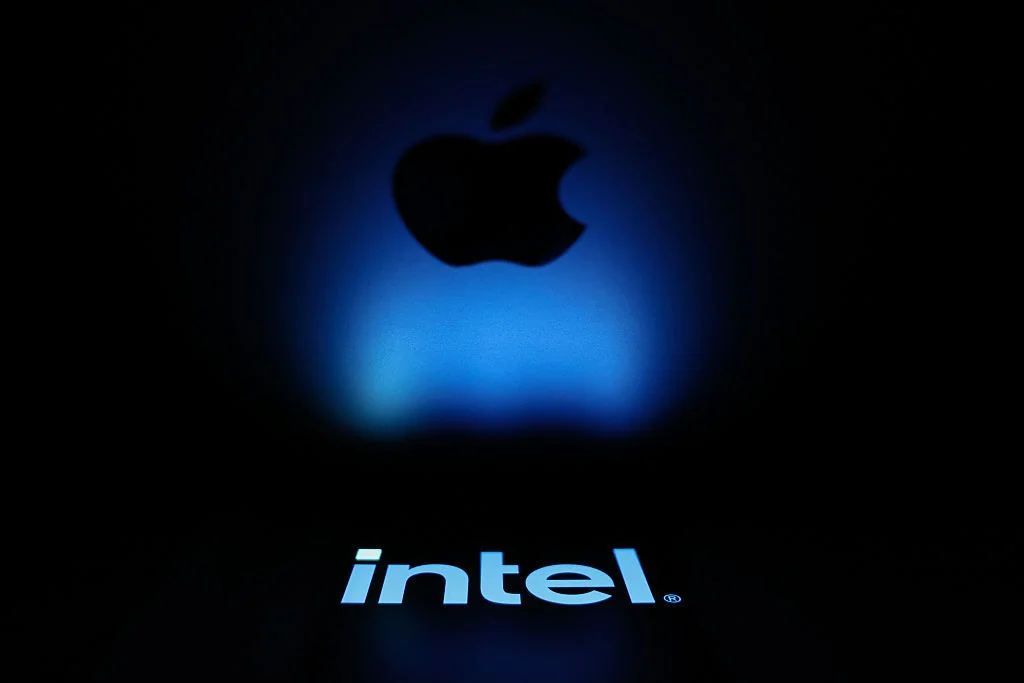
The centerpiece of Thursday’s market activity was the revelation of a strategic partnership between Apple and Intel. The news, publicized via a statement from President Donald Trump, highlighted a potential shift in the global supply chain, with Apple agreeing to work with Intel to design and build chips within the United States.
President Trump’s remarks on Truth Social were direct, referencing the historical significance of the "Intel Inside" brand and criticizing previous trade policies that allowed semiconductor manufacturing to migrate to Taiwan. While neither Apple nor Intel issued formal confirmation, the market reacted with immediate fervor. Intel’s stock surged 10.6% on the news, reflecting investor optimism that a domestic manufacturing deal could reinvigorate the legacy chipmaker. Apple shares also ticked up 0.7%, indicating that investors view the potential domestic production footprint as a long-term strategic advantage.
Conversely, the IT services sector faced a harsh reality check. Accenture, a bellwether for corporate technology spending, experienced its worst day on record, with shares plummeting 16.3%. CEO Julie Sweet cited ongoing volatility in the Middle East and a general reassessment of AI-related investments as primary drivers for the company’s reduced revenue guidance. Accenture now expects growth of 3% to 4%, down from earlier projections of up to 5%. This contagion hit IBM as well, which shed 5.1% in sympathy with the broader IT services weakness.
Implications for Investors and the Broader Economy
The events of this week highlight a bifurcated market environment. On one hand, there is a clear appetite for growth and a willingness to embrace "America First" industrial policy, as evidenced by the enthusiasm surrounding the Intel-Apple rumors. On the other hand, the reality of the Federal Reserve’s "higher for longer" policy remains a constant drag on risk appetite.
1. The Geopolitical Premium
The cooling of tensions in the Strait of Hormuz is not just a win for oil prices; it is a win for global logistics. If the 60-day provisional agreement holds, we can expect a continued decline in input costs for manufacturers and a potential stabilization in consumer goods pricing. However, the fragility of this peace means that energy volatility will likely remain a persistent risk factor for the remainder of the year.
2. The Fed’s Dual Mandate
Chair Warsh’s debut has effectively reset market expectations. By explicitly stating that the 2% inflation target is non-negotiable and that a rate hike is on the table, the Fed has signaled that it is willing to risk a slowdown to prevent a wage-price spiral. Investors should prepare for continued volatility in the bond market, as any further signs of sticky inflation will likely be met with hawkish commentary.
3. The AI and Infrastructure Paradox
The divergence between Intel (a manufacturer) and Accenture (a consultant) suggests that the market is beginning to differentiate between companies that own the "shovels" of the AI gold rush—the chipmakers and infrastructure providers—and those that are merely facilitating the transition. As companies like Accenture reassess their spending, we may see a period of consolidation where capital flows toward companies that provide tangible hardware solutions rather than abstract software services.
4. The SpaceX IPO Afterburn
As SpaceX navigates the aftermath of its record-breaking IPO, its 3.6% decline on Thursday serves as a reminder that even the most revolutionary companies are not immune to market gravity. The transition from a private entity to a publicly traded titan is rarely smooth, and investors should expect significant price discovery in the coming months.
Conclusion: A Cautiously Optimistic Outlook
As the dust settles on a volatile week, the primary takeaway is that the U.S. economy remains fundamentally robust, buoyed by domestic industrial ambition and a cooling energy sector. However, the specter of the Federal Reserve’s restrictive monetary policy looms large.
For the prudent investor, the coming weeks will require a focus on balance sheets, a careful watch on the stability of the Strait of Hormuz, and a disciplined approach to the tech sector, where the "winners" of the AI revolution are increasingly being defined by their ability to execute on tangible, domestic production strategies. As we move into the summer months, the market’s ability to sustain these record highs will depend heavily on whether the cooling of energy prices can offset the headwinds of higher interest rates.