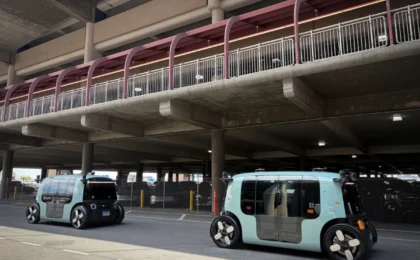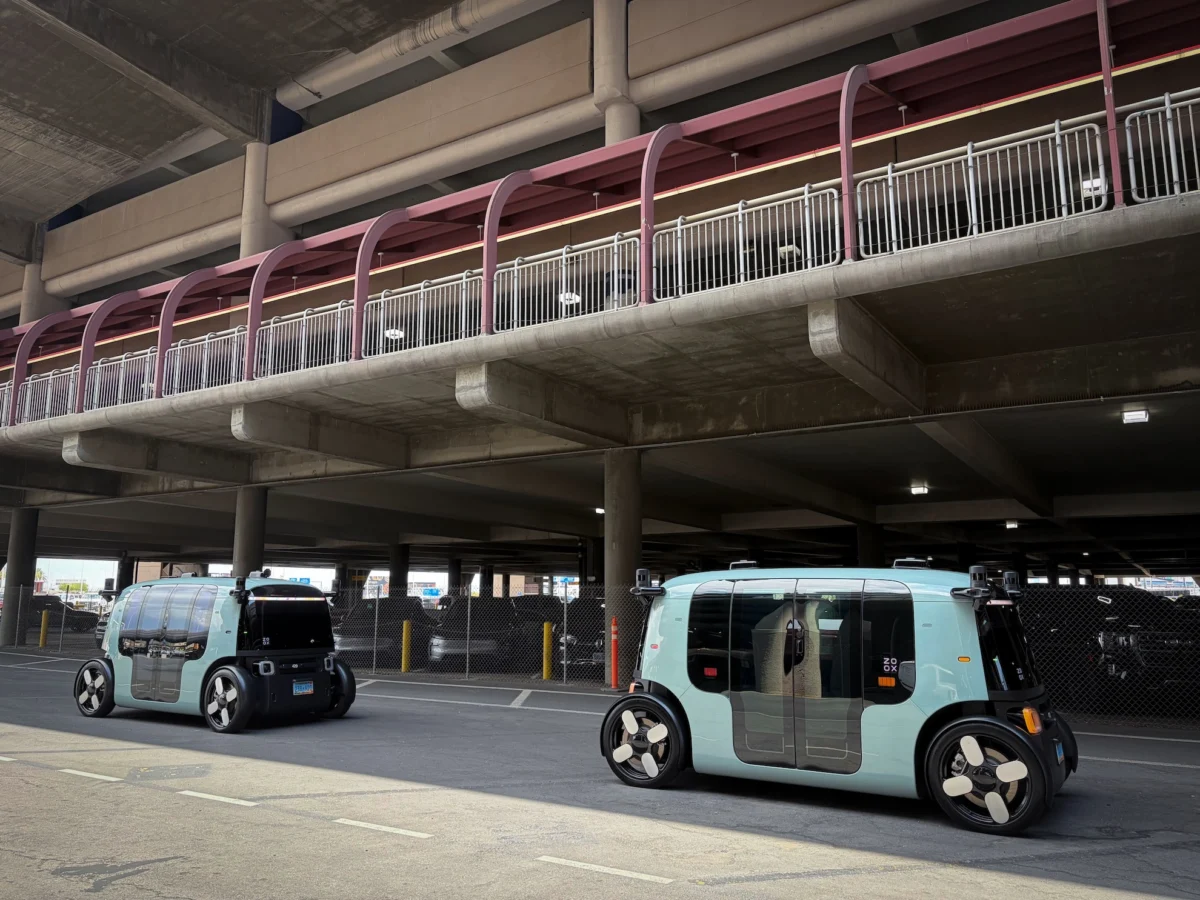
In a significant milestone for the autonomous vehicle (AV) industry, Amazon-owned Zoox has announced the expansion of its commercial robotaxi operations to include service to and from Harry Reid International Airport in Las Vegas. This strategic move, which officially commenced this Thursday, marks a critical step forward for the Silicon Valley-based company, transforming its custom-built, steering-wheel-free vehicles from a technological novelty into a practical, integrated component of urban transportation.
The expansion is the latest in a rapid sequence of operational breakthroughs for Zoox, which has spent over a decade refining its proprietary self-driving system. By securing a foothold at one of the nation’s busiest travel hubs, Zoox is signaling that it is no longer merely testing the waters; it is actively competing for the lucrative airport shuttle market, potentially disrupting the dominance of traditional ride-hailing giants like Uber and Lyft.
A Decade in the Making: The Path to Commercialization
Zoox’s journey has been defined by its commitment to a "purpose-built" philosophy. Unlike many competitors that retrofit existing passenger vehicles with sensor suites and compute modules, Zoox designed its vehicle from the ground up. The resulting robotaxi is a carriage-style, bidirectional vehicle that lacks traditional driver controls—no steering wheel, no pedals, and no cockpit.
For years, this design was both a technological marvel and a regulatory hurdle. While the company successfully navigated private testing and pilot programs, the inability to operate as a true commercial entity—charging fares to the public without a safety driver—stalled its growth.
The breakthrough arrived in August 2026, when federal safety regulators granted Zoox a vital temporary exemption from specific Federal Motor Vehicle Safety Standards (FMVSS). This exemption, covering eight specific standards—including requirements for windshield defrosting and braking systems—cleared the way for the deployment of up to 2,500 vehicles over the next two years. With this regulatory seal of approval, the floodgates opened. Within days, Zoox began charging for rides in Las Vegas, published its comprehensive safety framework, and announced plans to expand testing into Houston and San Diego.
Chronology: From Concept to Curb-Side
- 2014–2020: The formative years. Zoox focuses on internal R&D, developing its proprietary sensor fusion, AI, and the custom carriage-style vehicle architecture.
- 2020: Amazon acquires Zoox, providing the deep-pocketed backing necessary for scaling production and operational deployment.
- 2023–2025: Initial public trials in Las Vegas. Zoox begins offering rides to select users, gathering massive amounts of real-world data while navigating the complexities of the Las Vegas Strip.
- August 2026: The regulatory "Green Light." The federal government grants the exemption for the custom vehicle, allowing for commercial, paid service.
- August 10, 2026: Commercial operations officially begin. Zoox starts charging for rides within the Las Vegas metropolitan area.
- September 2026: The Airport Expansion. Zoox launches service to Harry Reid International, marking the first time a dedicated, driverless robotaxi service has integrated into a major U.S. airport terminal pickup/drop-off flow.
The Competitive Edge: Airport Logistics
One of the most compelling aspects of this rollout is the convenience factor. For the average traveler, navigating the pickup logistics at Harry Reid International can be a chore. Traditional ride-hailing services like Uber and Lyft, while efficient, are often relegated to the upper floors of parking garages, requiring passengers to navigate lengthy walks with luggage in tow.
Zoox’s current operational model allows it to pick up and drop off riders directly at the terminal near baggage claim. This "curbside" access provides a distinct friction-reduction advantage, positioning the robotaxi as a premium-yet-autonomous alternative to standard ride-shares. While the industry is watching to see if airport authorities maintain this access as volume increases, it represents a significant early victory for Zoox’s business development team.
Supporting Data: The Rising Tide of Robotaxis
The Nevada transportation landscape is undergoing a tectonic shift. The Nevada Transportation Authority (NTA) has been an aggressive proponent of autonomous innovation, and the recent influx of permits reflects a broader trend.
In addition to Zoox, major players including Tesla, Uber, and Waymo have received the necessary clearances to operate commercial services in Clark County. The combined capacity allowed by these recent permits is staggering: upwards of 8,000 autonomous vehicles are slated for deployment in the region over the coming 12 months.

Market Projections and Vehicle Density
- Zoox Authorization: Up to 2,500 units.
- Regional Ceiling: 8,000+ units across all operators (Tesla, Waymo, Uber/Motional).
- Strategic Growth: With Las Vegas serving as the "proving ground," data suggests that the city will see a saturation of AV services by late 2027, forcing companies to differentiate based on reliability, safety records, and price-per-mile.
Implications for the Future of Mobility
The implications of Zoox’s airport expansion extend far beyond the state of Nevada.
1. Regulatory Normalization
By operating under a federal exemption, Zoox is creating a template for other manufacturers. If Zoox can demonstrate a statistically safer record than human-driven vehicles while operating without manual controls, it will build a powerful case for the permanent amendment of federal safety standards. This could lead to a wave of "driverless-first" vehicle designs hitting the U.S. market.
2. The Shift in Ride-Hailing Economics
For companies like Uber and Lyft, the transition is existential. Their business model has historically relied on the "gig economy" labor force. By partnering with companies like Motional and integrating robotaxis into their existing apps, they are attempting to pivot from a labor-heavy model to a capital-intensive, asset-light (or asset-partnered) model. Zoox, by owning its hardware and its software, sits at a different end of the spectrum, potentially enjoying higher margins if it can scale its fleet production efficiently.
3. Urban Infrastructure Evolution
The presence of thousands of robotaxis will inevitably change how cities are designed. Airport planners, parking garage operators, and city traffic engineers are already beginning to reconfigure terminal drop-off zones to accommodate the specific behavior of autonomous vehicles, which require high-definition mapping and predictable, dedicated lanes to operate at peak efficiency.
Official Stance and Safety Protocols
Zoox has remained vocal about its "Safety First" approach, a necessity given the skepticism surrounding autonomous technology. Their published safety framework details the layers of redundancy integrated into the vehicle: multiple independent braking systems, steering redundancies, and an AI stack that monitors for behavioral anomalies in real-time.
"We aren’t just launching a car; we are launching a new mode of transit," a Zoox representative noted in a recent briefing. The company emphasizes that its two-year exemption is not a "free pass" but a period of rigorous data collection. They are required to report safety metrics to federal regulators regularly, ensuring that the privilege of the exemption is earned through consistent, incident-free performance.
Conclusion: A New Horizon for Transportation
The expansion to Harry Reid International Airport is a litmus test for the future of urban mobility. If Zoox can successfully manage the complexities of high-traffic airport environments, it will prove that the era of the robotaxi is not just coming—it is here.
As the competition in Las Vegas intensifies, the true winners will be the consumers, who stand to benefit from reduced wait times, lower costs, and a novel transportation experience. However, the next 12 months will be the most critical in the history of the industry. With 8,000 vehicles potentially flooding the streets of Clark County, the focus will shift from if these machines can drive, to how well they can coexist with human drivers in the complex, unpredictable environments of a major metropolis. For Zoox, the race is on, and they have clearly taken the pole position.