For eons, humanity has viewed the Sun as a steadfast, unchanging beacon—a reliable furnace providing the steady stream of light and heat necessary for life. However, cutting-edge research funded by NASA is fundamentally altering this perception. Two groundbreaking studies have emerged, revealing that our planet’s climate history is not merely a product of terrestrial processes or orbital cycles, but is inextricably linked to the Sun’s volatile history and its epic trek through the Milky Way.
These studies suggest that the Sun has acted as both a shield and a catalyst. From protecting our atmosphere during galactic transits to triggering chemical reactions that allowed life to take root on a "faint" young planet, the Sun’s influence is far more dynamic than previously understood.
The Galactic Voyager: Navigating the Interstellar Sea
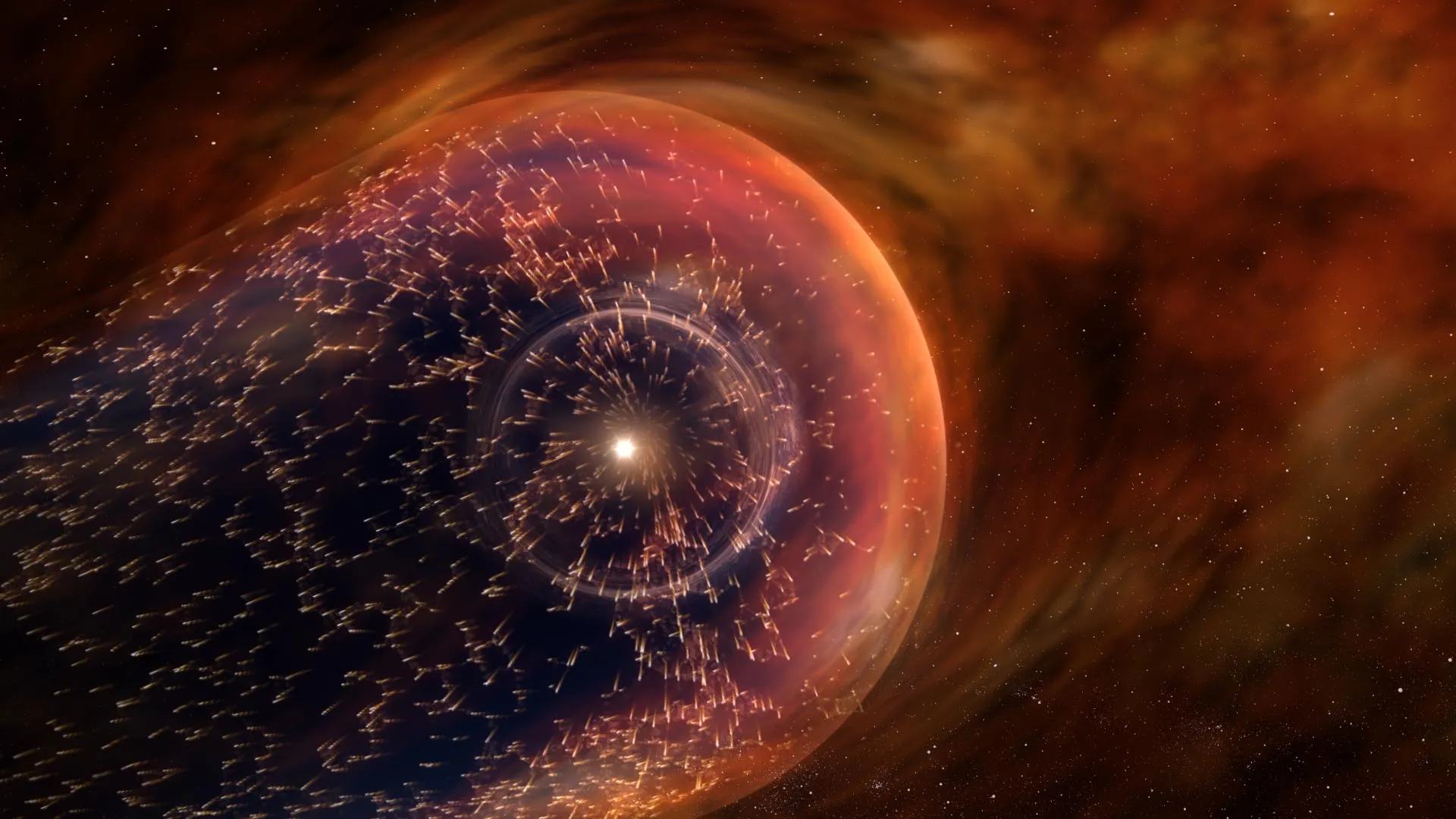
To understand Earth’s climate, one must look beyond the confines of the solar system. The Sun does not sit in a vacuum; it travels through the Milky Way, accompanied by its protective "bubble"—the heliosphere. This vast, invisible shield is formed by the solar wind, a constant stream of charged particles flowing outward from the Sun, pushing back against the interstellar medium.
The SHIELD Initiative
NASA’s SHIELD (Solar Wind with Hydrogen Ion charge Exchange and Large-Scale Dynamics) center, a specialized DRIVE (Diversify, Realize, Integrate, Venture, Educate) Science Center, has taken on the monumental task of reconstructing this journey. Led by principal investigator Merav Opher of Boston University, the team is building a "digital twin" of the heliosphere to model how it has responded to the shifting galactic landscape over the last 4.6 billion years.
The research, published in the Annual Review of Astronomy and Astrophysics, posits that the solar system has not always enjoyed the same level of protection. As the Sun orbits the galactic center, it periodically passes through dense, cold clouds of interstellar gas and dust.
Chronology of Cosmic Encounters
According to the SHIELD simulations, the solar system has encountered these frigid, high-density environments at least three times in the last 14 million years:
- 13 to 14 million years ago: A significant period where the heliosphere was subjected to intense external pressure.
- 6 to 7 million years ago: Another major interaction with interstellar matter.
- 2 to 3 million years ago: The most recent encounter, which may have had profound consequences for Earth’s then-developing climate.
During these events, the external pressure from the "cold clouds" became so immense that it compressed the heliosphere, potentially shrinking it to a size smaller than Earth’s orbit. In these instances, our planet was effectively stripped of its primary protective shield, leaving it exposed to the raw, unfiltered interstellar environment.
The Faint Young Sun Paradox: Solving an Ancient Mystery
While the SHIELD center examines the Sun’s middle age, other researchers are looking at its infancy. Roughly three billion years ago, the Sun was only 70% as bright as it is today. Under standard climate models, this "Faint Young Sun" should have been unable to sustain liquid water, leaving Earth a global snowball—a frozen rock drifting through space.
Yet, geological evidence contradicts this. We know liquid water existed on Earth billions of years ago, and life eventually emerged from those waters. This contradiction is known in the scientific community as the "Faint Young Sun paradox."
Violent Beginnings
Vladimir Airapetian, a scientist at NASA’s Goddard Space Flight Center, suggests that the Sun’s chaotic youth provides the missing piece of the puzzle. By observing "toddler" stars in our galaxy, astronomers have discovered that young stars resembling our Sun are far more aggressive than their mature counterparts. They produce frequent "superflares"—catastrophic releases of energy that launch high-energy particles into space at unprecedented rates.
Airapetian’s team hypothesized that if the young Sun exhibited this behavior, it would have bombarded early Earth with a relentless stream of energetic particles. To test this, they recreated the early Earth’s atmosphere in a lab, mixing molecular nitrogen, ammonia, carbon dioxide, and carbon monoxide, and then subjected this mixture to proton bombardment to simulate solar superflares.
A Greenhouse Solution
The results were revelatory. The high-energy bombardment induced chemical reactions that generated nitrous oxide, a greenhouse gas roughly 300 times more potent than carbon dioxide.
Even if much of this gas was eventually broken down by the Sun’s ultraviolet radiation, the researchers calculated that a surviving fraction—as little as 10%—would have been enough to raise temperatures at the equator to roughly 41 degrees Fahrenheit (5 degrees Celsius). This modest but vital warming would have been sufficient to keep the oceans liquid, effectively "thawing" the planet and creating a habitable environment for the earliest forms of life.
Implications for Life and Habitability
The convergence of these two research paths offers a new framework for understanding planetary evolution. It suggests that a planet’s habitability is not just a function of its distance from a host star, but a complex interplay between the star’s evolution, its magnetic environment, and the galactic neighborhood.
The Chemistry of Life
Interestingly, the "Faint Young Sun" scenario may have provided more than just warmth. Airapetian’s research suggests that the specific thermal conditions created by this greenhouse-gas-induced climate might have been ideal for prebiotic chemistry. Temperatures slightly above freezing are often more conducive to the assembly of complex amino acid chains than extreme heat, suggesting that the Sun’s violent behavior may have been a necessary precursor to the development of life.
The Climate Connection
On the other end of the spectrum, the SHIELD center’s findings regarding the heliosphere provide a potential explanation for Earth’s ancient climate swings. When the heliosphere collapses during a passage through a galactic cold cloud, Earth is exposed to increased levels of interstellar dust and hydrogen.
This exposure changes the chemistry of the upper atmosphere, increasing water vapor levels and potentially altering cloud formation. These shifts in atmospheric composition could be the long-sought drivers behind some of the major ice ages that have shaped Earth’s geological record. This provides a compelling bridge between galactic astronomy and terrestrial paleoclimatology.
Official Perspectives and Future Directions
The integration of these findings represents a shift toward a more holistic approach in heliophysics and Earth science. NASA’s investment in the DRIVE Science Centers reflects an understanding that individual disciplines—like astronomy, atmospheric science, and biology—are no longer sufficient to solve the complex mysteries of our origins.
The Quest for Digital Twins
The creation of a "digital twin" of the heliosphere remains the flagship goal for the SHIELD team. By refining this model, scientists hope to predict how our solar system will behave in the future as it continues its path through the Milky Way. While we are currently in a relatively stable "Local Bubble" of the galaxy, knowing the history of our transit helps us understand the resilience of our biosphere.
Searching for Habitable Worlds
Perhaps most importantly, these studies inform the search for life elsewhere. When exoplanet researchers look at distant star systems, they now have a more nuanced checklist. It is not enough to find a planet in the "habitable zone"; one must consider whether the host star is prone to the types of superflares that could jumpstart a greenhouse effect, or whether the planetary system’s movement through the galaxy might pose a threat to its atmosphere.
Conclusion: An Interconnected History
The story of Earth is not one of a lonely planet floating in the dark. It is a story of a world that has been molded by the Sun’s fiery tantrums and protected by its magnetic reach as it traverses the vast, often hostile, expanse of the Milky Way.
As we continue to analyze the signatures of the past—from deep-sea sediment cores containing interstellar isotopes to the chemical fingerprints of early life—we are building a clearer picture of our place in the cosmos. We are not separate from the universe; we are a product of it. The Sun has been our constant companion, our protector, and, in the earliest days of our history, the violent architect of our very existence. Understanding this relationship is the key to unlocking the mysteries of our past and securing our understanding of the conditions that make life possible in the vast, cold reaches of space.