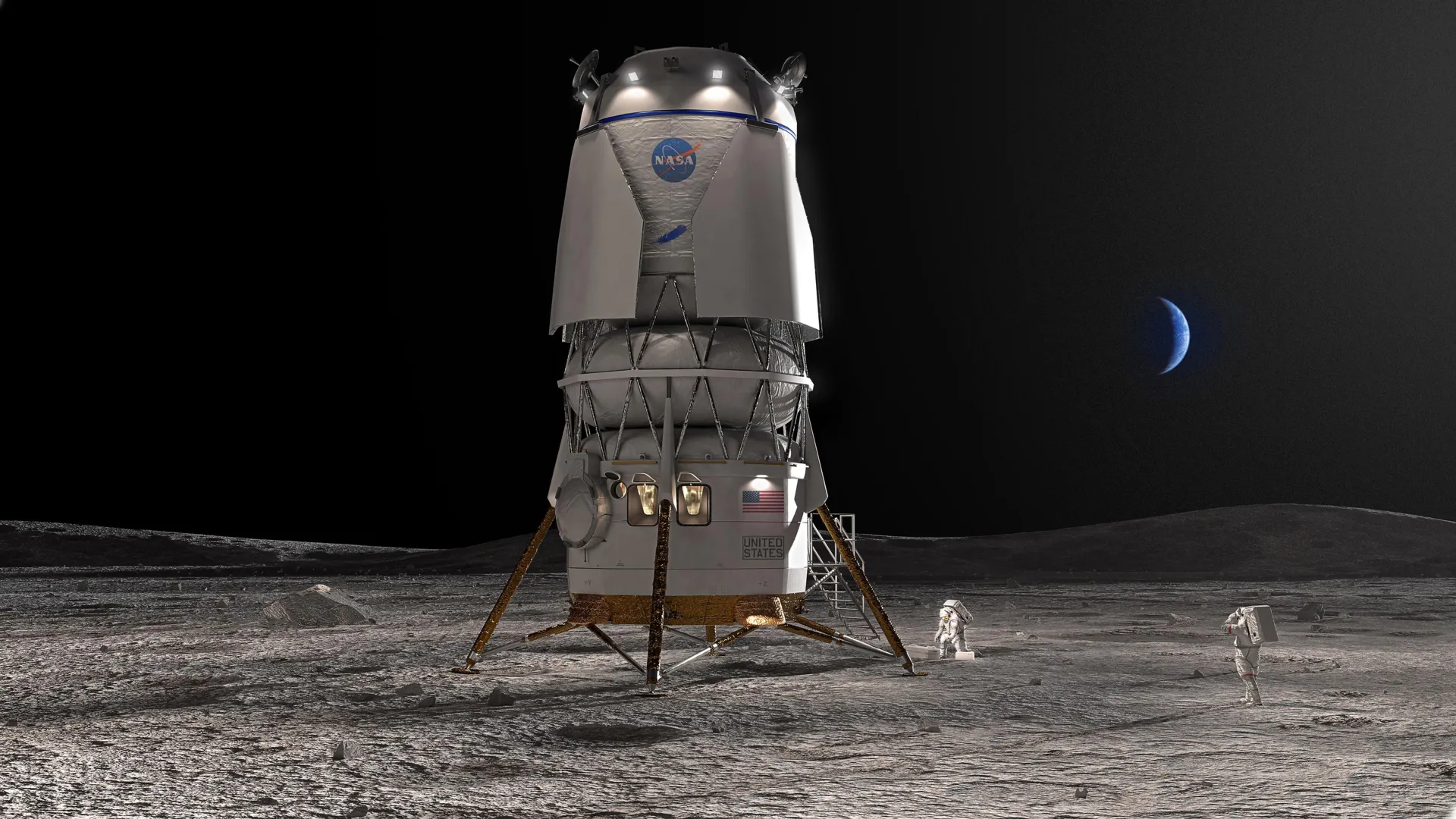
As the world stands on the precipice of a new "Lunar Gold Rush," with national space agencies and private enterprises alike pivoting their gaze toward the Moon’s South Pole, a sobering scientific reality has emerged. While the promise of lunar bases and resource extraction fuels the current space race, new research suggests that our very presence on the Moon could be systematically destroying the most valuable evidence of our own origins.
A study recently published in the Journal of Geophysical Research: Planets warns that the exhaust plumes from landing spacecraft are not merely fleeting clouds of gas; they are potential contaminants that could irreversibly alter the pristine chemical archives of the lunar surface. As methane and other organic compounds "hop" across the lunar landscape, they threaten to obscure the ancient clues trapped within the Moon’s permanently shadowed regions—clues that could hold the key to understanding how life first flickered into existence on Earth.
The Lunar Archives: A Time Capsule Under Threat
For billions of years, the Moon has served as a silent, relatively stable witness to the evolution of our solar system. Unlike Earth, which is constantly reshaped by tectonic activity, volcanic eruptions, and a dynamic atmosphere, the Moon’s surface is a static record of geological time.
Of particular interest to scientists are the Moon’s "permanently shadowed regions" (PSRs). Located primarily near the lunar poles, these deep, cratered landscapes never receive direct sunlight. The temperatures in these regions plummet to levels so low that they act as natural cryogenic freezers. For eons, these craters have trapped volatile compounds delivered by passing comets and asteroids.
Scientists theorize that among these frozen deposits lie "prebiotic organic molecules"—the fundamental chemical building blocks of DNA and proteins. Because these molecules have been shielded from the harsh solar radiation and thermal cycling that would have destroyed them elsewhere, they represent a pristine, ancient library. If researchers could successfully sample these molecules, they might finally bridge the gap between inanimate chemistry and the emergence of biological life. However, this scientific dream is now facing an unexpected antagonist: the exhaust of our own spacecraft.
The Mechanics of Contamination: A Ballistic Problem
The new study, led by researchers at the European Space Agency (ESA) and the Instituto Superior Técnico, utilized sophisticated computer simulations to model the behavior of exhaust gases. By using the proposed ESA Argonaut mission as a primary case study, the team focused on how methane—a byproduct of propellant combustion—behaves once it is released into the lunar environment.
A World Without Drag
On Earth, gas molecules are slowed by atmospheric pressure and air resistance. On the Moon, however, the near-total lack of an atmosphere changes the rules of physics. When a spacecraft touches down, the exhaust gases expand rapidly, untethered by air.
"Their trajectories are basically ballistic," explained lead author Francisca Paiva. "They just hop around from one point to another."
Because the Moon lacks a thick gaseous envelope to distribute these molecules, they bounce across the surface, energized by solar radiation and cooled by the lunar shadow. The team’s simulations, which accounted for solar wind, ultraviolet radiation, and complex molecular collisions, revealed a startling rate of dispersion.
Chronology of a Contamination Event
To quantify the risk, the researchers tracked thousands of simulated methane molecules following a landing at the lunar South Pole. The timeline of their findings is as follows:
- T-Plus 0 to 48 Hours: Within less than two lunar days, methane molecules released at the South Pole are detected at the North Pole. The vacuum environment facilitates a rapid, global spread that defies intuition based on terrestrial experience.
- T-Plus 7 Lunar Days (approx. 7 Earth months): The "cold trapping" effect takes hold. Over half of the total methane released during the landing event is captured by the extreme cold of the lunar poles.
- The Final Distribution: The simulation indicated that 42% of the total exhaust byproduct accumulates in the South Pole region, while 12% settles in the North Pole.
"The timeframe was the biggest surprise," said Silvio Sinibaldi, the planetary protection officer at ESA and the study’s senior author. "In a week, you could have distribution of molecules from the South to the North Pole. It effectively turns the entire Moon into a contaminated site."
The Paradox of Exploration
The findings present a profound philosophical and practical dilemma for space agencies. We are traveling to the Moon to conduct science, yet the act of landing may render the science impossible.
"We are trying to protect science and our investment in space," Sinibaldi noted. "The Moon offers a rare opportunity to study the early history of the solar system, but our activity can actually hinder scientific exploration."
This is not a theoretical exercise. As commercial entities begin planning for mining operations, water ice extraction, and human habitation, the sheer volume of spacecraft traffic is set to increase exponentially. If each landing deposits a layer of synthetic organic material on top of the ancient, primordial ice, the "original" chemical signature of the solar system will be masked or completely overwritten.
Mitigating the Impact: A Call for Policy
The researchers are not advocating for an end to lunar exploration, but rather a paradigm shift in how missions are designed. The study emphasizes that we must transition from "exploring at all costs" to "sustainable, protected exploration."
Potential Solutions
- Strategic Landing Sites: Paiva suggests that choosing specific landing sites—perhaps those that are warmer—might keep exhaust molecules more localized, preventing them from migrating toward the sensitive PSRs.
- In-Situ Validation: Sinibaldi argues that future missions must carry dedicated instrumentation to measure the actual spread of contamination. "We will miss an opportunity if we don’t have instruments on board to validate those models," he stated.
- Chemical Mitigation: Future research will explore whether these exhaust molecules merely coat the surface of the lunar ice, or if they permeate the deeper layers. If the contamination is only superficial, scientists may still be able to reach pristine material by drilling beneath the surface.
- Regulatory Frameworks: Paiva draws a parallel between the Moon and terrestrial protected areas. "We have laws regulating contamination of Earth environments like Antarctica and national parks," she said. "I think the moon is an environment as valuable as those."
Implications for Future Missions
The implications of this study reach far beyond the Journal of Geophysical Research: Planets. It signals a need for a new branch of "Lunar Planetary Protection." Historically, planetary protection focused on preventing Earth-based microbes from contaminating other worlds (forward contamination) or bringing extraterrestrial pathogens back to Earth (backward contamination). Now, the definition of contamination must expand to include inorganic and organic chemical compounds that are the byproducts of our own propulsion systems.
As international bodies like the United Nations Committee on the Peaceful Uses of Outer Space (COPUOS) and various national space agencies begin to draft guidelines for the next decade of lunar activity, the findings of Sinibaldi and Paiva provide a critical baseline for policy.
Conclusion: A Delicate Balance
The Moon is no longer a distant, unreachable target; it is a burgeoning frontier. However, we are currently acting with the blind optimism of early explorers, unaware that our footprint is not just a mark in the dust, but a chemical stain on the history of the universe.
The research conducted by Paiva and Sinibaldi serves as a vital reminder that the value of the Moon lies in its preservation. If we are to understand the genesis of life—the mystery of how we came to be—we must ensure that the very vessels that carry us to the Moon do not destroy the evidence we are there to find. As we prepare for the next generation of lunar landings, the mandate is clear: we must develop the technology to explore, but we must do so with the wisdom to leave the evidence of the past intact.