Eight decades after it burned off the coast of Tel Aviv, threatening to plunge the fledgling State of Israel into the abyss of civil war, the Altalena has resurfaced—not from the depths of the Mediterranean, but into the volatile arena of modern Israeli politics. As the nation prepares for what is widely considered its most consequential election in history, scheduled for October 27, 2026, the wreckage of this clandestine arms ship has been transformed into a potent, polarizing symbol of the ongoing battle between the country’s nationalist right and its liberal opposition.
The discovery of the Altalena’s remains, located at a depth of 503 meters off the Israeli coast on August 24, was immediately framed as a monumental breakthrough by the current far-right government. Yet, beneath the veneer of archaeological discovery lies a deeper, more cynical narrative: the calculated mobilization of historical trauma to sharpen the ideological divisions that define the modern Israeli electorate.
The Tragedy of 1948: A Nation Divided
To understand the current political firestorm, one must return to June 1948. Israel was less than a month old, fighting for its very survival against the armies of neighboring Arab states. The Altalena, a ship chartered by the Irgun—the right-wing paramilitary militia led by Menachem Begin—arrived from Marseille laden with 5,000 rifles, 450 machine guns, and millions of rounds of ammunition.
At the time, the provisional government led by David Ben-Gurion had issued a clear ultimatum: all independent militias, including the Irgun, were to be disbanded and integrated into the newly formed Israel Defense Forces (IDF). Ben-Gurion, the architect of the state, was determined to ensure that Israel would have a single, unified military authority. He viewed the Altalena’s arrival as a dangerous challenge to state sovereignty.

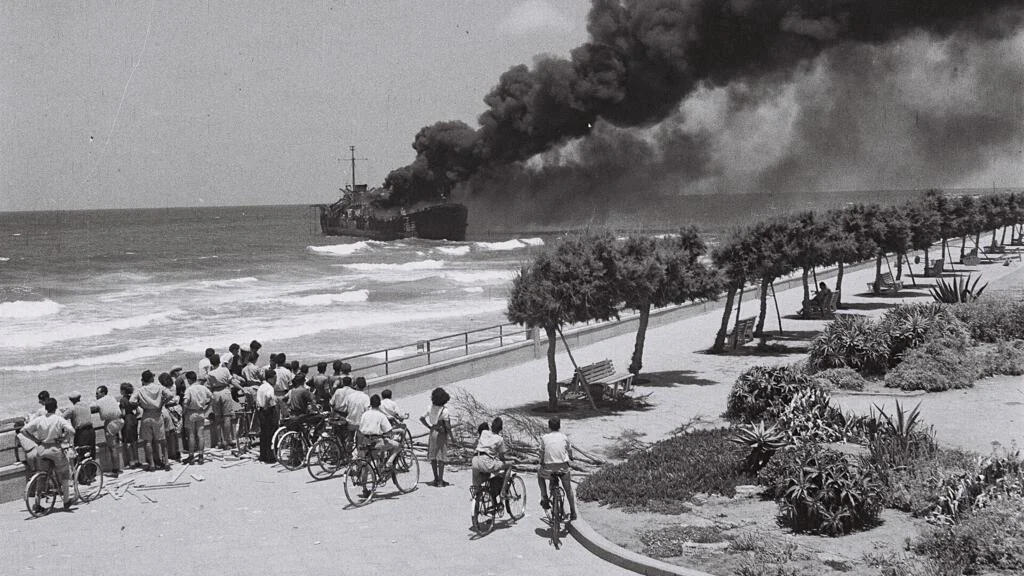
When negotiations over the distribution of the weapons collapsed, the standoff reached a point of no return. On Ben-Gurion’s orders, IDF forces fired upon the ship, setting it ablaze. Sixteen Irgun fighters and three soldiers were killed in the ensuing chaos. The event, which nearly ignited a fratricidal war, only ended when Begin—later to become Prime Minister—ordered his men to surrender, famously declaring, "There will be no civil war with the enemy at our gates."
The ship, damaged and gutted, remained visible off the coast for months as a haunting reminder of the incident, before being towed and sunk in 1949.
The Politicization of History: A Strategic Resurrection
The August 2026 announcement of the wreck’s location was coordinated by Heritage Minister Amichai Eliyahu and National Security Minister Itamar Ben-Gvir, both prominent figures in the far-right Otzma Yehudit party. For these leaders, the Altalena is not merely a historical artifact; it is a weapon of political mobilization.
"At 12:30 am, at a depth of 503 meters, west of the coast of Israel, the Altalena ship was located intact—78 years after that painful and seminal event that shook the young State of Israel," Eliyahu declared. Ben-Gvir added that the discovery closed a "historic chapter in one of the most painful and formative events in the history of Israeli society."

Prime Minister Benjamin Netanyahu, whose Likud party traces its political lineage to Begin’s Herut movement, quickly moved to capture the narrative. In a video address, he described the finding as an "emotional and defining moment," signaling his intention to utilize the vessel’s legacy to bolster his credentials as the standard-bearer of the nationalist camp.
Chronology of a Fractured Memory
- June 1948: The Altalena arrives at the Israeli coast; negotiations between the provisional government and the Irgun break down.
- June 22, 1948: The Israeli military shells the Altalena off the coast of Tel Aviv; 19 die; Menachem Begin calls for surrender to avoid civil war.
- 1949: The charred hull of the Altalena is towed out to sea and scuttled.
- 1977: Menachem Begin becomes Prime Minister, marking the first major shift from the socialist Labor camp to the nationalist right.
- August 24, 2026: The wreckage is officially located by the Israeli government, sparking a nationwide debate over the use of history in contemporary politics.
The Implications of the "Great Recovery"
The government has promised to raise the ship from the seabed to serve as a permanent memorial. However, the feasibility of such an operation has been met with intense skepticism. Ehud Galili, a renowned maritime archaeologist at the University of Haifa, has described the proposal as logistically near-impossible.
"Salvaging the Altalena, which weighs about 18,000 tons and is embedded in the clay seabed, would be an extraordinarily complex and costly operation," Galili noted. Many experts argue that the pledge is not intended to be fulfilled but is instead a "media stunt" designed to dominate the news cycle during the quiet weeks of summer leading into the October elections.
The political implications are profound. By framing the 1948 event as a "left-wing massacre" of right-wing patriots, Netanyahu and his allies are effectively attempting to delegitimize the institutional foundations of the Israeli state established by Ben-Gurion. It is a narrative that appeals directly to the base of the current coalition, reinforcing a sense of victimhood and historical grievance against the "left-wing establishment."

Voices of Dissent: The Witness Perspective
The attempt to weaponize the Altalena has drawn fierce criticism from historians and witnesses alike. Among the most vocal is Saul Friedlander, the world-renowned historian of the Holocaust, who was himself a 15-year-old passenger on the Altalena when it was attacked.
In a scathing op-ed, Friedlander condemned the exploitation of the tragedy for election propaganda. "The memory of the Altalena must not be used today for election propaganda by the most extreme camp," he wrote. He emphasized that the myth being cultivated by the right—that the Irgun were simply martyrs—ignores the reality that Begin himself had ultimately agreed to prioritize state unity over factional militia interests.
The View from the Media and Academia
Leading Israeli outlets have been equally critical. Haaretz, in an editorial, suggested that the timing of the "discovery" is no coincidence. "With elections approaching, all means are justified to get a headline," the paper argued, noting that the Altalena serves as a convenient vehicle for stoking incitement against the opposition.
The Jerusalem Post echoed these sentiments, with columnist Amotz Asa-El arguing that the plan to recover the wreckage is a calculated effort to distract from the current government’s policy failures. By forcing a debate on the foundational myths of 1948, the government hopes to avoid scrutiny of its current record, redirecting the national conversation toward an idealized, if distorted, version of the past.

Conclusion: A Nation at the Crossroads
The resurrection of the Altalena’s ghost serves as a mirror to the state of Israel in 2026. A society that is increasingly fragmented, it struggles to reconcile its diverse historical narratives. For the current government, the ship is a symbol of the struggle against a "hostile" elite; for its critics, it is a reminder of the dangers of allowing historical revisionism to dictate the future.
As the October 27 election approaches, the Altalena remains at the center of the fray. Whether or not the ship is ever brought to the surface, its presence is already felt—a submerged artifact of a bygone war, once again casting a long, dark shadow over the promise of Israeli democracy. The debate over its legacy is no longer just about 1948; it is a struggle for the very soul of the 2026 state, proving that in Israel, the past is never dead—it is not even past.