By Legal Affairs Correspondent
In a significant judicial intervention that reshapes the landscape of the upcoming midterm elections, U.S. District Judge Indira Talwani issued a 14-day temporary restraining order (TRO) on Thursday, effectively freezing key provisions of a controversial new United States Postal Service (USPS) rule. The rule, which sought to implement President Donald Trump’s Executive Order 14399, had been designed to fundamentally alter how mail-in and absentee ballots are processed and transmitted across the country.
The court’s decision arrives at a precarious moment, with election officials nationwide racing to finalize preparations for the November contests. By halting the implementation of these mandates, Judge Talwani has provided a narrow window of relief for states that argued the new requirements were not only logistically impossible to implement on short notice but also a potential violation of constitutional authority.
Main Facts: The Scope of the TRO
Judge Talwani’s ruling targets specific segments of the final rule published by the USPS, which was drafted in direct response to President Trump’s March executive order titled, “Ensuring Citizenship Verification and Integrity in Federal Elections.”
Under the now-blocked provisions, the USPS was directed to:
- Restrict ballot transmission: The rule empowered the Postal Service to prevent the delivery of ballots to individuals not appearing on specific voter registration lists provided by the states under a new, federally mandated verification system.
- Standardize ballot-mail design: The USPS sought to impose strict design requirements on all mail-in and absentee ballots, a move that critics argue would force states to discard millions of dollars’ worth of already-printed materials.
- Centralize oversight: The rule effectively granted federal postal authorities unprecedented control over the logistics of state-run elections.
The TRO prevents the USPS from enforcing these specific mandates while the court prepares for a critical hearing on September 3, where arguments regarding a longer-lasting preliminary injunction will be heard. Judge Talwani noted that the burden placed on state election infrastructure—so close to the November polls—posed an “irreparable harm” to the democratic process.
Chronological Breakdown: A Legal Tug-of-War
The trajectory of this litigation has been marked by high-speed judicial maneuvers and conflicting rulings, reflecting the deep polarization surrounding mail-in voting.
March 2026: The Executive Order
President Trump signs Executive Order 14399. The White House frames the order as a necessary step to secure federal elections against fraud, citing the need for rigorous citizenship verification.
August 11, 2026: The Initial Injunction
Judge Talwani issues a preliminary injunction against Section 3 of the order, barring the USPS from refusing to transmit ballots or completing the rulemaking process. This initial success for voting rights advocates appeared to offer a definitive roadblock to the administration’s plan.
August 24, 2026: Supreme Court Intervention
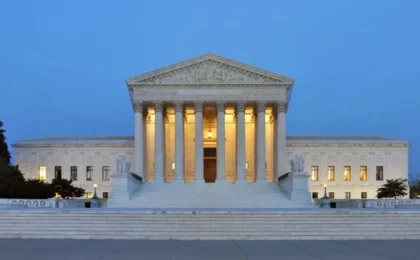
In a dramatic reversal of momentum, the U.S. Supreme Court intervenes in a separate, parallel challenge. The high court deems the previous lawsuit “premature,” noting that because the USPS had not yet finalized its administrative rules, there was no concrete “injury” for the court to address. This effectively vacated the lower court’s progress.
August 26-27, 2026: The Rule Finalizes and the TRO Follows
Immediately emboldened by the Supreme Court’s signal, the USPS publishes its final rule. Voting rights groups, armed with the now-concrete regulation, immediately return to Judge Talwani’s courtroom. Within 48 hours, the judge issues the 14-day TRO, arguing that the “ripeness” issue raised by the Supreme Court has now been resolved by the issuance of the final rule.
Supporting Data and Procedural Challenges
The scale of the opposition to the executive order is vast. Approximately two dozen states, led by Democratic attorneys general, have joined forces with non-partisan voting rights organizations, such as the League of Women Voters, to challenge the directive.
The Feasibility Gap
Election experts have provided testimony highlighting the impossibility of compliance. Many states operate on decentralized election systems where ballot design is governed by local county boards. The USPS mandate required:
- Re-printing: Estimates suggest that over 40 million ballots would need to be redesigned and re-printed to meet the new postal specifications.
- Database Integration: States were expected to cross-reference voter lists with federal citizenship databases in real-time—a technical hurdle that most state IT infrastructures are not currently equipped to handle.
- Cost Projections: Preliminary reports indicate that complying with the USPS rule would cost individual states anywhere from $2 million to $15 million, costs for which no federal appropriation has been provided.
Official Responses: A House Divided
The Administration’s Position
The White House and the Department of Justice (DOJ) maintain that the executive order is a lawful exercise of presidential power intended to protect the sanctity of the ballot box. A DOJ spokesperson stated, "The Postal Service has a duty to ensure that the integrity of the mail stream is not compromised by fraudulent or improperly registered ballots. This rule is a common-sense measure to ensure that only eligible voters cast ballots in federal elections."
The Plaintiffs’ Stance
Opponents argue that the administration is overstepping. "This is a naked attempt to weaponize the postal service to disenfranchise voters," said a lead attorney for the plaintiffs. "The Constitution grants states the authority to administer elections. The federal government cannot simply issue an executive order to override state law and turn the USPS into an election police force."
Implications: The Road to November
The implications of this legal battle are profound, extending far beyond the courtroom and into the lives of millions of American voters.
The "Chilling Effect"
Even with the TRO in place, legal scholars warn of a “chilling effect.” Uncertainty regarding the rules governing mail-in ballots may suppress voter turnout. If voters are unsure whether their mail-in ballot will be delivered, they may opt to stay home, or conversely, overwhelm in-person polling locations, potentially leading to long lines and administrative chaos on Election Day.
The Potential for Constitutional Crisis
Should the September 3 hearing lead to a preliminary injunction, the administration is widely expected to appeal to the Supreme Court once more. This creates the possibility of a "midnight ruling"—a last-minute decision issued days or even hours before the election—which could disenfranchise voters in key swing states.
The Future of Postal Neutrality
Historically, the USPS has maintained a strictly neutral role in election administration, prioritizing the efficient transit of mail regardless of content. By forcing the agency to act as an arbiter of voter eligibility, critics argue the executive order fundamentally threatens the public trust in the postal system. If the rule is ultimately upheld, it would signal a permanent shift in the relationship between the federal government and state election offices.
Conclusion
As the September 3 hearing looms, the judiciary finds itself at the center of a storm. Judge Talwani’s TRO is a temporary reprieve, but the fundamental question remains: Who holds the ultimate authority over the machinery of American democracy? As the calendar turns toward November, the answer to that question will likely determine the legitimacy of the midterm results and the future of the American electoral process for years to come.
The court’s decision to block the USPS rule for the next two weeks is not merely a procedural delay; it is a critical pause that forces the nation to confront the fragility of its electoral systems under the pressure of executive mandate. Whether the rule will be permanently struck down or reinstated remains the defining legal uncertainty of the 2026 election cycle.