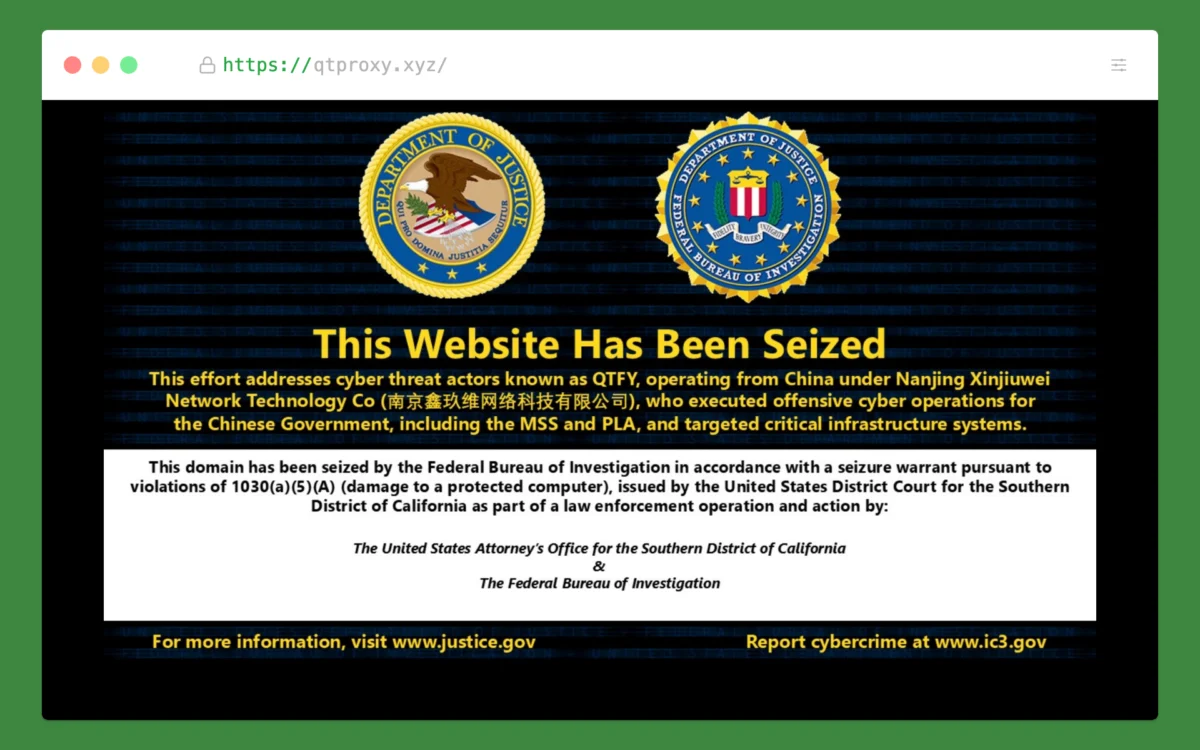
In a decisive strike against state-sponsored cyber espionage, the U.S. Department of Justice (DOJ) and the Federal Bureau of Investigation (FBI) have successfully seized a network of domains that served as the backbone for "QTFY," a sophisticated, China-backed botnet. This operation, detailed in a sweeping announcement this Wednesday, marks a significant escalation in the ongoing shadow war between Western infrastructure and state-affiliated hacking groups operating out of China.
The seized domains were the command-and-control (C2) lifelines for thousands of compromised internet-connected devices across the United States. By severing access to these domains, federal authorities have rendered the botnet inoperable, effectively blinding a network that had been used for years to infiltrate sensitive sectors, including federal government departments, hospitals, and major defense contractors.
The Anatomy of the QTFY Operation
At the center of this controversy is Nanjing Xinjiuwei Network Tech, a Chinese firm identified by U.S. prosecutors as the primary architect and operator of the QTFY botnet. Rather than acting as a traditional standalone hacking unit, QTFY functioned as a "cyber-enabler." It built and maintained a vast, global infrastructure of compromised devices—ranging from IoT gadgets to servers—which were then offered as a service to various state-sponsored actors, most notably those affiliated with China’s Ministry of State Security (MSS).
The brilliance, and the danger, of the QTFY model lay in its role as an "obfuscation network." By routing malicious traffic through a sprawling mesh of thousands of hijacked, legitimate devices, Chinese government hackers were able to mask their true origins. This made detection significantly more difficult for cybersecurity analysts, as the traffic appeared to originate from a diverse array of non-suspect IP addresses, effectively hiding the digital fingerprints of state-backed intruders.
Chronology of Infiltration: A Multi-Year Campaign
The scope of the infiltration revealed in the government’s affidavit is staggering, spanning nearly a decade of persistent cyber activity.
The Foundation (2018–2022)
Initial investigations indicate that the QTFY infrastructure began its systematic harvesting of vulnerable internet-connected devices as early as 2018. During this formative period, the botnet quietly built its capacity, focusing on gaining persistence within systems that would provide high-value intelligence.
The Expansion (2023–2025)
By 2023, the botnet had matured into a reliable tool for high-level espionage. According to federal prosecutors, the list of affected entities grew to include foundational pillars of the U.S. government, including the National Aeronautics and Space Administration (NASA), the Federal Reserve, and the Departments of Energy, Justice, and Health and Human Services. The ability of the botnet to infiltrate the Department of Health and Human Services and various hospital networks during this period raised alarms regarding the potential for medical data theft and the disruption of critical public health services.
The Recent Escalation (2026)
The threat did not diminish with time; rather, it became more brazen. Government records and court filings show that the U.S. Senate was compromised as recently as 2026. This intrusion into the legislative branch highlighted the evolving capabilities of the QTFY actors and their willingness to target high-ranking political institutions, even while facing increased scrutiny from Western intelligence agencies.
Supporting Data and Intelligence Insights
The success of the FBI’s seizure was not an isolated effort; it was the result of a long-term intelligence-sharing partnership with the private sector. Network infrastructure giant Lumen Technologies played a pivotal role in the takedown.
In a detailed post-mortem, Lumen researchers revealed they had been tracking the infrastructure for over a year. They observed the hackers engaging in systematic profiling—meticulously cataloging the digital landscape of U.S. government agencies, aerospace firms, and defense contractors. By identifying the patterns in how these actors were "scouting" their targets, Lumen was able to provide the FBI with the critical threat intelligence necessary to obtain a court order for the domain seizures.
The technical brilliance of the FBI’s intervention lies in the "hardcoded" nature of the botnet. The malware deployed by Nanjing Xinjiuwei was designed to communicate with specific, hardcoded domains to receive instructions. By seizing these domains, the FBI effectively issued a "stop" command to the entire network, locking the hackers out of their own command-and-control infrastructure.

Official Responses and Legal Justification
The U.S. Department of Justice has been clear in its messaging: this is not merely a technical fix, but a legal assertion of sovereignty in cyberspace.
"The Justice Department will not permit the exploitation of our critical infrastructure by state-sponsored actors," a spokesperson for the DOJ stated. The affidavit filed earlier this week provides a exhaustive legal argument for why the seizure was necessary, citing the imminent threat posed to national security and the ongoing nature of the compromise of the U.S. Senate.
The seizure is part of a broader "disrupt and dismantle" strategy that has become the hallmark of the FBI’s cyber division. Instead of simply monitoring the threat, the bureau is increasingly opting to proactively seize infrastructure, force password resets, and alert victims, even when the threat actors reside in jurisdictions where they cannot be easily arrested.
Implications for Global Cybersecurity
The dismantling of the QTFY botnet carries significant implications for the future of international cyber policy and the private sector.
1. The End of "Cyber-Enabled" Plausible Deniability
By linking the Nanjing Xinjiuwei company directly to the MSS, the U.S. government is effectively narrowing the window of plausible deniability for Beijing. This move suggests that the U.S. is moving toward a strategy of "naming and shaming" that includes holding private sector entities in foreign countries accountable for their role in state-sponsored espionage.
2. The Vulnerability of the IoT Ecosystem
The QTFY botnet thrived because of the inherent insecurity of the Internet of Things (IoT). Thousands of devices with weak security protocols, unpatched firmware, and default passwords served as the building blocks for this massive espionage engine. The incident serves as a grim reminder that the security of a nation is now inextricably linked to the security of the smallest, most mundane internet-connected device in a home or office.
3. The Need for "Active Defense"
The collaboration between the FBI and Lumen Technologies underscores the necessity of public-private partnerships. State-sponsored hackers move faster than the traditional regulatory environment, and the defense of the nation now requires real-time information sharing. Companies that own the "pipes" of the internet—like Lumen—are becoming the front line of national defense.
4. Lingering Risks
While the QTFY botnet is currently inoperable, experts warn that the actors behind it are likely resilient. The intelligence and tradecraft developed by the operators at Nanjing Xinjiuwei have not been erased. The underlying malware, while currently disconnected from its masters, may still reside on thousands of infected machines. The challenge for the next several months will be the massive remediation effort required to scrub these systems of the remaining malicious code.
Conclusion
The seizure of the QTFY domain infrastructure is a major victory for the FBI, but it is a temporary reprieve in a much larger, ongoing conflict. As state-sponsored actors continue to pivot toward more complex obfuscation techniques, the U.S. government and its private-sector allies must continue to innovate.
For now, the disruption of this network has likely caused a significant setback for Chinese intelligence operations targeting American defense and legislative assets. However, the incident remains a stark reminder that the digital landscape is a contested space, and the battle for the integrity of government and industrial networks is far from over. As we look toward the remainder of 2026 and beyond, the focus will likely shift from simple takedowns to more systemic efforts to secure the vulnerable infrastructure that allows such botnets to flourish in the first place.