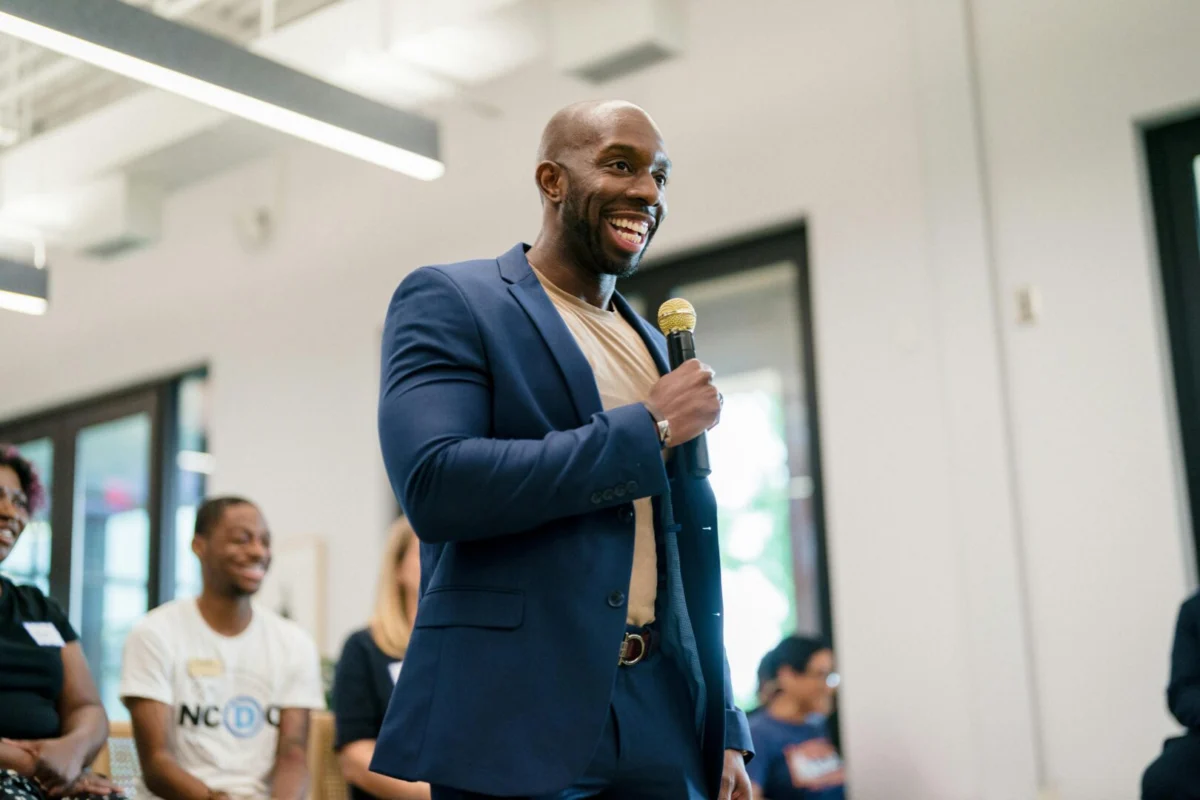
ATLANTA — In a milestone victory for Georgia political history, Democrat Everton Blair won the special runoff election for Georgia’s 13th Congressional District on Tuesday night, becoming the first openly gay man ever elected to represent the state in the United States Congress.
Blair, a former chair of the Gwinnett County Board of Education and high school mathematics teacher, defeated fellow Democrat Marcye Scott—the daughter of the late, long-serving Rep. David Scott—in a high-stakes intra-party runoff. With more than 95 percent of the votes tabulated late Tuesday evening, The Associated Press reported Blair leading Scott 53 percent to 47 percent.
The victory concludes a compressed and competitive special election campaign triggered by the death of Rep. David Scott in April. Blair will now travel to Washington, D.C., to be sworn into the 119th Congress following the House of Representatives’ August recess. He will fill the remainder of Scott’s unexpired term, serving through early January.
Beyond its state-level historic resonance, Blair’s win carries immediate tactical weight on Capitol Hill. His arrival, paired with another recent Democratic special election victory in California, narrows the House Republicans’ slim majority as the chamber prepares for high-stakes legislative battles in the autumn.
Chronology of the 13th District Special Election
The journey to Tuesday’s decisive runoff unfolded over five turbulent months marked by procedural complexity, shifting political coalitions, and dual-track primary campaigns.
+-----------------------------------------------------------------------------------+
|                                 TIMELINE OF EVENTS                                |
+-----------------------------------------------------------------------------------+
|  April 2026      : Rep. David Scott passes away; seat declared vacant.            |
|  May 2026        : Regular Democratic Primary held for full two-year term.         |
|                    State Rep. Jasmine Clark wins primary (Blair un-nominated).    |
|  May 1, 2026     : Gov. Brian Kemp sets Special Election for unexpired term.     |
|  July 28, 2026    : All-Party Special Election held.                               |
|                    - Marcye Scott: 46%                                            |
|                    - Everton Blair: 37%                                           |
|                    (No candidate reaches 50% majority threshold).                  |
|  August 25, 2026 : Special Election Runoff held.                                 |
|                    - Everton Blair: 53% (WINNER)                                  |
|                    - Marcye Scott: 47%                                            |
+-----------------------------------------------------------------------------------+
The Passing of Rep. David Scott and the May Primary
The vacancy arose in April 2026 following the death of Rep. David Scott, a veteran Democratic lawmaker who had represented the 13th District since 2003 and previously chaired the House Agriculture Committee. Scott’s passing came amid the ongoing 2026 election cycle, creating a unique dual-track situation for district voters.
In May 2026, the state held its regularly scheduled primary elections to determine party nominees for the full two-year congressional term beginning in January 2027. Blair competed in that regular Democratic primary but was defeated by state Rep. Jasmine Clark, who secured the nomination for the full term.
Governor Kemp’s Call and the July 28 Special Election
To ensure the district retained representation for the remainder of the 119th Congress, Georgia Republican Gov. Brian Kemp issued an executive order on May 1 setting an all-party special election for July 28, 2026. Under Georgia election law, all candidates—regardless of party affiliation—appear on a single ballot, and if no candidate achieves an absolute majority (50 percent plus one vote), the top two finishers advance to a head-to-head runoff.
The July 28 special election featured a crowded field, dominated by two distinct factions of the local Democratic ecosystem:
- Marcye Scott, leveraging broad name recognition and her late father’s deep institutional network, finished first with 46 percent of the vote.
- Everton Blair, consolidating progressive and youth turnout, placed second with 37 percent.
Because Scott fell four percentage points short of outright victory, Georgia law mandated a four-week runoff campaign between Scott and Blair, culminating in the August 25 contest.
Electoral Analysis and Candidate Coalitions
Blair’s ability to reverse a nine-point deficit from the July 28 election and secure a six-point victory on August 25 highlighted a dynamic shift in voter engagement within Metro Atlanta’s southern and eastern suburbs.
+-----------------------------------------------------------------------------------+
|                              SPECIAL ELECTION RUNOFF                              |
|                         Georgia's 13th Congressional District                     |
+-----------------------------------------------------------------------------------+
| Candidate            Affiliation      July 28 Vote (%)    Aug 25 Runoff (%)      |
+-----------------------------------------------------------------------------------+
| Everton Blair        Democrat         37%                 53% (ELECTED)          |
| Marcye Scott         Democrat         46%                 47%                    |
+-----------------------------------------------------------------------------------+
| Precincts Reporting: >95%                                                         |
| Source: Associated Press Election Data                                            |
+-----------------------------------------------------------------------------------+
Blair’s Progressive Coalition
Everton Blair, the son of Jamaican immigrants and a former high school math teacher, framed his campaign around educational equity, civil rights advocacy, and progressive economic reform. Blair first made history in 2018 when he became the first Black person and the youngest member ever elected to the Gwinnett County Board of Education, later serving as its chair. He subsequently ran for Georgia State School Superintendent in 2022, expanding his political footprint across the state.
In the special election runoff, Blair coalesced key progressive endorsements and national grassroots networks:
- U.S. Representative Lucy McBath, whose neighboring metro-Atlanta district overlaps in political culture and suburban constituency.
- Our Revolution, the national progressive organization founded in the wake of Sen. Bernie Sanders’ 2016 presidential campaign, which deployed field organizers and digital fundraising.
- LGBTQ+ Victory Fund, which provided targeted financial, strategic, and field support to boost turnout among queer voters and allies.
Scott’s Establishment and Legacy Support
Marcye Scott ran a campaign deeply rooted in institutional legacy and continuity, pitching herself as the rightful torchbearer to finish her father’s legislative priorities in Washington. Her candidacy sought to make political history of its own; Scott aimed to become only the second daughter to directly succeed her father in the 119th Congress, following Arizona Democrat Adelita Grijalva, who won a special election in late 2025 to succeed the late Rep. Raúl M. Grijalva.
Scott’s coalition featured influential figures within Georgia’s traditional Democratic establishment:
- U.S. Representative Nikema Williams, representative for Georgia’s 5th District and a prominent voice in state party leadership.
- Ambassador Andrew Young, former U.S. Ambassador to the United Nations, Mayor of Atlanta, and iconic civil rights leader who served as an early mentor to the late Rep. David Scott.
Despite these high-profile endorsements, Scott’s campaign struggled to expand its base beyond her father’s long-standing loyalists during the lower-turnout August runoff, allowing Blair to capitalize on high turnout in northern portions of the district, particularly within Gwinnett County.
District Profile and Turnout Dynamics
Georgia’s 13th Congressional District is a suburban, majority-minority district anchoring the southern and eastern stretches of the Metro Atlanta region. It spans portions of five counties: Gwinnett, Clayton, Cobb, Fulton, and Douglas.
+-----------------------------------------------------------------------------------+
|                        GEORGIA'S 13TH CONGRESSIONAL DISTRICT                      |
+-----------------------------------------------------------------------------------+
| Regional Composition : Portions of Gwinnett, Clayton, Cobb, Fulton, and Douglas   |
| Key Demographics     : Majority-minority district; significant Black population  |
| Political Lean       : Heavily Democratic (D+20 average)                          |
+-----------------------------------------------------------------------------------+
The district’s demographic transformation over the last two decades reflects the broader political evolution of Georgia. Historically moderate, suburban, and rural fringe areas have shifted rapidly into a reliable Democratic stronghold characterized by high educational attainment, rapid diversification, and growing immigrant communities.
Political analysts attribute Blair’s runoff reversal to two main factors:
- Gwinnett County Advantage: Blair’s previous tenure as Gwinnett County School Board Chair provided him with superior name recognition and organizational infrastructure in one of the state’s fastest-growing counties.
- Turnout Differential: In low-turnout August runoffs, ideological motivation and disciplined ground games often prove decisive. Blair’s campaign successfully mobilized younger voters and progressive activists who had fractured among multiple minor candidates during the July 28 open primary.
Official Responses and Reactions
Following the call by major news outlets late Tuesday night, leaders from across the political spectrum and advocacy community issued formal responses acknowledging the historic outcome.
Everton Blair
Addressing supporters at his campaign headquarters in suburban Atlanta, Congressman-elect Blair emphasized both the historic weight of his victory and his commitment to immediate legislative work.
"Tonight, voters across the 13th District sent a clear message that representation matters, our public schools matter, and our community’s future demands forward-looking leadership," Blair said. "I am deeply honored to step into this role to serve out the unexpired term of the late Congressman David Scott. We stand on the shoulders of giants who built this district, and I intend to work every single day in Washington to deliver real results for working families in Georgia."
Advocacy Groups and Community Leaders
The LGBTQ+ Victory Fund, which tracks and supports openly LGBTQ+ political candidates nationwide, released a statement celebrating Blair’s breakthrough in a region historically underrepresented by openly queer federal officials.
"Everton Blair’s historic victory breaks down long-standing barriers in southern politics," said a spokesperson for the LGBTQ+ Victory Fund. "As the first openly gay man elected to Congress from Georgia, Everton proves that qualified, dedicated community leaders can win anywhere when they speak directly to the needs of their constituents."
Representatives from Our Revolution similarly praised the result as a testament to grassroots organizing, noting that Blair’s campaign demonstrated the power of combining progressive policy commitments with localized public education advocacy.
Congressional Context and Strategic Implications
Blair’s election comes at a fragile moment for the House Republican conference, which has managed one of the narrowest governing majorities in modern congressional history throughout the 119th Congress.
+-----------------------------------------------------------------------------------+
|                        U.S. HOUSE VACANCY & SEAT CHANGES                          |
+-----------------------------------------------------------------------------------+
| District       Previous Incumbent           Reason        Special Election Status |
+-----------------------------------------------------------------------------------+
| CA-14          Eric Swalwell (D)            Resigned      Aisha Wahab (D) won    |
| GA-13          David Scott (D)              Deceased      Everton Blair (D) won  |
| TX-23          Tony Gonzales (R)            Resigned      Pending Announcement    |
| FL-20          Sheila Cherfilus-McCormick(D)Resigned      Pending Announcement    |
+-----------------------------------------------------------------------------------+
Narrowing the House Majority
Blair’s victory follows closely on the heels of another special election success for House Democrats. Just one week prior, California State Sen. Aisha Wahab won a special election in California’s 14th Congressional District to fill the seat vacated by former Democratic Rep. Eric Swalwell, who resigned in April.
Both Blair and Wahab are scheduled to be formally sworn into office when the House reconvenes following the August district work period. The addition of two Democratic members further compresses the GOP’s operating margin, reducing room for internal party defections on key fiscal and legislative votes slated for the autumn session.
Remaining Vacancies
Following the swearing-in of Blair and Wahab, two vacant seats will remain in the House of Representatives:
- Texas’s 23rd Congressional District: Vacated in April following the resignation of Republican Rep. Tony Gonzales.
- Florida’s 20th Congressional District: Vacated in April following the resignation of Democratic Rep. Sheila Cherfilus-McCormick.
To date, executive authorities in Texas and Florida have not formally scheduled special elections to fill those seats, leaving their respective districts unrepresented for the immediate future.
Looking Ahead to January 2027
Because Blair won the special election strictly to complete the remainder of the 119th Congress, his term in the House will run through early January 2027.
In the upcoming November 2026 general election, state Rep. Jasmine Clark—the winner of the regular Democratic primary in May—will compete as the Democratic nominee for the full two-year term representing Georgia’s 13th District in the 120th Congress. Given the district’s heavy Democratic lean, Clark is widely favored to win the seat in November and assume office in January, marking a seamless legislative transition for the district over the next five months.