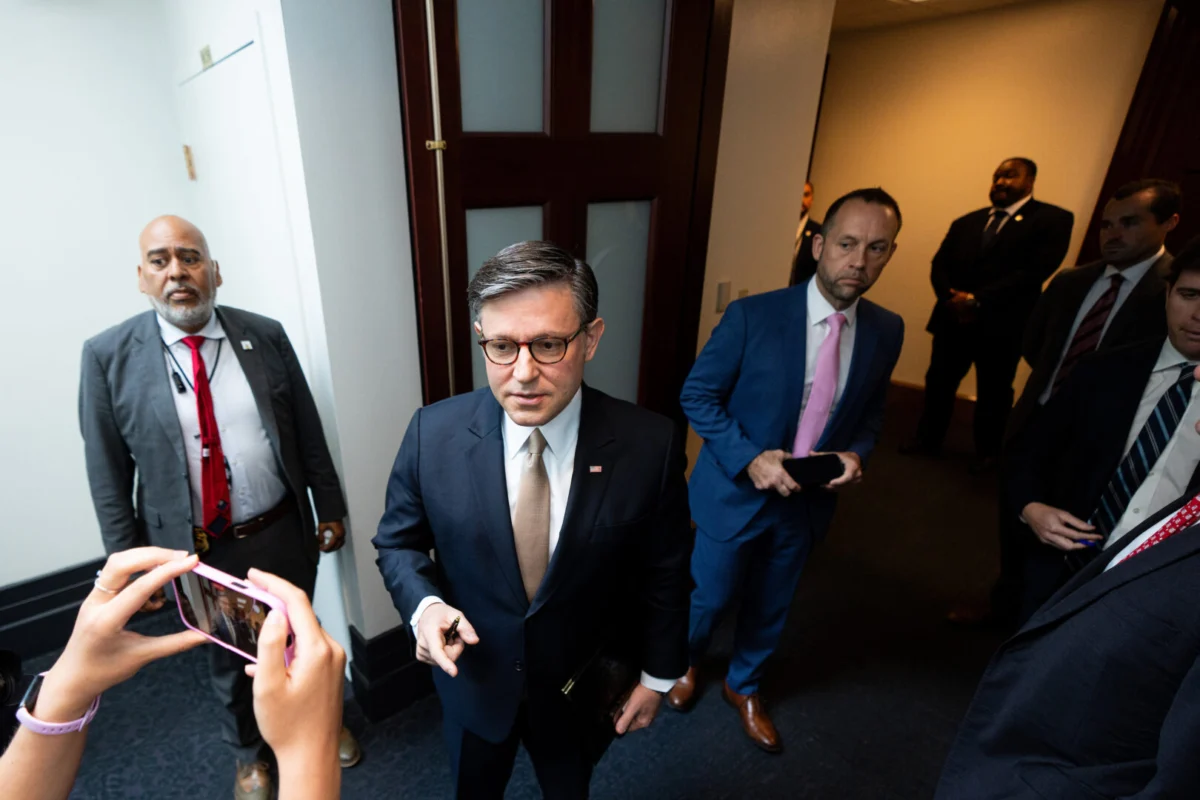
Washington D.C. – House Republican leaders have been forced to abandon a critical legislative push and send members home early for the July Fourth recess, a direct consequence of a rebellion within their own ranks. A group of conservative lawmakers blocked a procedural rule essential for advancing a raft of pre-recess priorities, primarily over demands for stricter voter identification requirements. This latest legislative setback underscores the profound challenges facing Speaker Mike Johnson as he struggles to unite a fractious caucus and navigate the narrowest of majorities.
The decision to cut short the legislative week came after Speaker Johnson (R-La.) engaged in urgent consultations with senior leadership, including Rules Chairwoman Virginia Foxx (R-N.C.), in a bid to salvage the stalled agenda. The earlier defeat of the rule, which would have paved the way for consideration of the fiscal 2027 defense authorization bill and a national security spending bill, left the House in an untenable position. What was initially hoped to be a temporary delay, with leaders vowing to persuade opponents, quickly devolved into an admission of defeat, prompting the early adjournment.
Chronology of a Legislative Collapse
The day began with an air of cautious optimism, despite underlying tensions. The procedural rule, typically a routine measure, came up for a vote Tuesday afternoon. The result was a stunning 198-224 defeat, with more than a dozen Republicans joining Democrats in opposition. Speaker Johnson, in the immediate aftermath, projected confidence, stating, “We’ll work on that over the next day and a half, and we’ll get everybody to yes. It’s too important to stop progress.”
However, the reality of the situation soon set in. Fourteen GOP lawmakers ultimately cast "no" votes, effectively torpedoing the rule. While House Majority Leader Steve Scalise (R-La.) also voted "no," his was a strategic maneuver designed to preserve the option for Republican leaders to bring the rule back for a do-over vote later. But the depth of the opposition proved insurmountable. Hours later, the leadership confirmed the decision to send members home, signaling a capitulation to the rebel faction and leaving crucial legislative work unfinished.
This marks the second time within the month that House Republican leaders have seen their legislative agenda derailed by internal dissent. Just last week, a similar situation unfolded when a vote on a rule to take up two appropriations bills was abruptly postponed. That incident was largely influenced by former President Donald Trump, who canceled a signing ceremony for bipartisan housing legislation until Congress passed the so-called SAVE America Act. This proposed legislation demands proof of citizenship to register to vote and photo identification at the polls – precisely the type of voter ID measure that ignited the current rebellion. The recurring pattern highlights a fundamental instability within the GOP conference, where a small number of members can effectively grind legislative progress to a halt.
The Voter ID Impasse: A Deep Dive into the Rebellion’s Core
At the heart of the latest legislative gridlock lies the contentious issue of voter identification. The most prominent dissenter advocating for the inclusion of stringent voter ID requirements was Florida Representative Anna Paulina Luna. Luna had been steadfast in her insistence on an amendment to the defense authorization bill that would incorporate the voting measure, mirroring the principles of the SAVE America Act championed by former President Trump.
In an effort to win Luna’s support and break the impasse, Speaker Johnson had attempted a compromise. He tweaked the rule to include a provision that would automatically attach the voter ID measure to the defense authorization bill after the latter bill’s passage. This procedural maneuver was intended to satisfy the demands for the voter ID measure while allowing the defense bill to move forward.
However, Luna swiftly rejected this overture, lambasting it on social media platform X as a "procedural head fake." Her primary concern was that such an arrangement would make it "too easy for the Senate to remove the voter measure from the bill." Luna argued that by attaching it post-passage, the voter ID component would be vulnerable to being stripped out during subsequent legislative stages, particularly in a House-Senate conference committee tasked with reconciling differences between the two chambers’ versions of the defense bill.
Speaker Johnson countered Luna’s assertion, telling reporters that the rule, as proposed, would have placed the text of the voting measure directly into the defense bill, as Luna ostensibly sought. Yet, even if Luna’s amendment had been adopted and the measure integrated into the House-passed defense bill, the fundamental obstacle remains: the Senate.
Democrats vehemently oppose the voter ID measure, viewing it as a tactic to disenfranchise eligible voters. They argue that such requirements disproportionately impact minority groups, low-income individuals, students, and the elderly who may lack easy access to birth certificates, U.S. passports, or other required forms of identification. Without bipartisan support, the voting legislation faces an insurmountable hurdle in the Senate, where a 60-vote threshold is typically required to advance significant legislation. This reality makes any House-passed voter ID measure largely symbolic, destined for failure in the upper chamber. The issue remains a top priority for former President Trump, who continues to propagate unsubstantiated claims of a "rigged" 2020 election, thereby fueling the calls for stricter voting laws within his party.
Beyond Voter ID: A Symphony of Grievances
While voter ID was the primary catalyst, the rebellion was fueled by a broader spectrum of frustrations among the holdout Republicans. These grievances reflect deeper ideological divisions and a simmering discontent with leadership’s perceived failures to deliver on key conservative promises.
One significant point of contention was leadership’s failure to bring up a major immigration overhaul before the recess. This legislation, known in the last Congress as HR 2, aims to significantly tighten border security and reform immigration policies. Many conservative members had been promised that this bill would be considered before the July 4th break, and its absence became a flashpoint.
Representative Eric Burlison (R-Mo.) articulated this frustration, stating, "When they make a promise to me, and to other members, that we’re going to bring up HR 2 before July 4, and they don’t even try to do that, then you leave me with no choice." He was joined by other prominent conservatives, including GOP Representatives Chip Roy and Keith Self of Texas, and Andy Harris of Maryland, who chairs the influential Freedom Caucus. Harris underscored the urgency, remarking, "We have to pass laws to secure our borders, so that 10 to 20 million people don’t come in under future Democratic presidents."
House Majority Leader Steve Scalise acknowledged the concerns regarding immigration but offered a practical explanation for the delay. He revealed that recent meetings with a large group of members, including those from swing districts, had shown a lack of consensus on the path forward for immigration legislation. "At the end of the day, we’ve got to have consensus before we can move forward," Scalise explained, highlighting the difficulty of crafting legislation that can unite the diverse ideological wings of the Republican conference.
A more minor, yet symbolically potent, frustration among some holdouts was leadership’s decision to not allow consideration of an amendment from Representative Burlison relating to potential extraterrestrial life. Burlison’s amendment sought to mandate the National Archivist to release records related to "unidentified anomalous phenomena" – more commonly known as UFOs. Representative Tim Burchett (R-Tenn.) cited the lack of consideration for this amendment as a factor in his "no" vote, cryptically stating, "It was clear the deep state didn’t want it, and we’re in cahoots with them. We need to clean up our act. It’s disgusting." While seemingly tangential, the inclusion of such an issue underscores the breadth of grievances that can galvanize a small but determined faction within a narrow majority.
The "Math Problem" and Johnson’s Tightrope Walk
The arithmetic of the House of Representatives presents Speaker Johnson with a perpetual "math problem." With a razor-thin majority, he can ill afford to lose more than three votes from the GOP caucus on any given measure, assuming all members are present and voting. The defeat of the rule, with fourteen Republican defections, dramatically illustrates the fragility of his control and the immense power wielded by even a small group of determined rebels.
The challenge for Johnson is not merely in numbers but in the unpredictable nature of his caucus. Some of those who voted "no" on Tuesday might be persuadable, but others are deeply entrenched in their positions. Representative Lauren Boebert (R-Colo.), for instance, offered a somewhat flippant explanation for her "no" vote, suggesting she was "sitting on the fence." "Well, I was gonna behave and be a good girl, but it was going down, way down," she said of the rule vote. "So I just decided to play." Such comments reveal a willingness among some members to engage in tactical obstruction, not always out of deep ideological conviction, but sometimes as a form of protest or leverage, further complicating leadership’s efforts.
Official Responses and Internal GOP Strife
The immediate aftermath of the rule’s defeat brought forth a mix of frustration, defiance, and strategic messaging from Republican leaders and members.
Retiring Representative Don Bacon (R-Neb.) did not mince words when faulting Luna and her allies for blocking House business. His critique was particularly scathing, labeling the rebel faction "low-IQ strategists" and lamenting that "They’re shitting in their own house because they’re mad at the neighbor." Bacon’s blunt assessment highlights the intense exasperation felt by more pragmatic Republicans who view the internal squabbling as self-defeating and damaging to the party’s broader agenda.
Speaker Johnson, while adopting a more measured tone, echoed Bacon’s sentiment. He downplayed the setback, framing it as an inevitable challenge of governing with a slim majority rather than a failure of his leadership. "It makes no sense for us to stop our very important progress forward from House Republicans because some Senate Democrats are refusing to do their job," he said, deflecting blame towards the opposing chamber. He concluded with an acknowledgment of the persistent reality: "That’s the reality of it. This is life with a small margin, small majority, and we’ll work through it." This response attempts to project resilience but also implicitly acknowledges the limitations imposed by his conference’s internal dynamics.
Conversely, Representative Andy Harris, a leading figure among the dissenters, placed the onus back on leadership. "Leadership decided to put this on the floor, I think, knowing that it probably wasn’t going to pass. So it’s their decision how they handle it now," Harris asserted. This statement suggests a deliberate act of defiance and a willingness to challenge leadership’s legislative strategy, rather than a mere tactical disagreement.
Implications: A Broader Look at the GOP’s Predicament
The latest legislative collapse carries significant implications for the House Republican agenda, Speaker Johnson’s leadership, and the party’s prospects heading into the 2024 election cycle.
Legislative Stagnation: The immediate consequence is the stagnation of critical legislative priorities. The inability to pass a simple procedural rule means that key bills, including the defense authorization and national security spending measures, are now in limbo. These bills are not only vital for national security but also represent core Republican legislative aims. Their delay disrupts the regular appropriations process and creates uncertainty.
Speaker Johnson’s Authority: This defeat further weakens Speaker Johnson’s authority and complicates his ability to effectively lead his caucus. Having taken the gavel under turbulent circumstances, Johnson has consistently faced challenges in uniting the diverse factions of his party. Each legislative setback, particularly those caused by internal rebellion, chips away at his perceived strength and makes future legislative endeavors even more precarious. It sends a message that a small number of members can hold the entire legislative process hostage, emboldening future acts of defiance.
Internal Divisions: The incident starkly highlights the persistent ideological and tactical splits within the House GOP. The divisions are not just over policy but also over strategy and the very approach to governing. The Freedom Caucus and other hardline conservatives often prioritize ideological purity and leverage their votes to force action on their specific demands, even if it means disrupting the party’s broader agenda. This internal conflict makes it exceedingly difficult for the GOP to present a united front or achieve significant legislative victories.
Impact on the Election Cycle: As the 2024 election approaches, these highly public struggles within the House GOP could be damaging. Voters often reward parties that demonstrate competence and the ability to govern. The spectacle of internal squabbling and legislative paralysis risks alienating moderate voters and providing ammunition for Democrats, who can portray the Republicans as too extreme or too divided to lead effectively. Furthermore, the focus on issues like voter ID and border security, while important to the conservative base, can be polarizing in swing districts.
The Role of Rules: This episode also underscores the critical importance of procedural rules in the House. These rules are the foundation upon which all legislative action is built. Their defeat, particularly when caused by members of the majority party, is a severe blow to the party’s ability to control the legislative flow and advance its agenda.
The Shadow of Trump: The influence of former President Trump continues to loom large over the Republican Party. His vocal advocacy for the SAVE America Act and his claims about the 2020 election directly fueled the demands for stricter voter ID, demonstrating how his priorities continue to shape the legislative agenda of House Republicans, even when it leads to internal conflict.
Outlook: As members head home for the recess, the immediate outlook for House Republicans is one of uncertainty and continued struggle. The "small majority" that Speaker Johnson referenced ensures that every vote will be a negotiation, every rule a potential flashpoint. The ability of the GOP to overcome these internal divisions, particularly on contentious issues like appropriations, immigration, and election integrity, will determine not only their legislative effectiveness but also their long-term political viability. The challenge for Johnson is not merely to pass bills, but to forge a semblance of unity from a caucus that increasingly seems to prefer internal battles to collective legislative achievement.
Nina Heller and John M. Donnelly contributed to this report.