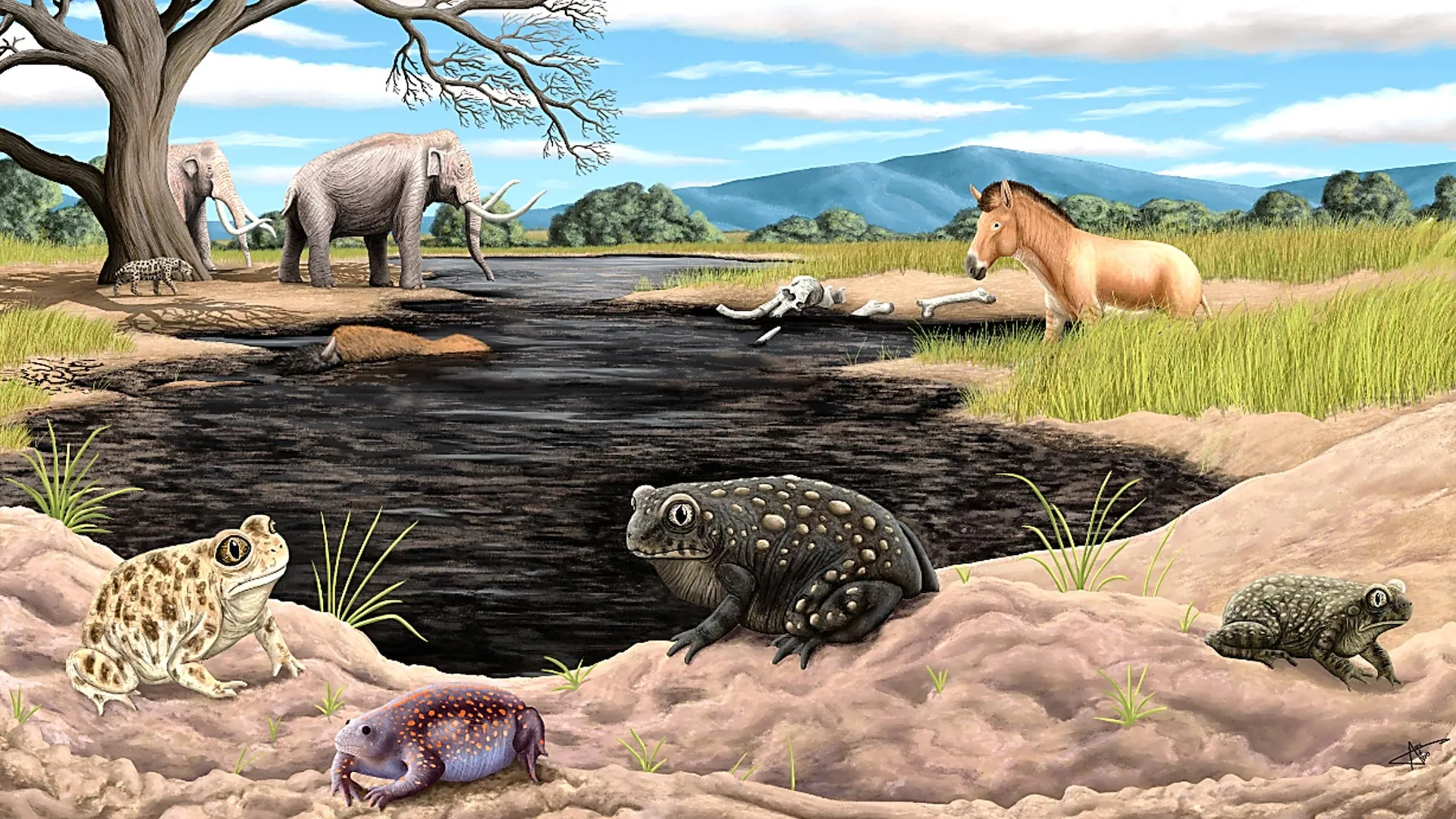
In the popular imagination, the La Brea Tar Pits are synonymous with the colossal: the hulking silhouettes of Columbian mammoths, the prowling menace of saber-toothed cats, and the lumbering gait of giant ground sloths. However, a groundbreaking discovery recently pulled from the asphaltic depths suggests that the true story of Ice Age Los Angeles was being written just as much by the tiny, damp-skinned residents of the landscape as it was by the megafauna.
Researchers at the La Brea Tar Pits have officially identified a previously unknown species of amphibian that once thrived in Southern California. Named Spea labreae, this extinct spadefoot toad marks a historic milestone as the first new extinct amphibian species ever discovered at the world-famous fossil site. While its physical stature is dwarfed by the prehistoric giants that surround it in the museum’s collection, its scientific impact is immense, offering a new, high-resolution lens through which to view the volatile climate shifts of the Pleistocene epoch.
A Hidden Treasure in the Archives
The discovery of S. labreae was not the result of a fresh excavation, but rather the product of meticulous archival detective work. Dr. Alberto Cruz, the lead author of the study published in the Journal of Vertebrate Paleontology, stumbled upon the species while conducting a comprehensive review of the museum’s understudied reptile and amphibian collections.
Dr. Cruz, a Postdoctoral Fellow at the time of the discovery and currently a researcher for Mexico’s Centro de Investigación Paleontológica Quinametzin (CIPAQ), was not initially hunting for new species. As a paleoecologist and paleogeographer, his interest lay in the broader ecological context of the site. However, while analyzing specimens that had been sitting in museum drawers since their collection in the 1950s, he noticed morphological irregularities that defied classification.
"I’m really more of a paleoecologist, not a taxonomist," Dr. Cruz explained. "But when you review a set of specimens repeatedly, you begin to recognize when something just doesn’t fit the established patterns."
Initially, Dr. Cruz entertained the possibility that the unique skeletal features were the result of paleopathology—the animal having suffered a fracture or disease during its life. To confirm his suspicions, he embarked on a rigorous comparative analysis. He spent months examining the fossilized remains against 80 modern specimens housed in the Herpetology Collections at the Natural History Museum of Los Angeles County and the Museum of Vertebrate Zoology at the University of California, Berkeley. The evidence was undeniable: the bones belonged to a distinct, previously unknown species of spadefoot toad.
"I reviewed and reviewed a lot of specimens until I was convinced," Cruz said. "I thought, ‘Oh my gosh, this is a new species.’ This material is originally from the 1950s, but when you study it again with fresh eyes, you can find gold in these specimens. It’s very cool."
The Chronology of an Amphibian Renaissance
The story of this discovery spans nearly a century of institutional history. Excavations at the La Brea Tar Pits have been ongoing for over 100 years, yielding millions of fossils. However, the sheer volume of material—much of it comprised of smaller, more fragile bone fragments—has meant that many treasures remained buried within the museum’s storage facilities long after they were pulled from the tar.
- 1950s: The original fossils of S. labreae are excavated from the asphalt deposits, cataloged, and stored, remaining largely untouched for decades as focus remains on large mammalian fossils.
- Early 2020s: Dr. Alberto Cruz begins a systematic, long-overdue assessment of the museum’s reptile and amphibian collections, which had not seen a major review in nearly 30 years.
- 2023-2024: After exhaustive comparative analysis and anatomical study, the identification of S. labreae is finalized and documented.
- 2024: The formal description of the species is published in the Journal of Vertebrate Paleontology, marking a significant shift in how researchers approach the site’s "micro-fossils."
This timeline underscores a pivotal moment for the Samuel Oschin Global Center for Ice Age Research. As the museum undergoes a historic transformation and facility upgrade, the renewed interest in long-held collections is yielding dividends that modern excavations alone might take years to replicate.
Why Small Creatures Tell Big Stories
The discovery of S. labreae is exceptionally rare. In the entire North American fossil record, only one other extinct Pleistocene amphibian—a tree frog from Florida—has been formally identified. The reason for this scarcity is biological: amphibians have delicate, porous skeletons that rarely survive the harsh, acidic, and shifting conditions of typical fossilization. The asphaltic environment of La Brea is one of the few places in the world where such fragile bones can be preserved for tens of thousands of years.
Because amphibians are highly sensitive to their environment and possess limited mobility compared to larger animals, they serve as excellent "climate proxies." Unlike a mammoth, which might traverse hundreds of miles, a spadefoot toad is inextricably tied to the moisture levels, soil composition, and temperature of its immediate vicinity.
"If you change the environment, you change the vegetation, and if the climate becomes warmer or colder, it affects these animals directly," says Dr. Cruz. By mapping the presence and absence of these toads, scientists can reconstruct a localized, high-definition timeline of how the Los Angeles basin transitioned out of the last Ice Age.
Official Responses and Museum Implications
The scientific community has lauded the discovery as a testament to the untapped potential of museum archives. Dr. Emily Lindsey, Curator and Excavation Site Director at the Samuel Oschin Global Center for Ice Age Research, views the discovery as a validation of the museum’s ongoing commitment to re-examining the past.
"It’s a great example of how we’re still finding new things at La Brea Tar Pits, even after a century of ongoing excavation and research," Dr. Lindsey stated. "This discovery shows that the ‘story’ of the Tar Pits is far from finished. There is definitely more to come."
The museum is currently utilizing the discovery to highlight the importance of "hidden" research. By applying modern imaging techniques and comparative DNA analysis (where possible) to older, cataloged specimens, researchers like Dr. Cruz are effectively "re-discovering" the past. The facility’s transformation into the Samuel Oschin Global Center is intended to provide the space and resources to continue this intensive work, moving beyond the traditional display of megafauna to tell a more nuanced story of environmental change.
A Landscape Transformed: The Case of the Mexican Burrowing Toad
The study did not stop at S. labreae. In the process of analyzing the collection, researchers made a second, equally startling discovery: the first known record of the Mexican burrowing toad, Rhinophrynus, in the southwestern United States.
Today, the natural range of these toads is restricted to regions far to the south, with the closest populations residing in Mexico, nearly 2,500 kilometers away. Their presence in the Ice Age fossil record of Los Angeles serves as a powerful indicator of how drastically the climate and ecosystem shifted at the end of the Pleistocene. It suggests a time when the Southern California environment was significantly different—likely warmer and more humid—allowing tropical or subtropical species to thrive where they would find no purchase today.
Implications for the Future
The extinction of S. labreae and the retreat of species like Rhinophrynus provide a sobering mirror for modern climate change. By analyzing how these amphibians responded to the rapid, natural warming that ended the last Ice Age, researchers hope to build predictive models for how current, human-driven climate change might affect today’s amphibian populations.
"Amphibians are the first to feel the heat," notes Dr. Cruz. "Their history in the Tar Pits is a warning. If they vanished when the environment shifted before, we need to understand exactly how and why that happened to prevent similar losses in the present day."
As the scientific world turns its eyes toward the La Brea Tar Pits, the legacy of the spadefoot toad serves as a reminder that history is not just found in the bones of giants. Sometimes, the most important lessons are hidden in the small, fragile remains of creatures that were once just a part of the local scenery, waiting for a persistent researcher to tell their story. The "gold" hidden in the archives of the 1950s is proving to be as valuable as any mammoth tusk, providing a clearer, more detailed picture of the ancient world and, by extension, the one we inhabit today.