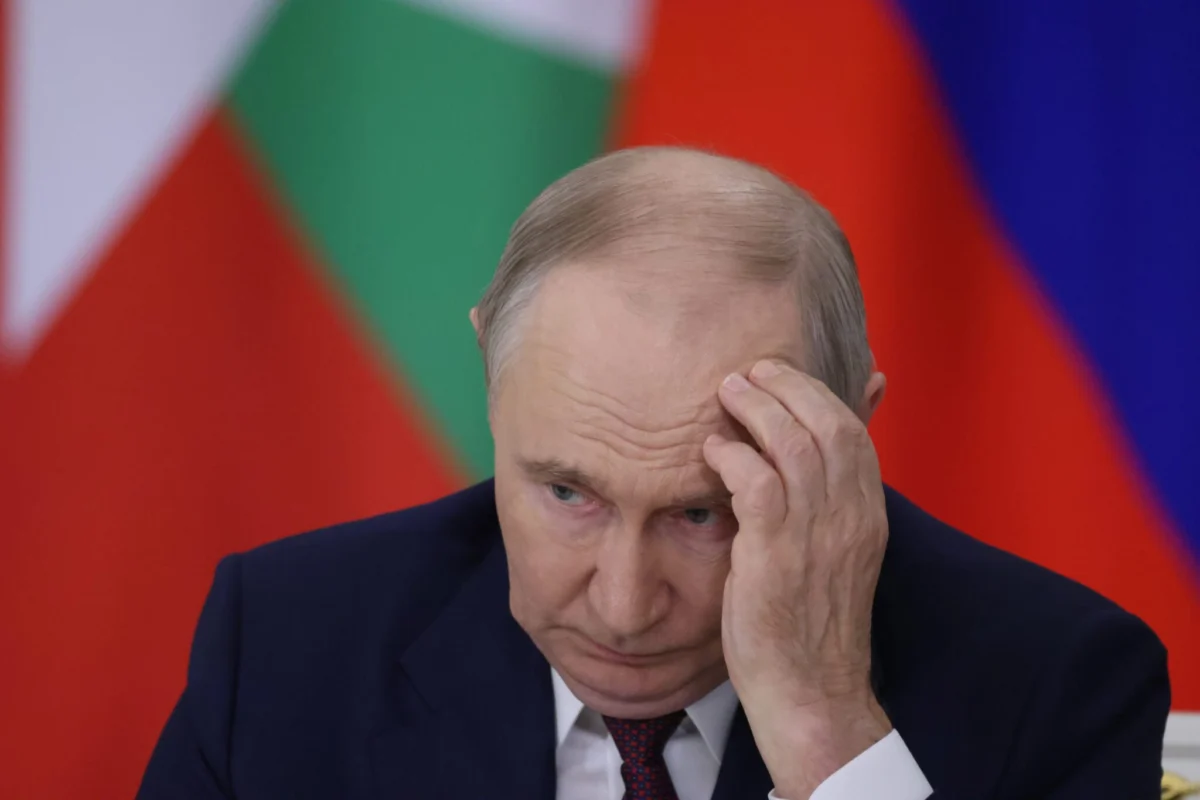
The long-anticipated financial reckoning for the Russian Federation, a scenario debated by economists and Kremlin insiders since the 2022 invasion of Ukraine, appears to have transitioned from a theoretical risk to a present-day emergency. As the summer of 2026 progresses, the Russian banking sector is grappling with a destabilizing "bank run" fueled by a toxic combination of military setbacks, soaring inflation, and a growing public fear that the state is preparing to seize private savings to fund its mounting war deficits.
Main Facts: A Mass Exodus of Capital
The primary catalyst for the current alarm is a sharp and accelerating withdrawal of deposits by the Russian public. According to recent Central Bank data, the first half of August 2026 saw Russians withdraw approximately $3.4 billion (286.4 billion rubles). This follows a staggering $7.3 billion withdrawn in July and $4.5 billion in June. The trend suggests that the pace of capital flight is on track to nearly double the $24.7 billion outflow recorded in 2022, the year the full-scale invasion of Ukraine began.
This "stampede" out of traditional lenders is not merely a reaction to interest rates, but a fundamental loss of confidence in the safety of the banking system. Former finance officials and market analysts point to a growing "everyday wisdom" among the populace: in times of extreme geopolitical volatility and domestic instability, cash held "under the pillow" is perceived as safer than a digital balance that the Kremlin could freeze or "mobilize" at a moment’s notice.
The liquidity crisis is further exacerbated by the structural state of Russian banks. For the past four years, Moscow has directed major financial institutions to provide massive capital injections to the defense industry. These loans, often issued under political pressure rather than sound credit assessment, have increasingly turned into "bad debts" as the war of attrition drags on. Consequently, when depositors show up to demand their cash, banks find their capital tied up in illiquid, non-performing military assets.
Chronology of the Crisis: From Resilience to Rupture
To understand the current precipice, one must look at the timeline of Russia’s economic degradation over the past several years:
- February 2022 – Early 2023: Russia entered the conflict flush with cash, benefiting from high energy prices and a significant "rainy day" Sovereign Wealth Fund. Despite initial sanctions, the Kremlin managed to stabilize the ruble and project an image of "fortress Russia."
- June 2025: The first major cracks appeared in the corporate sector. Russian banks began raising red flags regarding a potential debt crisis as the Central Bank’s high interest rates—intended to combat inflation—began to crush the ability of businesses to service their loans.
- December 2025: The Center for Macroeconomic Analysis and Short-Term Forecasting, a state-backed think tank, issued a chilling warning: the country could face a full-scale banking crisis by late 2026 if loan defaults worsened and depositor confidence waned.
- February 2026: Internal reports delivered to President Vladimir Putin warned that a financial crisis was likely to hit by the summer, driven by spiraling inflation and the exhaustion of fiscal buffers.
- May 2026: Data revealed that nearly 25% of the Russian bond market was at risk of default. Many companies that had borrowed at low, pre-war rates found themselves unable to refinance at the now-exorbitant market rates.
- July 2026: The Finance Ministry took the unprecedented step of halting government bond auctions indefinitely. This move was prompted by a total lack of investor demand and prohibitively high borrowing costs, effectively cutting off the Kremlin’s primary domestic method of financing its budget deficit.
- August 2026: The bank run intensifies, as rumors of a new military mobilization and the "nationalization" of private savings reach a fever pitch.
Supporting Data: The Erosion of the State’s Safety Net
The gravity of the situation is reflected in the deteriorating fiscal indicators of the Russian state. The Kremlin’s "quagmire" in Ukraine has moved from a manageable expense to an existential drain on the national budget.
1. The Budget Deficit and the Bond Market
As of the end of July 2026, Russia’s budget deficit hit a staggering $76 billion. Historically, such deficits were covered by the National Wealth Fund (NWF). However, that fund has been nearly depleted by years of war spending and subsidies for sanctioned industries. With the NWF exhausted, the government turned to domestic bond auctions (OFZ). The recent indefinite suspension of these auctions indicates that the state can no longer find enough buyers—even among state-controlled banks—to fund its operations.
2. Corporate and Personal Insolvency
The human element of the crisis is visible in bankruptcy statistics. A European intelligence report highlighted that the number of Russians declaring bankruptcy jumped by nearly 33% last year, surpassing 500,000 individuals. This rise in personal insolvency is a direct result of high inflation and the loss of purchasing power, which has forced many to rely on high-interest credit for basic survival.
3. Asset Seizures and Nationalization
To plug the holes in the budget, the Kremlin has moved from taxing profits to seizing assets. Last year alone, approximately $51.5 billion in assets belonging to Russian oligarchs were nationalized. This "grab for assets" has now moved down the ladder to include private pension funds. The Finance Ministry is currently preparing legislation to gain access to $40 billion in pension savings held in privately managed funds, a move that has sparked widespread panic among the middle class.
Official Responses and Political Rhetoric
The official narrative from the Kremlin remains one of "stability" and "economic sovereignty," but the rhetoric from within the government suggests a much more desperate reality.
Taras Skvortsov, a senior executive at Sberbank—Russia’s largest retail lender—recently admitted to Russian radio that the liquidity crunch is so severe that many banks simply do not have the cash on hand to purchase government bonds, even if they wanted to support the state. This rare public admission of weakness underscores the disconnect between the Kremlin’s demands and the banking sector’s capabilities.
Perhaps more alarming for the average citizen was a recent speech by the leader of Russia’s Communist Party in parliament. He suggested that the 130 trillion rubles currently held in private bank accounts should be "mobilized" to address the country’s economic and budget woes. While not yet official policy, such statements from high-ranking political figures have served as a "fire alarm" for depositors, convincing many that their life savings are the government’s next target.
In the shadows, an associate of a Russian billionaire told the Washington Post that the government’s desperation has reached a point where property rights are effectively non-existent: "If the government needs cash, Putin will just do a grab for assets. He doesn’t care."
Implications: The Intersection of Finance and the Battlefield
The financial crisis is not occurring in a vacuum; it is inextricably linked to the failing military campaign in Ukraine. The worsening state of the financial sector mirrors Russia’s performance on the battlefield, where Ukrainian drone strikes have decimated Russian oil infrastructure—the country’s primary source of hard currency—and halted Russian advances.
The New Mobilization and the "Second Exodus"
As the military seeks to replace casualties that have now exceeded the replacement rate, reports indicate that the Kremlin is preparing for a new, wider round of military mobilization. To avoid immediate political backlash, analysts believe the announcement is being held until after the upcoming parliamentary elections.
However, the "financial mobilization" of savings and the "military mobilization" of men are creating a pincer effect on the Russian population. Rumors of these twin threats have already led to a surge in cross-border traffic. Real estate prices in neighboring countries like Georgia and Armenia have spiked as Russians anticipate another mass exodus similar to the one seen in September 2022.
Long-term Economic Decay
The implications for the Russian economy are grim. Even if a total systemic collapse is avoided in the short term, the "liquidity crunch" ensures that there will be no capital available for non-military investment for years to come. The "illusion of a dynamic economy," as described by European intelligence, has been stripped away to reveal a hollowed-out shell.
Russia is now trapped in a cycle where it must seize private wealth to fund a war that is destroying the very infrastructure required to generate future wealth. For the Russian depositor, the choice is becoming increasingly clear: keep money in the bank and risk it being "mobilized" by the state, or withdraw it now and face the uncertainty of an economy on the brink of a historic implosion. As the queues at ATMs grow longer, the "everyday wisdom" of the Russian people may prove to be the final blow to the Kremlin’s wartime financial stability.